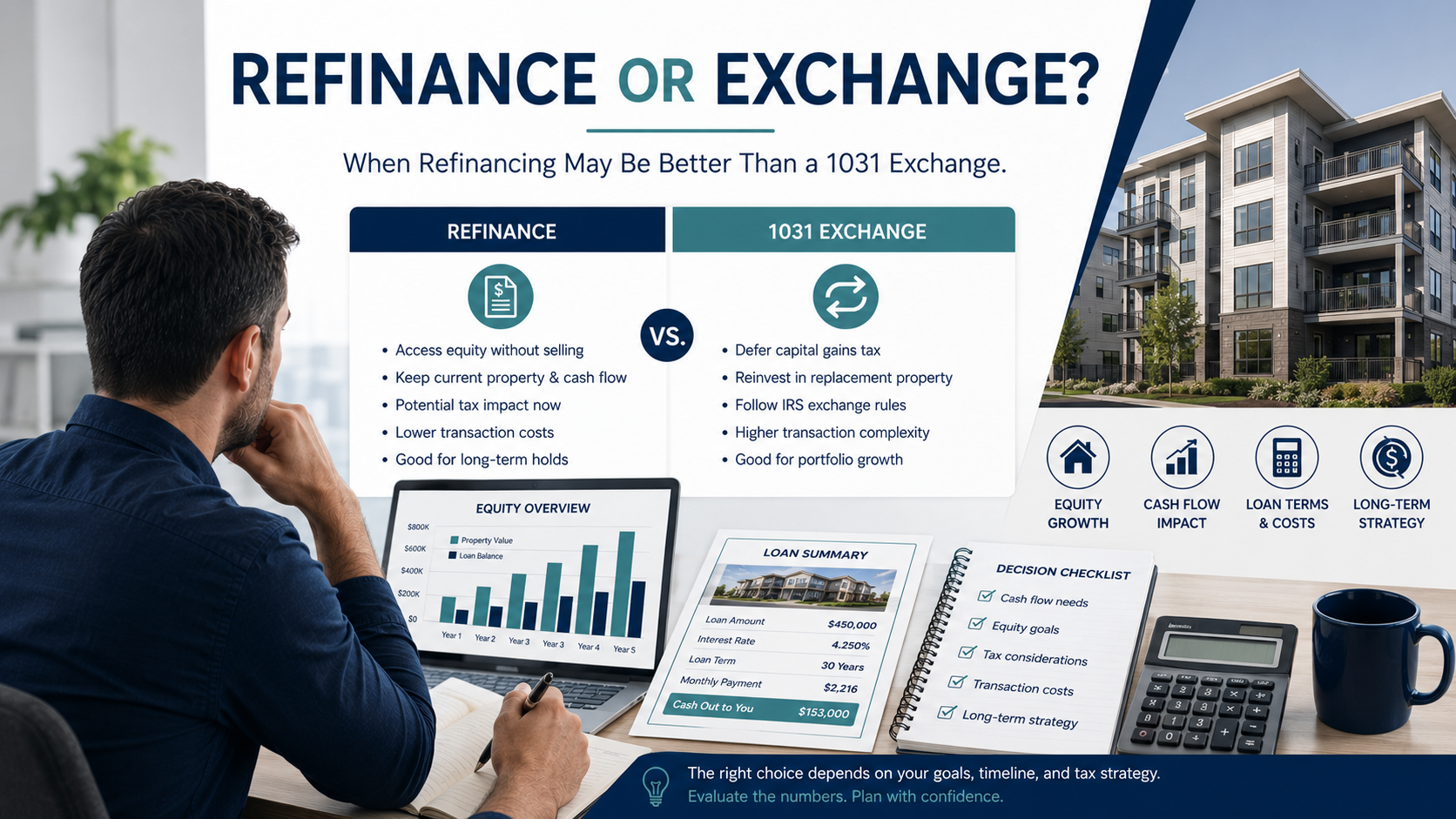
A 1031 exchange is not the only way to use equity in an appreciated rental property. In some situations, refinancing may be the better strategy.
Refinancing can allow a landlord to access equity without selling the property. But it also adds or changes debt, which can affect cash flow and risk.
Planning question: Does the current property still fit your strategy, or are you trying to use refinancing to avoid a bigger decision?
What Refinancing Can Do
A refinance may allow an investor to keep the existing rental property while accessing some equity. This can be useful if the property still performs well and the investor wants capital for another purpose.
Potential uses may include another investment, reserves, repairs, debt restructuring, or personal planning needs. The right use depends on the investor’s facts and risk tolerance.
When Refinancing May Be Worth Considering
Refinancing may be reasonable when:
- The property still fits the investor’s long-term plan.
- The cash flow can support the new or larger loan payment.
- The investor wants access to equity without selling.
- The property still has strong income, location, tenant quality, or appreciation potential.
- The investor is comfortable with the additional debt risk.
The Risk: Debt Changes the Investment
A refinance can feel easier than selling because it does not require giving up the property. But the property after refinancing is not the same investment as before.
The new loan may increase monthly payments, reduce cash flow, increase interest expense, and add pressure if rents decline or expenses rise.
Warning: Accessing equity is not the same as creating profit. Borrowed money must be repaid, and the property must be able to support the debt.
When a 1031 Exchange May Still Be Better
If the property no longer fits the investor’s goals, refinancing may only delay the real issue.
A 1031 exchange may deserve review if the investor wants to move equity into a better property, reduce concentration risk, improve portfolio quality, reduce management burden, or trade up into a stronger asset.
The question is whether the current property still deserves to hold the equity.
Compare Cash Flow Before and After Refinancing
Before choosing refinance over exchange, model the numbers carefully.
- Current mortgage payment.
- New projected mortgage payment.
- Interest rate and loan term.
- Closing costs.
- Net cash-out amount.
- Projected net rental cash flow after refinance.
- Reserve needs.
- Vacancy and repair risk.
Refinance vs. Exchange: The Core Difference
Refinancing keeps the investor in the same property with a new debt structure. A 1031 exchange moves equity into different replacement property.
That means the decision is not only about tax. It is about whether the current property or a replacement property is the better home for the investor’s capital.
Learn How to Compare Refinance and 1031 Exchange Options
The AssetWise Institute course walks through sell, refinance, and exchange decisions so investors can compare tax exposure, equity, debt, cash flow, replacement property, and long-term goals.
View the 1031 Exchange Strategy CourseUse Tools to Compare the Numbers
Planning tools can help compare refinance cash flow, sale proceeds, exchange buying power, and replacement property strategy.
Looking for 1031 exchange calculators and templates?
Final Takeaway
Refinancing may be better than a 1031 exchange when the current property still fits the investor’s plan and can support the new debt.
But if the property no longer fits the investor’s cash flow, risk, management, or long-term goals, refinancing may simply postpone a needed portfolio decision.
Important Educational Disclaimer
This article is for general educational purposes only and does not provide tax, legal, financial, investment, lending, real estate, or qualified intermediary advice. 1031 exchange rules are complex and time-sensitive. Before selling, refinancing, exchanging, identifying replacement property, changing ownership structure, or making any tax or investment decision, consult your own CPA, tax advisor, attorney, qualified intermediary, lender, financial advisor, and real estate professionals.
Official references: IRS Like-Kind Exchanges Real Estate Tax Tips and IRS Instructions for Form 8824.