A 1031 exchange can be powerful, but it is not always the right answer.
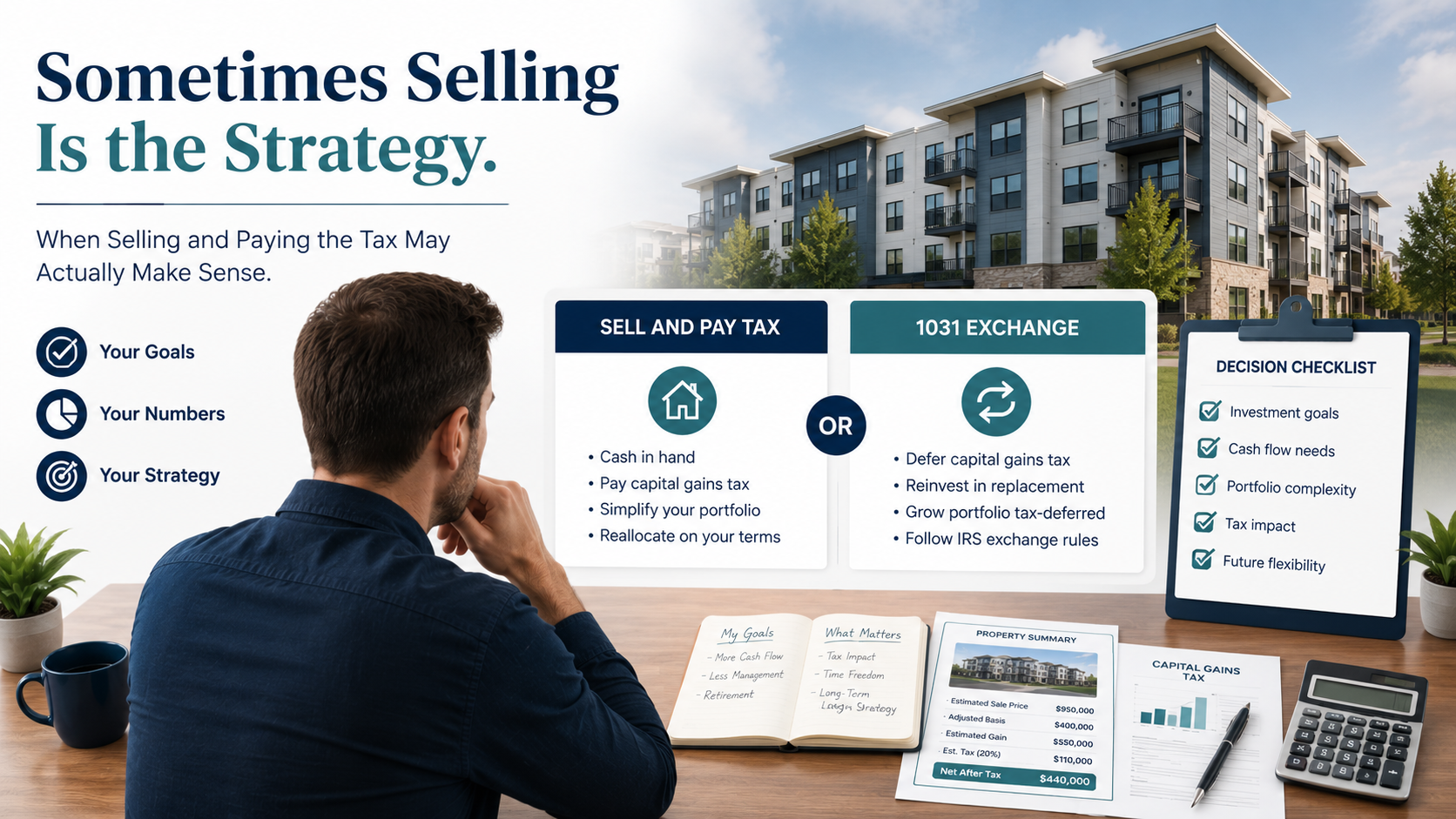
Sometimes the better strategy may be to sell the rental property, pay the tax, and move on with a clear plan.
Planning idea: The goal is not to avoid tax at all costs. The goal is to make the best after-tax decision for your life, risk, cash flow, and long-term plan.
Why Investors Feel Pressure to Exchange
Many landlords hear that a 1031 exchange is the “smart” move whenever a rental property has appreciated. That can be true in the right situation, but it can also create pressure.
If the investor only focuses on avoiding tax, they may exchange into a property they do not really want, do not understand, or are not prepared to manage.
Tax deferral is valuable, but it should not be the only reason for the next investment decision.
When Selling May Make Sense
Selling and paying tax may be reasonable when the investor’s goals no longer match continued real estate ownership.
Common examples include:
- The investor needs liquidity for a major personal, family, or business purpose.
- The investor wants to reduce debt and risk.
- The property has become too stressful or management-heavy.
- The investor does not want to own replacement property.
- The available replacement properties are weak or overpriced.
- The investor wants to simplify life more than preserve every dollar of tax deferral.
Liquidity Can Be More Important Than Deferral
A 1031 exchange keeps capital inside real estate. That can be useful if the investor wants to continue building a real estate portfolio.
But if the investor needs cash outside of real estate, tax deferral may not solve the real problem.
For example, an investor may need liquidity for retirement spending, debt reduction, medical needs, family support, business investment, or diversification outside real estate. In those situations, selling may deserve serious review.
Weak Replacement Options Can Change the Decision
A 1031 exchange requires replacement property. If the available options do not fit the investor’s goals, the exchange may create a new problem.
A poor replacement property can bring weak cash flow, bad debt terms, management stress, market risk, or future regret.
Warning: A bad replacement property can be more expensive than paying tax, especially if the investor buys only because the deadline is approaching.
Management Burnout Is a Real Planning Factor
Many landlords do not want out of real estate because the numbers are bad. They want out because the management burden has become too much.
In some cases, a 1031 exchange into a lower-management property may help. In other cases, the investor may want to sell and simplify completely.
The key is to be honest about what the next chapter should look like.
What to Calculate Before Selling
Before deciding to sell and pay tax, review:
- Estimated capital gain.
- Depreciation recapture exposure.
- State tax exposure.
- Debt payoff and closing costs.
- Net cash after sale.
- What the cash will be used for.
- What income or growth may be lost by leaving real estate.
- Whether refinancing or exchanging would better match the goal.
Compare Selling, Refinancing, and 1031 Exchange Options
The AssetWise Institute course helps real estate investors think through when selling may make sense, when refinancing may work, and when a 1031 exchange may create the most value.
View the 1031 Exchange Strategy CourseUse Tools to Compare the Decision
A decision workbook or calculator can help compare after-tax sale proceeds, refinance assumptions, exchange buying power, and replacement property options.
Looking for 1031 exchange decision tools?
Final Takeaway
Selling and paying tax is not automatically a mistake. It may be the right move when liquidity, simplicity, risk reduction, or lifestyle goals matter more than staying invested in real estate.
The best decision is the one that is made consciously, after reviewing the tax cost, the remaining cash, the alternatives, and the investor’s long-term goals.
Important Educational Disclaimer
This article is for general educational purposes only and does not provide tax, legal, financial, investment, lending, real estate, or qualified intermediary advice. 1031 exchange rules are complex and time-sensitive. Before selling, refinancing, exchanging, identifying replacement property, changing ownership structure, or making any tax or investment decision, consult your own CPA, tax advisor, attorney, qualified intermediary, lender, financial advisor, and real estate professionals.
Official references: IRS Like-Kind Exchanges Real Estate Tax Tips and IRS Instructions for Form 8824.