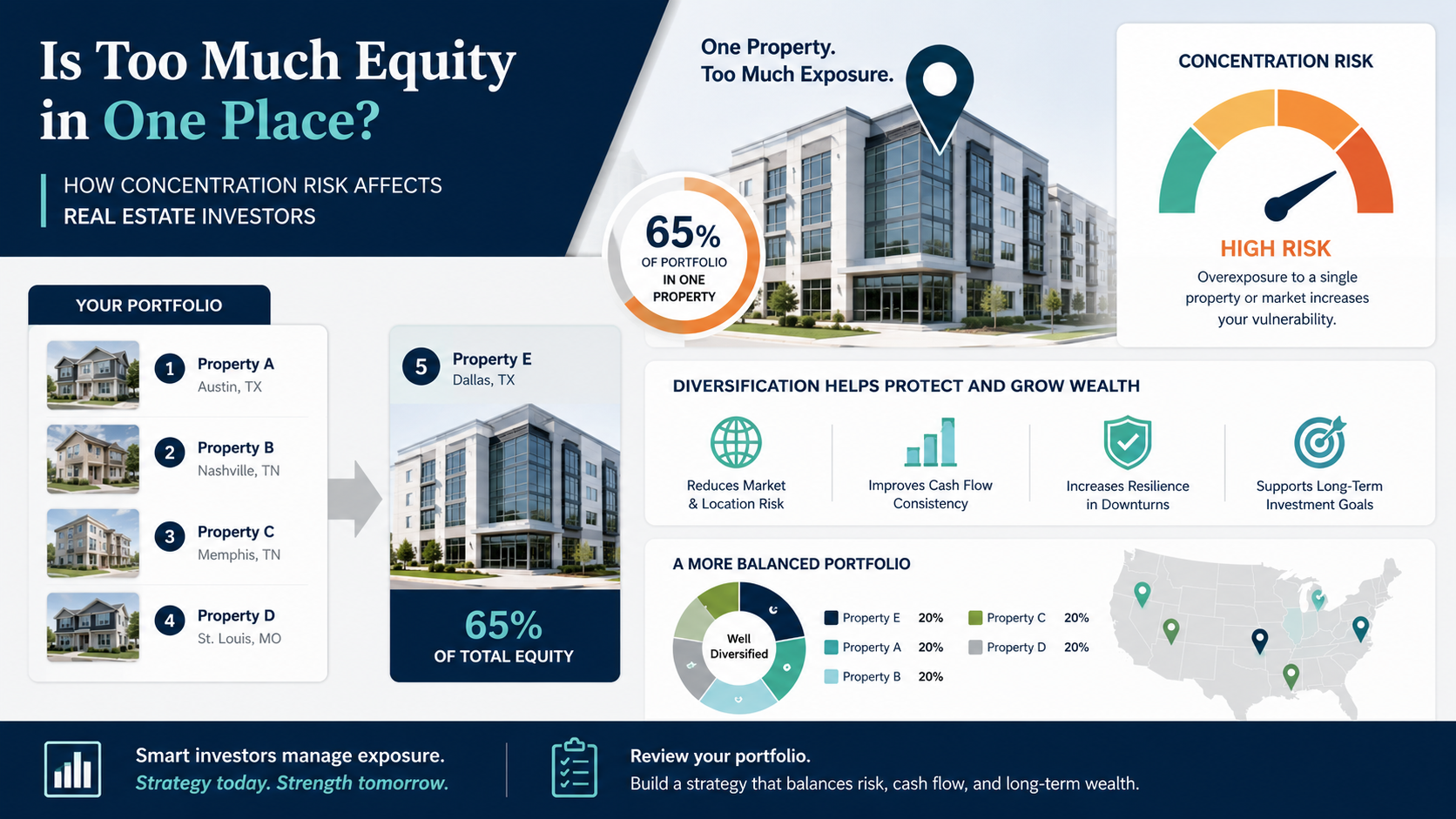
Real estate concentration risk happens when too much of an investor’s wealth depends on one property, one market, one tenant type, or one strategy.
Concentration is not always bad, but it should be understood before an investor sells, refinances, or completes a 1031 exchange.
Portfolio question: If one property, market, or tenant type had a problem, how much of your financial life would be affected?
What Concentration Risk Looks Like
Concentration risk can show up in several ways. An investor may have too much equity in one property, too much income from one tenant, too much exposure to one city, or too much dependence on one type of rental activity.
For example, a landlord may own one highly appreciated property that represents most of their net worth. Another investor may own several properties, but all of them are exposed to the same local economy or regulatory environment.
Why Concentration Risk Matters Before a 1031 Exchange
A 1031 exchange may be an opportunity to reposition capital. But if the investor does not review concentration risk, the exchange may simply move the same risk into another property.
Sometimes the investor should diversify. Other times, consolidation may be more appropriate. The right answer depends on goals, risk tolerance, cash flow, debt, management burden, and replacement property options.
Common Types of Real Estate Concentration
- Property concentration: too much equity in one property.
- Market concentration: too much exposure to one city or local economy.
- Tenant concentration: too much income dependent on one tenant or tenant type.
- Debt concentration: too much risk tied to one loan, rate, or maturity date.
- Strategy concentration: too much reliance on one rental model, such as short-term rental income.
Planning warning: A portfolio can look diversified because it has multiple properties, but still be concentrated if all the properties depend on the same market, financing, or tenant base.
How a 1031 Exchange May Help
Depending on the facts, a 1031 exchange may allow an investor to move from one concentrated property into multiple replacement properties, or from one risky property type into a more stable asset.
However, diversification should not be automatic. Multiple properties can also create more complexity, more management, and more financing issues.
Questions to Review
- How much equity is tied to one property?
- How much income depends on one tenant or one rental model?
- How much exposure is tied to one local market?
- Would diversification improve risk, or create too much complexity?
- Would consolidation reduce workload, or create too much dependence on one asset?
- What level of risk fits the investor’s current life stage?
Learn How Concentration Risk Fits Into 1031 Planning
The AssetWise Institute course helps investors think through replacement property strategy, diversification, consolidation, portfolio design, and long-term planning before making exchange decisions.
View the 1031 Exchange Strategy CourseUse Tools to Review Portfolio Risk
A concentration risk worksheet can help investors organize property values, debt, income sources, market exposure, management burden, and replacement property options.
Looking for 1031 portfolio planning tools?
Final Takeaway
Concentration risk is not automatically bad, but it should be intentional. Investors should know where their portfolio is exposed before choosing replacement property.
A 1031 exchange can be a chance to redesign the portfolio, but only if the investor reviews concentration risk before the decision is made.
Important Educational Disclaimer
This article is for general educational purposes only and does not provide tax, legal, financial, investment, lending, real estate, or qualified intermediary advice. 1031 exchange rules are complex and time-sensitive. Before selling, refinancing, exchanging, identifying replacement property, changing ownership structure, or making any tax or investment decision, consult your own CPA, tax advisor, attorney, qualified intermediary, lender, financial advisor, and real estate professionals.
Official references: IRS Like-Kind Exchanges Real Estate Tax Tips and IRS Instructions for Form 8824.