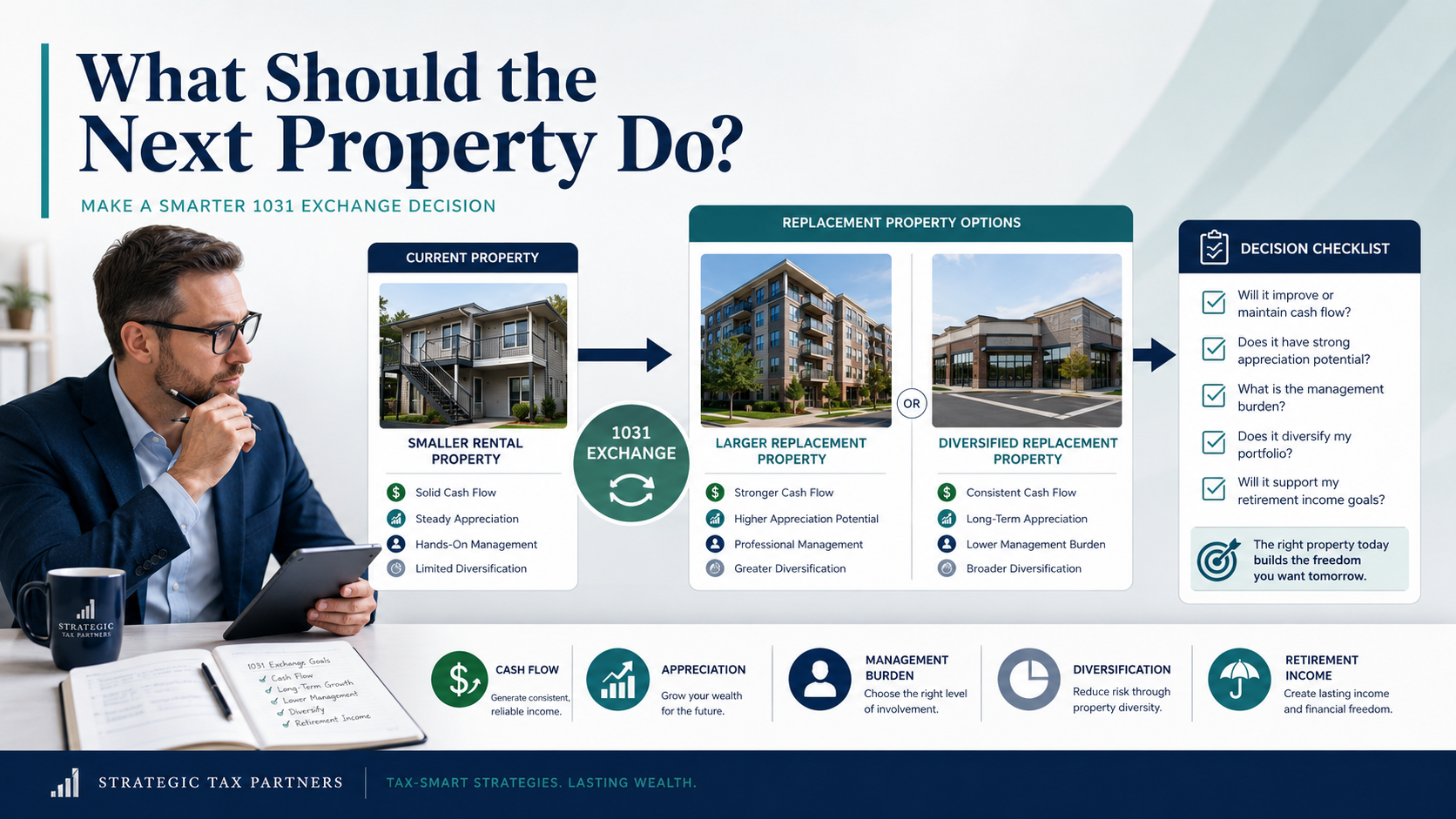
A replacement property should do more than qualify for a 1031 exchange. It should have a clear job in the investor’s portfolio.
Many investors begin replacement property shopping by asking, “What can I buy in time?” But the better question is, “What should the next property actually do?”
Strategy question: Is the replacement property supposed to create income, growth, diversification, simplicity, retirement stability, or long-term family value?
Qualification Is Only the Starting Point
A property may qualify as replacement property and still be a poor strategic fit. It may satisfy the exchange rules but create weak cash flow, higher debt pressure, more management burden, or concentration risk.
That is why investors should define the mission of the replacement property before they are under deadline pressure.
Possible Jobs for a Replacement Property
The right replacement property depends on what the investor needs next. Common replacement property goals include:
- Cash flow: producing more dependable income.
- Appreciation: positioning capital in a stronger growth market.
- Lower management: reducing repairs, tenant calls, or hands-on work.
- Diversification: reducing exposure to one property, market, or tenant type.
- Retirement income: supporting future spending needs with more predictable net cash flow.
- Legacy planning: making the portfolio easier for heirs to understand and manage later.
Do Not Let the Deadline Pick the Strategy
In a deferred exchange, replacement property identification is time-sensitive. That pressure can push investors toward quick decisions.
The problem is that quick decisions can become expensive decisions. If the investor has not defined the replacement property mission, every available property can start to look acceptable simply because the clock is running.
Planning warning: A property that solves the 45-day problem may still create a 10-year portfolio problem.
Match the Property to the Investor’s Stage
A growth-focused investor may choose differently than a tired landlord approaching retirement. A high-income professional may want exposure without another demanding job. A family legacy investor may care more about future management and heir readiness.
The replacement property should fit the investor’s life stage, not just the exchange timeline.
Questions to Ask Before Choosing Replacement Property
- What problem does the current property create?
- What problem should the next property solve?
- Does the investor need more income, more growth, less management, or more diversification?
- Will the replacement property improve cash flow after debt service and reserves?
- Does the investor understand the market, tenant type, financing, and risk?
- Would the property still make sense if there were no tax deadline?
Learn How to Choose Replacement Property Strategically
The AssetWise Institute course walks through replacement property strategy, portfolio design, exchange execution risk, tax coordination, retirement income, and legacy planning.
View the 1031 Exchange Strategy CourseUse Tools to Compare Replacement Property Options
Replacement property workbooks can help investors compare cash flow, appreciation potential, holding costs, management burden, concentration risk, and professional questions.
Looking for 1031 replacement property planning tools?
Final Takeaway
The replacement property should have a job. It should not be chosen only because it qualifies or because the deadline is getting close.
Before identifying replacement property, define whether the next property should improve income, growth, diversification, management burden, retirement readiness, or future family planning.
Important Educational Disclaimer
This article is for general educational purposes only and does not provide tax, legal, financial, investment, lending, real estate, or qualified intermediary advice. 1031 exchange rules are complex and time-sensitive. Before selling, refinancing, exchanging, identifying replacement property, changing ownership structure, or making any tax or investment decision, consult your own CPA, tax advisor, attorney, qualified intermediary, lender, financial advisor, and real estate professionals.
Official references: IRS Like-Kind Exchanges Real Estate Tax Tips and IRS Instructions for Form 8824.