Nonprofit Cash Flow Reports: What Leaders Should Watch
A nonprofit can show positive income on a report and still feel short on cash. That surprises many board members, executive directors, treasurers, and finance committee members. The reason is simple: revenue and cash do not always arrive at the same time expenses must be paid.
Grant reimbursements may be delayed. Donations may come in seasonally. Payroll may be due before a fundraising event closes. Restricted funds may sit in the bank but not be available for general operations. A cash flow report helps nonprofit leaders see those timing issues before they become emergencies.
This guide explains what nonprofit leaders should watch in cash flow reports, how cash flow differs from a basic profit and loss report, and when bookkeeping support may help your organization create clearer board financial reports.
If your organization wants a practical self-review, you can download the free nonprofit bookkeeping checklist before your next board or year-end review.
Why Cash Flow Reports Matter for Nonprofit Leaders
Nonprofit leaders often review a profit and loss statement, balance sheet, and budget versus actual report. Those reports are important, but they may not fully answer the cash question: will the organization have enough available money to cover upcoming needs?
A cash flow report helps leadership understand:
- How much cash is currently available
- What money is expected to come in soon
- What bills, payroll, grants, reimbursements, and commitments are coming due
- Whether cash is unrestricted or restricted
- Whether the organization is relying on future donations or grants to cover current costs
- Whether cash reserves are increasing, shrinking, or staying stable
- Whether grant timing, fundraising timing, or reimbursement delays are creating pressure
For a small nonprofit, a cash flow report does not need to be overly complex. Even a simple monthly cash summary can help the board and leadership make better decisions.
Cash Flow Is Not the Same as Profit and Loss
A profit and loss report shows income and expenses for a period. A cash flow report focuses on the movement and availability of cash. The two reports are related, but they do not tell the same story.
For example, a nonprofit may record grant revenue when it is awarded or earned, but cash may arrive later. A nonprofit may show a strong fundraising month, but merchant processor payouts may not hit the bank until after payroll is due. The organization may also have restricted funds that increase total cash but cannot be used for general bills.
That is why nonprofit leaders should avoid relying only on the question, “Did we make money this month?” A better question is, “Do we have enough unrestricted cash to meet upcoming obligations?”
Need clearer reports? Small Business Accounting Inc. provides Form 990 and board reporting support, including bookkeeping cleanup, QuickBooks Online organization, grant tracking, restricted fund bookkeeping, and nonprofit board financial reports.
What Nonprofit Leaders Should Watch in Cash Flow Reports
A useful nonprofit cash flow report should help the board and leadership spot timing issues, restricted cash concerns, and future cash needs. Here are the main areas to review.
1. Cash on Hand
Cash on hand means how much cash is available in bank accounts, savings, money market accounts, and other liquid accounts. But the total balance is only the starting point.
The board should also ask how much of that cash is unrestricted, how much is restricted, and how much is already committed to upcoming expenses.
2. Unrestricted Cash
Unrestricted cash is especially important because it is usually the cash available for general operations. A nonprofit may have a healthy bank balance, but if much of it is restricted for grants, scholarships, donor purposes, or board-designated reserves, the organization may still have limited flexibility.
A strong cash flow report should help separate total cash from available operating cash.
3. Timing of Donations and Grants
Many nonprofits receive donations or grants unevenly throughout the year. Cash may be strong after an annual campaign and tighter during slower months. Grant-funded organizations may also face reimbursement delays.
Tracking timing helps leadership plan ahead instead of reacting after cash gets tight.
4. Payroll and Fixed Expenses
Payroll, rent, insurance, software, professional fees, utilities, and other recurring costs often need to be paid regardless of when donations or grants arrive. The cash flow report should show whether recurring commitments are covered.
For nonprofits with employees, payroll timing should be watched closely because it is one of the most important cash needs.
5. Grant Restrictions and Reimbursements
Grant-funded organizations should watch whether expenses must be paid before reimbursement is received. This can create temporary cash pressure even when the grant is approved.
Cash flow reports should help leadership understand what has been spent, what is awaiting reimbursement, and what funds are restricted for specific uses.
6. Cash Reserves
Cash reserves help an organization handle timing gaps, emergencies, funding delays, and seasonal swings. A board should understand whether reserves are growing, shrinking, or being used without a plan.
For small organizations, even a basic reserve target can help leadership make more thoughtful decisions.
Practical Nonprofit Cash Flow Checklist
Use this checklist as a practical monthly review tool for your board, executive director, treasurer, or finance committee.
- Confirm bank balances. Review operating, savings, money market, and investment cash balances.
- Reconcile accounts. Confirm QuickBooks Online agrees with bank statements before relying on reports.
- Separate restricted and unrestricted cash. Identify what money is available for general operations and what is limited.
- Review upcoming deposits. Look at expected donations, grants, reimbursements, pledges, program revenue, and fundraising proceeds.
- Review upcoming payments. Identify payroll, rent, insurance, contractor payments, grants payable, reimbursements, debt payments, and vendor bills.
- Review grant reimbursement timing. Track expenses paid but not yet reimbursed.
- Review budget versus actual activity. Compare cash reality to the approved budget.
- Review cash reserves. Compare current reserves to the board’s target or operating needs.
- Flag timing gaps. Identify months where expenses may exceed available unrestricted cash.
- Prepare board notes. Explain unusual activity, major changes, upcoming deadlines, and open questions.
If this checklist reveals gaps in your books, you can use our free nonprofit bookkeeping checklist to review other areas before year-end or Form 990 support begins.
Cash Flow Red Flags Nonprofit Boards Should Not Ignore
Cash flow problems often show up before they become serious. The board and leadership should pay attention to these red flags:
- The nonprofit has cash in the bank but cannot explain how much is unrestricted.
- Payroll or rent depends on a grant reimbursement that has not arrived yet.
- The organization regularly delays vendor payments.
- Board reports show income and expenses but not available cash.
- Restricted funds are mixed with general operating funds.
- QuickBooks Online has not been reconciled regularly.
- Grant reports are prepared manually from bank statements.
- Cash reserves are being used without board discussion.
- The board does not receive a cash flow or cash-on-hand summary.
- Leadership only discovers cash shortages after bills are already due.
These red flags do not always mean the organization is in trouble. They may simply mean the bookkeeping and reporting system needs to be more detailed and more timely.
How Cash Flow Reports Support Better Board Decisions
Cash flow reporting helps the board move from reviewing the past to planning for the near future. Instead of only asking what happened last month, leaders can ask what is likely to happen next month, next quarter, or before year-end.
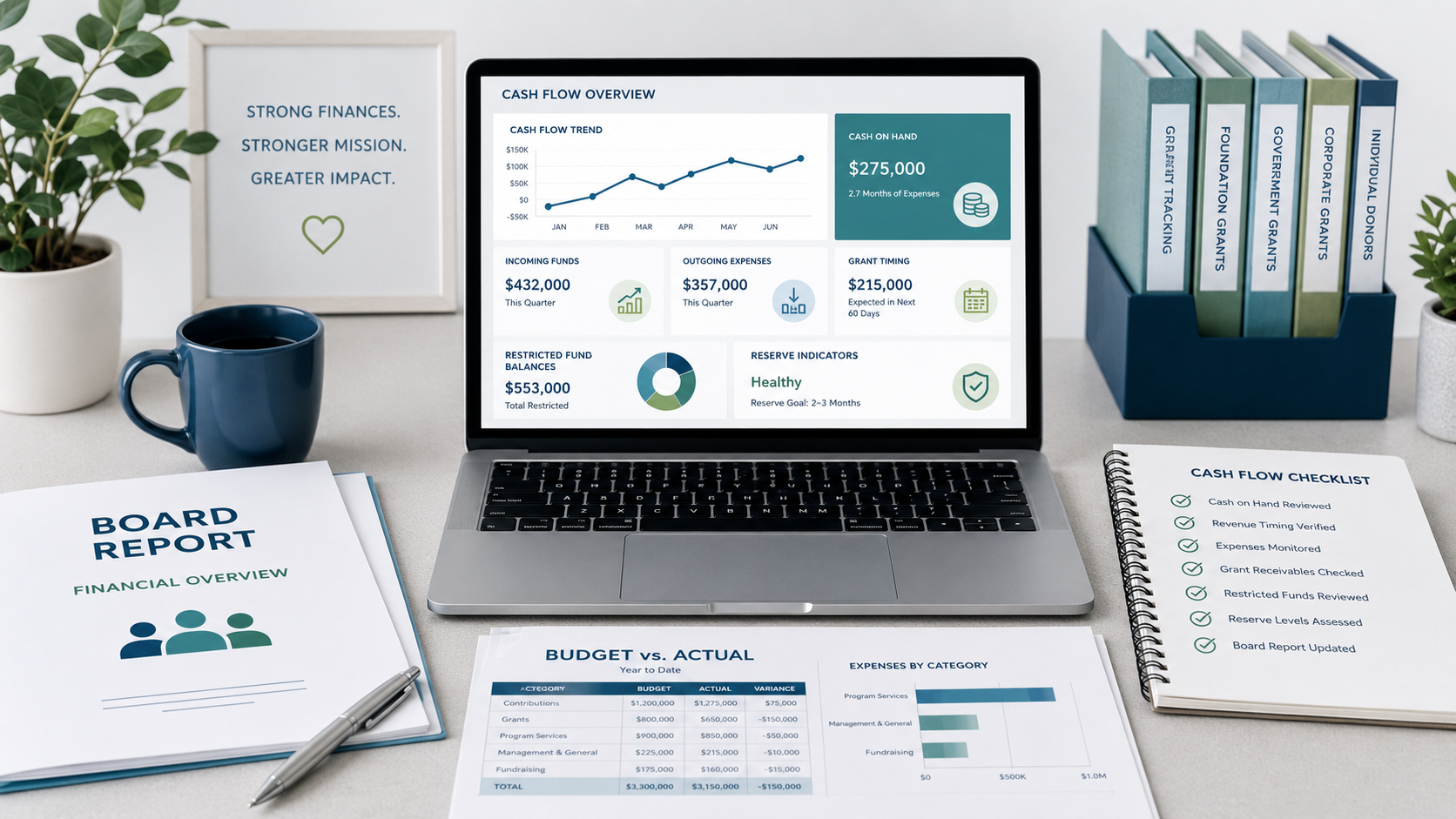
A practical board cash flow report may include:
- Beginning cash balance
- Cash received during the period
- Cash paid during the period
- Ending cash balance
- Restricted versus unrestricted cash
- Expected grant reimbursements
- Upcoming payroll and fixed costs
- Cash reserve summary
- Notes about major timing issues
This kind of reporting can help the board decide whether to approve new spending, delay a project, adjust fundraising timing, request grant reimbursement sooner, or build operating reserves.
Board report note: Board financial reports prepared as part of bookkeeping support are generally for internal management and board use unless a different engagement is specifically agreed to in writing. Small Business Accounting Inc. does not claim to provide CPA audit, review, or compilation services.
How Cash Flow Reporting Supports Year-End and Form 990 Readiness
Cash flow reports are mainly management tools, but they also support better year-end organization. Clean cash flow reporting usually depends on reconciled bank accounts, organized income categories, clear expense coding, grant tracking, and restricted fund bookkeeping.
Those same records can also help with annual filing support. Many exempt organizations file Form 990-N, 990-EZ, or 990 depending on gross receipts, total assets, organization type, and facts. The annual filing deadline can vary depending on the organization’s accounting period, so nonprofits should confirm current IRS and state requirements before filing.
Cash flow reports do not replace Form 990 support, but they can help identify whether the books are ready. If cash balances, deposits, grant reimbursements, restricted funds, or old balance sheet items are unclear, year-end cleanup may be needed before filing support begins.
When to Get Professional Help
Some nonprofits can prepare basic cash summaries internally. Professional bookkeeping support may be helpful when the organization needs cleaner QuickBooks reports, better grant tracking, restricted fund summaries, board financial reports, or help understanding cash timing.
Consider getting help if:
- QuickBooks Online has not been reconciled regularly.
- The board does not know how much cash is unrestricted.
- Grant reimbursements are creating timing problems.
- Restricted funds are not separated from operating cash.
- Board reports do not include cash flow or cash-on-hand information.
- The organization has multiple programs, grants, or funding sources.
- Year-end bookkeeping cleanup has been stressful in prior years.
- Form 990 support is approaching and the books are not ready.
Professional support can help your nonprofit organize QuickBooks Online, reconcile accounts, separate restricted and unrestricted cash, prepare clearer board reports, and build a monthly reporting process.
For service details, visit our nonprofit bookkeeping services page. If your organization needs help with messy books or unclear cash flow reports, you can request nonprofit bookkeeping support.
FAQ: Nonprofit Cash Flow Reports
1. What is a nonprofit cash flow report?
A nonprofit cash flow report shows how money moves in and out of the organization. It helps leaders understand cash on hand, upcoming deposits, upcoming payments, restricted cash, and potential timing gaps.
2. How is cash flow different from a profit and loss report?
A profit and loss report shows income and expenses for a period. A cash flow report focuses on when cash is received and paid. A nonprofit can show income on a report but still have cash pressure if money has not arrived yet.
3. Should restricted funds be included in a cash flow report?
Yes, but they should be clearly separated from unrestricted cash. The board needs to know total cash and how much is actually available for general operations.
4. How often should nonprofit leaders review cash flow?
Many nonprofits benefit from monthly cash flow review, especially if they have payroll, grants, restricted funds, seasonal donations, or reimbursement-based funding.
5. Can QuickBooks Online help with nonprofit cash flow reports?
Yes, QuickBooks Online can help when the file is reconciled and organized. However, nonprofits may still need customized reporting for restricted funds, grant timing, cash reserves, and board-level summaries.
Simple Compliance Note
This article provides general educational information and is not legal advice. Nonprofit bookkeeping, cash flow reporting, restricted funds, grant reporting, Form 990 requirements, state filings, tax-exempt status issues, and board reporting needs can vary depending on the organization’s facts, tax year, funding sources, activities, and filing requirements. Always confirm current IRS and state requirements before filing or making compliance decisions.
Need help getting your nonprofit books organized?
Small Business Accounting Inc. helps nonprofits with bookkeeping cleanup, QuickBooks Online organization, board financial reports, grant tracking, restricted fund bookkeeping, and Form 990 support. Remote support is available nationwide. Hawaii and Oahu clients may request local appointment availability when appropriate.
Learn more about nonprofit bookkeeping support:
https://smallbusinessaccountingfirm.com/nonprofit-bookkeeping/
Ready to request help?
https://smallbusinessaccountingfirm.com/contact/
Want to start with a checklist?
https://smallbusinessaccountingfirm.com/nonprofit-bookkeeping-checklist-pdf/