The right real estate exit strategy should not be based on pressure, fear, or what another investor did.
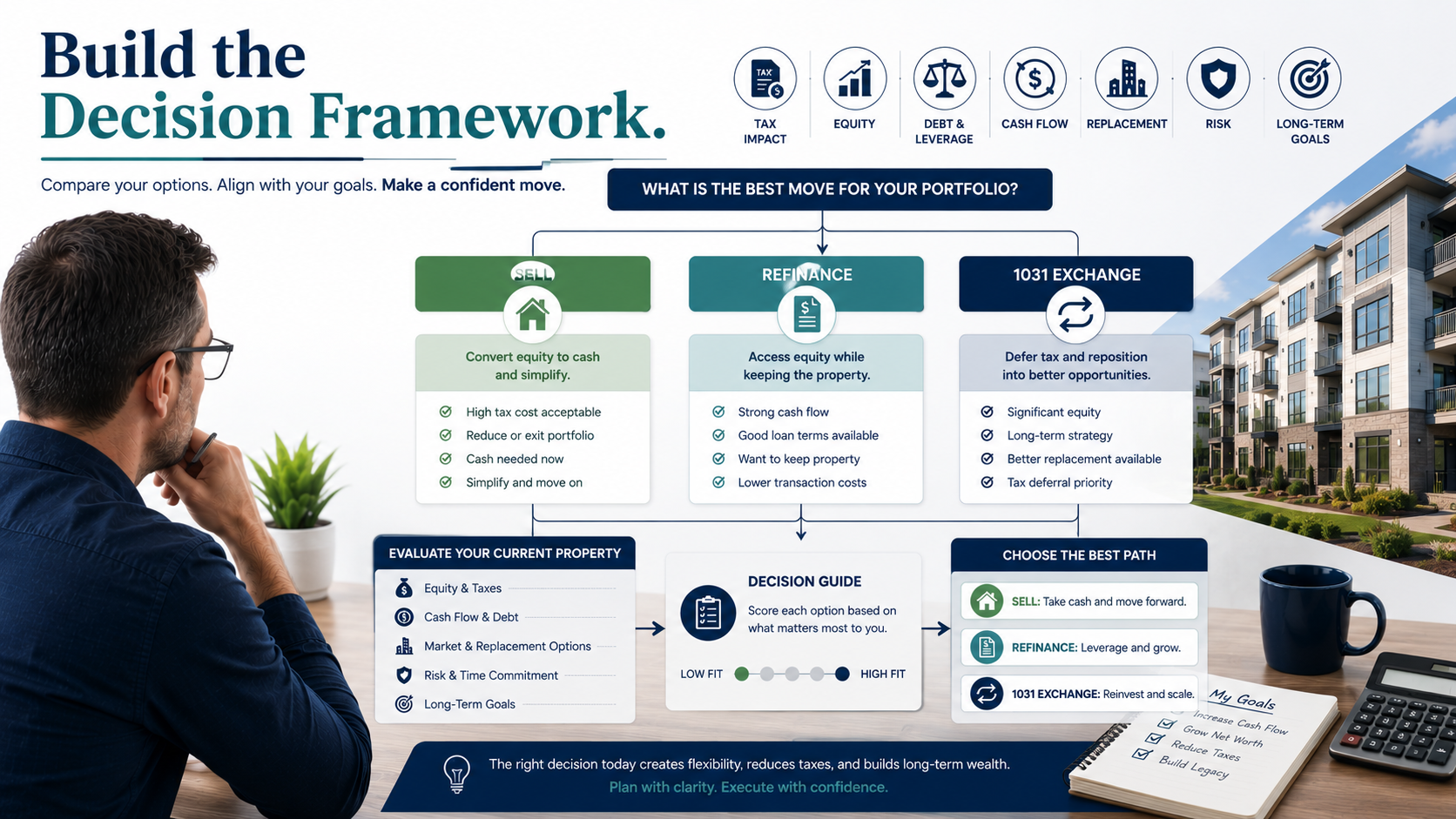
Before selling an appreciated rental property, investors should compare three paths: sell, refinance, or complete a 1031 exchange.
Framework question: What does your money need to do next: create cash, reduce risk, grow, simplify, produce income, or prepare for future transfer?
Why a Decision Framework Matters
Without a framework, investors often react to the loudest pressure in the transaction.
A buyer wants to close. A broker wants movement. A lender offers options. A family member gives opinions. A tax bill creates fear. A deadline creates urgency.
A decision framework helps the investor slow down and compare the actual trade-offs.
Step 1: Define the Primary Goal
Start with the investor’s real goal. The right answer changes depending on the goal.
- If the goal is liquidity, selling may be more relevant.
- If the goal is keeping a strong property while accessing equity, refinancing may be worth review.
- If the goal is staying invested and redeploying equity, a 1031 exchange may be worth exploring.
- If the goal is retirement, management burden and dependable cash flow matter.
- If the goal is legacy, future management and family readiness matter.
Step 2: Measure the Tax Exposure
Before choosing a path, estimate the potential tax result from a sale. This may include capital gains tax, depreciation recapture, state tax, and other possible tax effects depending on the facts.
The tax result affects how much capital remains available after the sale and whether tax deferral may materially improve replacement property buying power.
Step 3: Review Equity and Debt
Next, review the property’s value, debt, equity, and current cash flow.
Equity is not just profit. It is capital that can stay in the property, be accessed through refinancing, be converted to cash through a sale, or be redeployed through an exchange.
Step 4: Compare the Three Paths
| Path | What It May Solve | What to Watch |
|---|---|---|
| Sell | Liquidity, exit, simplification, debt reduction. | Tax cost, reduced future buying power, loss of real estate exposure. |
| Refinance | Access equity while keeping the current property. | New debt, higher payments, cash flow pressure, interest cost. |
| 1031 Exchange | Keep more equity working in replacement real estate. | Deadlines, replacement property risk, boot, debt replacement, execution issues. |
Step 5: Review Replacement Property Reality
A 1031 exchange only makes sense if the replacement property strategy makes sense.
If available replacement options are weak, overpriced, too risky, or too management-heavy, the tax deferral benefit may not justify the new investment risk.
Planning warning: Do not use a 1031 exchange to buy a property that does not fit your portfolio just because it qualifies technically.
Step 6: Factor in Timing and Professional Coordination
A 1031 exchange is time-sensitive. Investors should involve the appropriate professionals early, especially before closing on the relinquished property.
The professional team may include a CPA, tax advisor, qualified intermediary, attorney, lender, real estate agent, property manager, financial advisor, and insurance professional.
Step 7: Choose the Path Before the Transaction Controls the Timeline
The best time to build the decision framework is before the property is already deep into the sale process.
Once deadlines, buyer pressure, financing issues, and replacement property decisions begin, it becomes harder to think clearly.
Learn the Full Sell, Refinance, or Exchange Framework
The AssetWise Institute course helps investors compare tax exposure, equity, debt, cash flow, replacement property strategy, execution risk, retirement goals, and legacy planning before choosing a path.
View the 1031 Exchange Strategy CourseUse Tools to Make the Framework Practical
Decision tools can help organize estimated tax cost, refinance assumptions, exchange buying power, replacement property fit, debt risk, and professional questions.
Looking for 1031 exchange planning tools?
Final Takeaway
The sell, refinance, or exchange decision should be based on a framework, not panic.
Start with the goal, measure the tax exposure, review equity and debt, compare the three paths, evaluate replacement property reality, and coordinate with the right professionals before acting.
Important Educational Disclaimer
This article is for general educational purposes only and does not provide tax, legal, financial, investment, lending, real estate, or qualified intermediary advice. 1031 exchange rules are complex and time-sensitive. Before selling, refinancing, exchanging, identifying replacement property, changing ownership structure, or making any tax or investment decision, consult your own CPA, tax advisor, attorney, qualified intermediary, lender, financial advisor, and real estate professionals.
Official references: IRS Like-Kind Exchanges Real Estate Tax Tips and IRS Instructions for Form 8824.