Rental Property Closing Costs: Which Items May Affect Taxes and Depreciation
When you buy a rental property, the closing statement is more than a purchase document. It can affect your cost basis, depreciation schedule, loan cost tracking, and how certain expenses are treated on your rental tax return.
Before filing, landlords and real estate investors should review closing costs carefully instead of assuming every item is immediately deductible or automatically included in depreciation.
Quick Summary
Rental property closing costs may affect taxes in different ways. Some items may increase basis, some may relate to the loan, some may be deductible, and some may need to be separated between land and building.
- Review the closing disclosure or settlement statement
- Separate purchase costs from loan costs
- Identify items that may be added to property basis
- Allocate basis between land and building
- Check depreciation schedules for missing acquisition costs
- Keep the closing statement with permanent property records
Why Closing Costs Matter for Rental Property Taxes
Rental property tax preparation is not just about rent deposits and annual expenses. The purchase documents can affect depreciation from the first year the property is placed in service.
If closing costs are not reviewed correctly, the property basis may be understated, loan costs may be mixed with acquisition costs, or depreciation may be calculated from an incomplete number. A careful tax review can help organize these items before the return is prepared.
Start With the Closing Disclosure or Settlement Statement
The first document to review is the closing disclosure, settlement statement, HUD-1 if applicable, escrow closing statement, or attorney closing statement. This document usually lists the purchase price, loan charges, title fees, escrow items, recording fees, transfer taxes, prorations, credits, and prepaid items.
For tax purposes, these items should not all be treated the same way. Some may become part of the rental property’s basis. Some may relate to financing. Some may be deductible in the current year if they qualify. Others may need to be tracked separately.
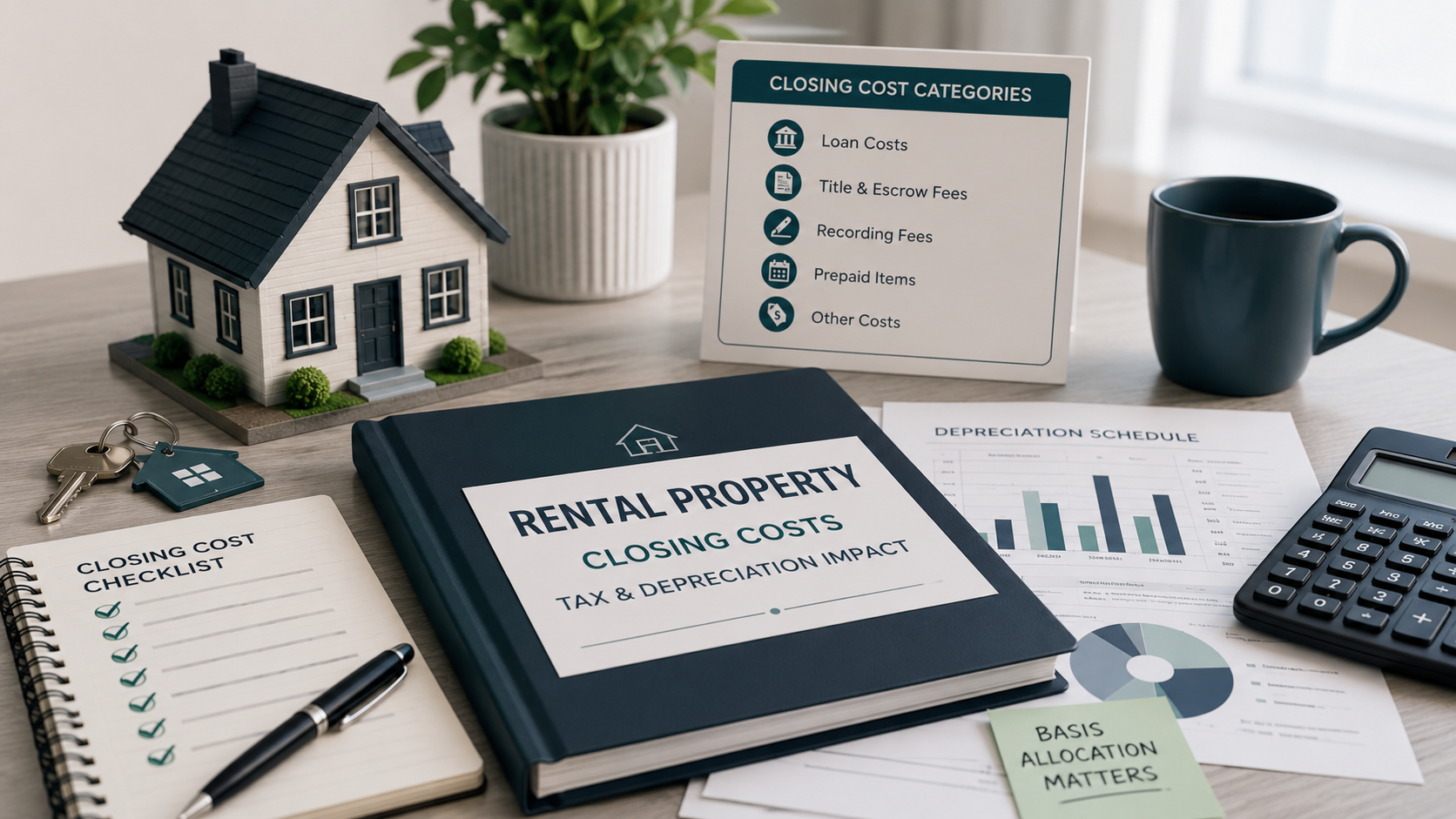
Common Closing Cost Categories to Review
Closing statements can be difficult to read because they mix lender charges, title costs, escrow items, prorations, seller credits, government recording charges, and prepaid expenses in one document.
| Closing Cost Category | Examples | Tax Review Question |
|---|---|---|
| Purchase and title costs | Title insurance, escrow fees, recording fees, transfer taxes, legal fees, surveys | Should some of these costs be added to property basis? |
| Loan costs | Lender fees, underwriting, processing, credit report, appraisal for lender, loan points | Are these financing costs separate from property basis? |
| Prepaid and escrow items | Insurance premiums, property tax reserves, escrow deposits, prepaid interest | Are these current costs, escrow balances, or timing items? |
| Prorations | Property tax prorations, rent prorations, HOA prorations, utility adjustments | Do these affect current-year rental income, expenses, or basis? |
| Seller credits | Repair credits, closing cost credits, concessions, unpaid seller obligations | Do credits reduce basis or offset certain costs? |
| Post-closing costs | Repairs, improvements, cleaning, setup, furniture, appliances | Were these incurred before or after the property was placed in service? |
Free Checklist: Review Rental Property Tax Savings Before Filing
A closing cost review is only one part of a strong rental tax review. Use the free Rental Property Tax Savings Checklist to organize basis, depreciation, repairs, improvements, income, expenses, and records before filing.
Which Closing Costs May Be Added to Basis?
Certain costs paid to acquire the rental property may become part of the property’s basis. Basis matters because it can affect depreciation while you own the rental and gain or loss when the property is eventually sold.
Common items that may need basis review include title-related costs, recording fees, transfer taxes, surveys, legal fees connected with the purchase, and certain amounts the buyer agrees to pay on behalf of the seller.
Items Often Reviewed for Basis Treatment
- Title insurance and title search fees
- Escrow or settlement fees related to the purchase
- Recording fees connected to acquiring title
- Transfer taxes
- Legal fees related to acquiring the property
- Survey fees
- Utility installation charges
- Certain seller obligations the buyer agreed to pay
Which Closing Costs May Be Loan Costs?
Loan-related costs should generally be separated from costs of acquiring the property itself. These may include lender charges, loan origination fees, underwriting fees, credit report fees, mortgage broker fees, and other financing-related charges.
Some financing costs may need to be amortized or reviewed under separate rules rather than added to building basis. This is one reason it is important to separate purchase costs from loan costs before preparing the depreciation schedule.
Loan Cost Items to Review
- Loan origination fees
- Mortgage points
- Underwriting and processing fees
- Credit report fees
- Lender-required appraisal fees
- Mortgage broker fees
- Other charges connected to obtaining financing
Do Property Taxes and Insurance on the Closing Statement Matter?
Yes. Property taxes, insurance, prepaid interest, rent prorations, and escrow deposits may appear on the closing statement, but they do not all have the same tax treatment.
For example, an escrow deposit may simply be money held for future payment. A property tax proration may relate to the buyer’s or seller’s share of taxes. Insurance may be prepaid for a coverage period. These items should be reviewed so they are not duplicated, omitted, or added to the wrong category.
Basis Allocation Between Land and Building
After identifying acquisition costs, rental owners usually need to allocate total basis between land and building. This matters because land is not depreciable, while the building and certain improvements may be depreciable.
The allocation should be supported by reasonable records. Depending on the facts, this may involve county assessment ratios, appraisal information, purchase documents, or other support. The key is to avoid depreciating land by mistake.
Allocation Items to Gather
- Purchase agreement
- Closing disclosure or settlement statement
- County property tax assessment
- Appraisal, if available
- Records of land value and building value
- Improvement records after purchase
Depreciation Schedule Review After Purchase
Once basis is determined and allocated, the depreciation schedule should be reviewed for accuracy. Missing closing costs, incorrect land allocation, or misclassified improvements can affect depreciation for years.
A depreciation review may help identify whether the building basis appears complete, whether land was separated properly, whether improvements were added, and whether furniture or appliances should be tracked separately from the building.
Need Help Reviewing Rental Property Basis and Depreciation?
Small Business Accounting Inc. helps landlords, real estate investors, Airbnb owners, short-term rental owners, commercial property owners, and property managers review rental property tax records before filing.
If your closing statement, depreciation schedule, land allocation, improvements, or loan costs are unclear, a focused tax savings review may help organize the records and identify items worth discussing before filing.
When Bookkeeping Cleanup May Be Needed
Closing costs are often entered incorrectly when the purchase is first recorded. A rental owner may enter the entire closing statement as one expense, skip the closing statement entirely, or record loan proceeds, escrow deposits, and purchase costs in the wrong accounts.
If the books do not clearly show the purchase, loan, escrow, basis, and depreciation details, bookkeeping cleanup may be needed before tax preparation.
For help organizing rental records, visit our Rental Property Bookkeeping Cleanup page.
Cost Segregation Considerations
If you purchased a higher-value rental property or made significant improvements, you may want to ask whether cost segregation planning is worth reviewing. Cost segregation is not necessary for every rental property, and the benefit depends on the property, income, tax position, future plans, and the quality of the supporting study.
Small Business Accounting Inc. does not prepare engineering-based cost segregation studies in-house. When a formal cost segregation study is appropriate, the firm can help clients understand the tax impact, coordinate with a qualified third-party provider, and properly use the final report for tax planning and filing.
Learn more on our Cost Segregation Tax Planning page.
Related Real Estate Tax Services
Depending on your rental property records and filing needs, these related services may be helpful:
Frequently Asked Questions
Are rental property closing costs deductible?
Some closing-related items may be deductible, but many acquisition costs are not immediately deducted. Certain costs may be added to basis, while loan costs, prepaid items, and prorations may need separate review.
Which closing costs may increase rental property basis?
Costs connected with acquiring the property may increase basis, such as certain title fees, recording fees, transfer taxes, legal fees, surveys, and settlement costs. The exact treatment depends on the charge and the facts.
Can I depreciate all rental property closing costs?
No. Some closing costs may be included in depreciable building basis, some may relate to nondepreciable land, some may be loan costs, and some may be deductible or prepaid items. The costs need to be reviewed and categorized first.
Why does land allocation matter?
Land is not depreciable. If land is not separated from the building, depreciation may be calculated incorrectly. Rental owners should keep support for how land and building values were allocated.
What records should I keep from closing?
Keep the closing disclosure, settlement statement, purchase agreement, appraisal if available, property tax assessment, loan documents, escrow records, and any post-closing improvement records.
When should I request a depreciation and tax savings review?
Consider a review if the closing statement was never analyzed, depreciation seems incomplete, land allocation is unclear, improvements were made after purchase, or the rental property was entered into the books as one lump-sum transaction.
Final Step: Review Closing Costs Before Depreciation Errors Carry Forward
Closing cost classification can affect rental property basis and depreciation for years. A careful review before filing can help organize purchase records, loan costs, land allocation, improvements, and depreciation schedules.
Small Business Accounting Inc. provides remote real estate tax and accounting services nationwide. Hawaii and Oahu clients may ask about local appointment availability when appropriate.