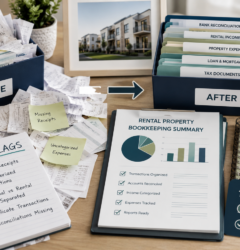
Messy Rental Books? Bookkeeping Cleanup Steps Before Tax Preparation
Messy rental books can make tax preparation harder than it needs to be. If rental income, security deposits, repairs, mortgage payments, owner transfers, and property expenses are mixed together, it becomes harder to prepare an accurate Schedule E and review potential tax savings.
Before filing, landlords, Airbnb owners, short-term rental owners, and real estate investors should clean up the books enough to clearly show what happened for each property during the year.
Quick Summary
Rental bookkeeping cleanup helps organize income, expenses, assets, loans, deposits, and property records before tax preparation.
- Separate income and expenses by property
- Reconcile bank and credit card accounts
- Review owner transfers and personal expenses
- Identify repairs, improvements, and depreciable assets
- Match 1099-K or platform income to actual rental records
- Prepare cleaner records for tax filing and planning
Why Rental Bookkeeping Cleanup Matters
Rental property tax preparation depends on good records. Your tax preparer needs to understand rental income, expenses, mortgage interest, property taxes, insurance, repairs, depreciation, and other property-level details.
If the books are messy, tax preparation may take longer, questions may pile up, and important deductions or depreciation items may be harder to identify. Cleanup does not guarantee tax savings, but it can make the filing process more organized and help support better tax decisions.
Common Signs Your Rental Books Need Cleanup Before Filing
Many rental owners do not realize the books are messy until tax season. The issue is not always the software. Sometimes the problem is inconsistent categorization, missing support, mixed personal activity, or a lack of property-by-property tracking.
Free Checklist: Review Your Rental Tax Records Before Filing
If your rental books feel messy, start with a structured review. Our free Rental Property Tax Savings Checklist helps rental owners identify tax records, expense categories, depreciation items, and filing questions worth reviewing before tax preparation.
Step 1: Separate Each Rental Property
The first cleanup step is to organize records by property. A rental owner with three properties should not have one combined category called “rental expenses” with no property detail. Each property may have different income, expenses, mortgage interest, repairs, taxes, insurance, depreciation, and passive activity reporting.
If you use QuickBooks, spreadsheets, or property management software, consider whether each property is clearly tracked. Depending on the software, this may be done through classes, locations, tags, projects, separate spreadsheets, or property-specific worksheets.
Step 2: Reconcile Rental Income
Rental income should be reviewed carefully before filing. For long-term rentals, this usually means reconciling tenant rent payments to bank deposits and lease records. For Airbnb and short-term rentals, it may mean reconciling platform payouts, cleaning fees, refunds, host fees, occupancy-related charges, and Form 1099-K reporting.
A common mistake is reporting only the net deposit that hits the bank without understanding whether fees or adjustments were already deducted before payout. Another common issue is mixing security deposits, reimbursements, and true rental income in the same category.
Income Items to Review
- Monthly rent received from tenants
- Advance rent or prepaid rent
- Airbnb, VRBO, or other platform payouts
- Cleaning fees charged to guests
- Tenant reimbursements for utilities or repairs
- Security deposits retained as income, if applicable
- Refunds, cancellations, and adjustments
- 1099-K or platform income reporting
Step 3: Reconcile Bank and Credit Card Accounts
Bank reconciliation is one of the most important cleanup steps. If bank balances do not reconcile, the income and expense reports may not be reliable. Missing deposits, duplicate expenses, uncategorized transactions, and manual entries can create problems during tax preparation.
For rental property owners, reconciliation should include the rental bank account, credit cards used for rental expenses, property management deposits, escrow accounts if applicable, and any personal accounts used to pay rental costs.
Step 4: Review Expense Categories Before Tax Preparation
Rental expense categories should be clear enough to support tax preparation. If everything is coded to “miscellaneous,” “repairs,” or “other expenses,” the tax return may need additional review before filing.
| Category | What to Review | Why It Matters |
|---|---|---|
| Repairs and Maintenance | Small repairs, routine maintenance, contractor invoices, materials | Some items may be repairs, while larger projects may be improvements. |
| Mortgage Payments | Principal, interest, escrow, taxes, insurance | Only certain portions may be deductible as current rental expenses. |
| Property Taxes | County tax bills, escrow payments, prorations | Tax payments should match the correct property and tax year. |
| Insurance | Landlord policy, liability coverage, STR coverage | Insurance may need to be separated from escrow or mortgage payments. |
| Utilities | Electric, water, gas, internet, trash, sewer | Mixed personal use and tenant reimbursements may need allocation. |
| Professional Fees | Tax, bookkeeping, legal, property management | Fees should be categorized clearly and tied to the rental activity. |
Step 5: Identify Repairs, Improvements, and Depreciable Assets
Messy rental books often hide important depreciation issues. A new appliance, flooring project, HVAC system, roof replacement, furniture package, or major remodel may not belong in a simple repair category.
This is where bookkeeping cleanup overlaps with tax planning. The books should help identify which costs may be ordinary expenses, which may need to be capitalized, and which may need to be added to the depreciation schedule.
If you had major renovations, new assets, or improvements, a Real Estate Depreciation & Tax Savings Review may help identify items worth reviewing before filing.
Step 6: Clean Up Owner Transfers and Personal Expenses
Owner transfers can make rental books look messy if they are categorized incorrectly. Contributions, draws, reimbursements, credit card payments, and transfers between accounts should generally not be treated the same as rental income or deductible expenses.
Personal expenses can also create confusion. If a personal purchase was accidentally coded to the rental property, it may need to be removed or reclassified. If a rental expense was paid personally, it may need to be documented and recorded properly.
Items That Often Need Cleanup
- Owner contributions to cover repairs or mortgage payments
- Transfers between checking, savings, and credit card accounts
- Personal expenses accidentally coded to rental categories
- Rental expenses paid from personal accounts
- Reimbursements from tenants, guests, or insurance companies
Step 7: Review Security Deposits and Tenant Payments
Security deposits can be tricky because not every deposit is automatically rental income. A deposit held for possible refund is different from rent received. If part of a deposit is kept for damages, unpaid rent, or other lease charges, it may need a different treatment.
Cleanup should separate rent, refundable deposits, nonrefundable fees, retained deposits, and tenant reimbursements. This is especially important when the same bank deposit includes multiple types of tenant payments.
Step 8: Prepare a Tax-Ready Rental Bookkeeping Package
The goal of cleanup is not perfection for its own sake. The goal is to prepare records that can support tax preparation and help answer common filing questions.
A Tax-Ready Package May Include:
- Profit and loss report by property
- Rental income reconciliation
- Bank and credit card reconciliation reports
- Mortgage interest and property tax support
- Repair and improvement detail
- List of new assets and placed-in-service dates
- Property management statements
- Airbnb, VRBO, or 1099-K reports, if applicable
- Prior-year depreciation schedule
- Notes explaining unusual transactions
Need Help Cleaning Up Rental Books Before Filing?
If your rental records are messy, Small Business Accounting Inc. can help organize your rental bookkeeping before tax preparation. We work with landlords, Airbnb owners, short-term rental owners, real estate investors, commercial property owners, and property managers nationwide.
Hawaii and Oahu clients may ask about local appointment availability when appropriate, but remote service is available nationwide.
Special Notes for Airbnb and Short-Term Rental Owners
Airbnb and short-term rental bookkeeping can be more detailed than long-term rental bookkeeping because platforms may report gross income, withhold fees, issue refunds, collect guest charges, and provide annual tax forms.
Short-term rental owners should also review furniture, appliances, supplies, cleaning costs, maintenance, occupancy-related charges, and any personal-use days. If you operate an Airbnb or short-term rental, visit our Airbnb & Short-Term Rental Tax Services page for more information.
When Cleanup Should Lead to a Bigger Tax Review
Bookkeeping cleanup may uncover issues that go beyond categorization. For example, you may discover missing depreciation, an old improvement that was never added to the depreciation schedule, unclear cost basis, unrecorded assets, or expenses that were incorrectly treated in prior years.
When that happens, a cleanup project may naturally lead to a broader tax savings review. This can be especially useful if you have multiple properties, short-term rentals, major improvements, refinances, sales, or cost segregation questions.
Learn more about our Real Estate Tax & Accounting, Rental Property Tax Preparation, and Real Estate Depreciation & Tax Savings Review services.
Cost Segregation and Cleanup Considerations
If your cleanup identifies large improvements, renovations, or property purchases, you may want to review whether cost segregation planning is appropriate. Cost segregation is not needed for every rental property, but it may be worth discussing when there are significant building costs or improvements.
Small Business Accounting Inc. does not prepare engineering-based cost segregation studies in-house. When a formal cost segregation study is appropriate, the firm can help clients understand the tax impact, coordinate with a qualified third-party provider, and properly use the final report for tax planning and filing.
Learn more on our Cost Segregation Tax Planning page.
Frequently Asked Questions
Do I need bookkeeping cleanup before rental tax preparation?
You may need cleanup if your rental income does not match deposits, expenses are uncategorized, multiple properties are mixed together, mortgage payments are not split correctly, or repairs and improvements are not clearly separated.
Can I still file if my rental books are messy?
It may still be possible to file, but messy books can create delays, more questions, and a higher risk of missing important details. A cleanup review before filing can help organize the records and make tax preparation more efficient.
What reports should I prepare for rental tax filing?
Helpful reports may include a profit and loss report by property, bank reconciliation, mortgage interest support, property tax records, repair and improvement details, depreciation schedules, and platform income reports for Airbnb or short-term rentals.
How should I handle rental expenses paid from a personal account?
Rental expenses paid personally should be documented and recorded clearly. The key is to support the business purpose, property connection, date, amount, and payment source.
What if my Airbnb 1099-K does not match my bank deposits?
This is common because platform reporting may include gross amounts, fees, refunds, adjustments, or timing differences. The income should be reconciled carefully so the tax return reflects the proper rental activity.
Can bookkeeping cleanup help find missed tax savings?
Cleanup does not guarantee savings, but it can uncover items worth reviewing, such as missing expenses, miscategorized improvements, unrecorded assets, depreciation issues, or property-level reporting problems.
Final Step: Clean Up the Books Before the Return Is Prepared
Messy rental books can make tax preparation more stressful, but the cleanup process does not have to be overwhelming. Start with property-by-property organization, reconcile income and bank activity, review major expenses, and identify any depreciation or improvement issues before filing.