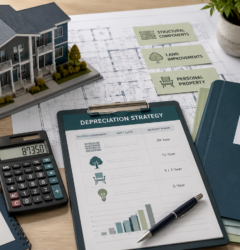
Land vs Building Allocation: Why Rental Property Owners Should Review Their Depreciation
A rental property depreciation schedule is only as strong as the numbers behind it. If the land and building allocation was guessed, copied without review, or never documented clearly, your rental deductions may deserve a closer look.
When a rental property owner buys a property, the purchase price usually includes both land and a building. For tax purposes, that distinction matters because land is not depreciated, while the building portion may generally be depreciated over time if the property is used as a rental.
The challenge is that closing statements, appraisal reports, county assessments, prior-year tax returns, and bookkeeping records do not always tell the full story in a clean, tax-ready way. If the original allocation was not reviewed carefully, your depreciation schedule may be too low, too aggressive, or poorly supported.
This article explains why land vs building allocation matters, what rental property owners should review, and when it may be worth requesting a professional Real Estate Depreciation Tax Savings Review.
Quick Guide
Why Land vs Building Allocation Matters
Depreciation is one of the most important deductions for many rental property owners. It allows the owner to recover the cost of certain property over time instead of deducting the full purchase cost in one year.
But the entire purchase price of a rental property is not automatically depreciable. The land portion must be separated from the building portion because land does not wear out in the same way a building does. That means the allocation between land and building directly affects the amount that goes on the depreciation schedule.
This is why rental property owners should not treat land vs building allocation as a small setup detail. It affects Schedule E reporting, depreciation schedules, future tax planning, and potentially the records needed if the property is sold, refinanced, improved, or exchanged.
Common Land and Building Allocation Mistakes
Many depreciation issues do not start with the depreciation calculation itself. They start with the original basis and allocation entered into the tax software or accounting records.
Using a Random Percentage
Some owners use a flat percentage, such as 80 percent building and 20 percent land, without checking whether it makes sense for the actual property, location, and records available.
Ignoring County Assessment Data
County tax assessment information may provide a starting point for reviewing the relationship between land and improvement values, but it should be used thoughtfully and documented clearly.
Forgetting Closing Costs
Certain acquisition-related costs may need to be added to basis and allocated properly. If these costs were ignored, the depreciation schedule may not reflect the full tax basis.
Not Reviewing Prior Returns
If the property has been rented for years, the current-year return depends on what was already reported in prior years. A review should consider depreciation already claimed.
Want a Cleaner Rental Tax Review Starting Point?
Use our free Rental Property Tax Savings Checklist to organize the records that often matter for depreciation, repairs, improvements, rental income, and tax planning.
Documents Rental Property Owners Should Review
A good depreciation review starts with documentation. The goal is not simply to increase a deduction. The goal is to understand whether the depreciation schedule is reasonable, complete, and supported by the records available.
Key records to gather
- Final closing statement or settlement statement from the purchase
- Purchase contract and any allocation details included in the agreement
- Appraisal report, if available
- County property tax assessment showing land and improvement values
- Prior-year tax returns with Schedule E and Form 4562 depreciation schedules
- Capital improvement invoices after purchase
- Bookkeeping records showing repairs, improvements, mortgage escrow, and property expenses
- Records showing when the property was placed in service as a rental
If your rental property records are incomplete or your books are messy, it may be helpful to clean up the accounting before finalizing tax planning. Our Rental Property Bookkeeping Cleanup service is designed for owners who need cleaner rental income, expense, and property records before tax filing.
Red Flags That Your Depreciation May Need a Review
Not every rental property needs a deep depreciation analysis. However, the following signs may indicate that your land vs building allocation or depreciation schedule deserves a closer look.
- Your tax return shows depreciation, but you do not know how the building basis was calculated.
- The land value was entered as zero or nearly zero without clear support.
- The property was converted from personal use to rental use.
- You bought the property years ago but never reviewed Form 4562 or the depreciation schedule.
- You made major renovations, additions, or improvements after purchase.
- Your prior preparer used a simple percentage split with no backup records.
- You own multiple rentals and each property appears to have a different allocation method.
- You are preparing to sell, refinance, complete a 1031 exchange, or update your books.
How Land Allocation Affects Your Rental Tax Picture
Land vs building allocation can affect more than one line on the tax return. It may influence your annual depreciation, your long-term records, and how confidently your tax file explains the numbers used.
Annual depreciation deduction
The building portion is generally the amount used to calculate depreciation for the rental building. If the building basis is too low because too much was assigned to land, the annual depreciation deduction may be lower than it could have been.
Future sale planning
Depreciation claimed over the years can matter when you sell the property. A clearer depreciation history can make it easier to understand potential gain, depreciation recapture exposure, and planning options before a sale.
1031 exchange planning
If you are considering a like-kind exchange, clean rental property basis and depreciation records can help you and your tax advisor evaluate the tax impact more clearly. You can learn more about our related service here: 1031 Exchange Tax Planning.
Cost segregation decisions
For certain properties, especially higher-value rentals, commercial buildings, or properties with major improvements, a cost segregation discussion may be appropriate. Small Business Accounting Inc. does not prepare engineering-based cost segregation studies in-house, but we can help clients understand the tax impact, coordinate with a qualified third-party provider when appropriate, and properly use the final report for tax planning and filing. Learn more here: Cost Segregation Tax Planning.
How a Real Estate Depreciation Tax Savings Review Can Help
A depreciation review is a practical way to evaluate whether your rental property depreciation is complete, reasonable, and better organized for tax planning. It is especially useful for landlords and real estate investors who have owned property for several years, changed preparers, completed renovations, or are unsure how their original building basis was calculated.
Review the Existing Depreciation Schedule
We review the depreciation records available from prior returns and identify items that may need clarification, correction, or better documentation.
Evaluate Land vs Building Support
We help assess whether the land and building allocation appears reasonable based on the available purchase, assessment, appraisal, and tax records.
Identify Missing Basis Items
We look for acquisition costs, capital improvements, and other records that may affect the depreciable basis or future tax planning.
Create Cleaner Planning Questions
We help you understand what questions to ask before filing, selling, refinancing, or making major improvements to your rental property.
What If You Also Need Rental Tax Preparation?
If your goal is to get the rental tax return prepared, not just review depreciation, we can also help with rental property tax preparation. This may include Schedule E rental income and expenses, depreciation schedules, mortgage interest, property taxes, repairs, improvements, and related tax questions.
Visit our Rental Property Tax Preparation page to learn more. If your property is used as an Airbnb or short-term rental, you may also want to review our Airbnb & Short-Term Rental Tax Services.
Not Sure Whether Your Rental Depreciation Was Set Up Correctly?
Small Business Accounting Inc. helps rental property owners, landlords, and real estate investors review depreciation, organize tax records, and identify planning questions before filing or making major property decisions.
Frequently Asked Questions
Can land be depreciated on a rental property?
No. Land is not depreciated. For rental real estate, the building portion may generally be depreciated over time, but the land portion must be separated out.
How do I know if my land vs building allocation is reasonable?
A reasonable allocation may be supported by records such as a property tax assessment, appraisal, purchase documents, or other valuation information. The right approach depends on the facts, the property, and the records available.
What happens if my depreciation was calculated incorrectly in prior years?
The next step depends on the type of error, the years involved, and the tax impact. Some issues may require a correction strategy, amended return analysis, or accounting method discussion. A depreciation review can help identify what questions need to be addressed.
Should I review depreciation before selling a rental property?
Yes, it is often helpful. Depreciation history can affect the tax picture when a rental property is sold. Reviewing records before a sale may help you understand your basis, prior deductions, and planning options more clearly.
Is land vs building allocation the same as cost segregation?
No. Land vs building allocation separates nondepreciable land from the building portion. Cost segregation is a more detailed analysis that may identify certain building components or land improvements with different recovery periods. Formal cost segregation studies are typically prepared by qualified third-party specialists.
Can Small Business Accounting Inc. help with rental depreciation review nationwide?
Yes. Small Business Accounting Inc. provides remote tax and accounting services nationwide for landlords, real estate investors, short-term rental owners, and property owners. Hawaii and Oahu clients may ask about local appointment availability when appropriate.