Form 990 Document Checklist: What to Gather Before Filing
Form 990 preparation is much easier when your nonprofit’s records are already organized. The return or annual notice may be due only once a year, but the support behind it is built throughout the year through clean bookkeeping, reconciled accounts, board reports, grant tracking, and organized documents.
For many nonprofits, the hard part is not only completing the form. The hard part is finding the records that support the numbers. Bank statements may be in one folder, receipts may be in email, grant documents may be in a staff member’s drive, and board reports may not tie back to QuickBooks Online.
This Form 990 document checklist can help nonprofit board members, executive directors, treasurers, finance committee members, church administrators, foundation leaders, scholarship fund managers, and grant-funded organizations understand what to gather before annual filing support begins.
For a simple self-review, you can download the free nonprofit bookkeeping checklist before you start organizing Form 990 support.
Why Documents Matter Before Form 990 Filing
Good nonprofit filing support starts with good records. A financial report may show total revenue, expenses, assets, and liabilities, but the organization also needs the documents that explain where the money came from, how it was spent, and whether certain funds were restricted.
Organized documents can help your nonprofit:
- Confirm gross receipts and year-end assets
- Support donation, grant, program, and fundraising income
- Separate restricted and unrestricted funds
- Prepare clearer board financial reports
- Support grant reporting and reimbursement requests
- Review payroll, contractor, and reimbursement activity
- Reduce last-minute bookkeeping cleanup
- Answer follow-up questions more efficiently
Most tax-exempt organizations have some type of annual filing requirement unless an exception applies. Depending on the organization’s gross receipts, total assets, organization type, and facts, the filing may be Form 990-N, Form 990-EZ, Form 990, Form 990-PF, or another return. Because filing requirements can vary, the document checklist should be adjusted to the organization’s facts.
Start With the Prior-Year Filing and Organization Information
Before gathering financial documents, start with the basic organization records. These help confirm the filing history, accounting period, responsible parties, and prior-year reporting.
Basic Organization Records to Gather
- Prior-year Form 990, 990-EZ, 990-N confirmation, or 990-PF, if applicable
- IRS determination letter or exemption approval records
- Organization legal name, EIN, mailing address, and principal officer information
- Articles of incorporation, bylaws, and major governance documents
- List of current officers, directors, trustees, and key employees
- Accounting period or fiscal year-end
- State registration or charity filing records, if applicable
- Prior-year financial statements and board reports
These records are especially important if the nonprofit changed leadership, changed bookkeepers, moved locations, added programs, or missed a prior filing.
Financial Reports and QuickBooks Records
Next, gather the financial reports that summarize the year. These should come from the organization’s bookkeeping system, such as QuickBooks Online, and should tie to reconciled bank and credit card statements.
Useful financial reports may include:
- Profit and loss statement for the tax year
- Balance sheet as of year-end
- Budget versus actual report
- General ledger detail
- Bank reconciliation reports
- Restricted fund summary
- Grant activity summary
- Program, management, and fundraising expense summary
- Accounts receivable and accounts payable details, if applicable
- Fixed asset and depreciation schedules, if applicable
If QuickBooks Online has not been reconciled, the reports may not be reliable. Bank balances, old liabilities, uncategorized transactions, and restricted fund balances should be reviewed before relying on the reports for annual filing support.
Need a cleaner starting point? Small Business Accounting Inc. provides nonprofit QuickBooks cleanup and reporting support for organizations that need better books before Form 990 support.
Bank, Credit Card, and Deposit Records
Bank and credit card records help verify the activity behind the financial reports. The goal is to make sure the bookkeeping agrees with the actual statements.
Bank and Credit Card Records to Gather
- Monthly bank statements for all accounts
- Monthly credit card statements
- Merchant processor statements, such as donation platform or payment processor reports
- Deposit details and batch reports
- Bank reconciliation reports
- Loan statements, if applicable
- Investment statements, if applicable
- Year-end cash, savings, money market, and investment balances
Do not rely only on the bank feed. Bank feeds can miss transactions, duplicate transactions, import information without enough detail, or create coding errors. A clean filing package should be supported by reconciled statements.
Income Documents: Donations, Grants, Programs, and Fundraising
Nonprofit revenue should be organized by source. This helps the board understand funding sources and helps support annual filing information.
Gather documents for:
- Donations and contribution records
- Donor statements and donor restriction letters
- Grant award letters and grant agreements
- Grant payment notices and reimbursement records
- Program service revenue reports
- Fundraising event income reports
- Membership dues records
- Sponsorship income records
- Interest, dividends, or investment income reports
- In-kind contribution records, if applicable
For grant-funded nonprofits, income support should also show the grant period, allowed uses, reporting requirements, and whether funds are restricted. This helps connect income to grant tracking and restricted fund bookkeeping.
Expense Documents: Receipts, Invoices, Payroll, and Contractors
Expense support helps explain what the nonprofit paid for and how each expense relates to the organization’s operations, programs, fundraising, management, or grant activity.
Expense Records to Gather
- Vendor invoices and receipts
- Credit card receipts and itemized purchase support
- Rent, utilities, insurance, and software bills
- Contracts and service agreements
- Reimbursement forms with receipts and business purpose
- Payroll reports and payroll tax filings
- Contractor payment records and Forms 1099, if applicable
- Travel, mileage, meals, and event expense support
- Program expense documentation
- Fundraising expense documentation
Credit card statements alone usually do not tell the full story. A statement may show where money was spent, but a receipt or invoice explains what was purchased and why it was connected to the nonprofit’s activity.
Grant Tracking and Restricted Fund Documents
Grant tracking and restricted fund documentation are especially important for higher-value nonprofits and organizations with multiple funding sources. A nonprofit can have money in the bank but still have limited flexible cash if some of that money is restricted.
Gather records such as:
- Grant agreements and award letters
- Approved grant budgets
- Grant reporting deadlines
- Allowable cost rules or grantor instructions
- Grant expense support
- Grant reimbursement requests
- Remaining grant balance schedules
- Donor restriction letters
- Restricted fund release or satisfaction documentation
- Board-designated fund approvals, if applicable
These documents help the organization separate restricted funds from unrestricted funds and support clearer board reports. If your nonprofit does not have a clean tracking system, use our free nonprofit bookkeeping checklist to identify common gaps before year-end.
Governance and Board Reporting Documents
Form 990 and annual filing support often require more than financial totals. Depending on the form required and the organization’s facts, governance, program, and board-related information may also be needed.
Gather documents such as:
- Board meeting minutes
- Approved budgets
- Board financial reports
- Conflict of interest policy and annual disclosures, if applicable
- Compensation approvals or related documentation
- Program service descriptions and accomplishments
- Major contracts, leases, or agreements
- Records of major purchases, loans, or asset sales
- Policies related to reimbursements, document retention, or financial controls
Board financial reports prepared as part of bookkeeping support are generally for internal management and board use unless a different engagement is specifically agreed to in writing. Small Business Accounting Inc. does not claim to provide CPA audit, review, or compilation services.
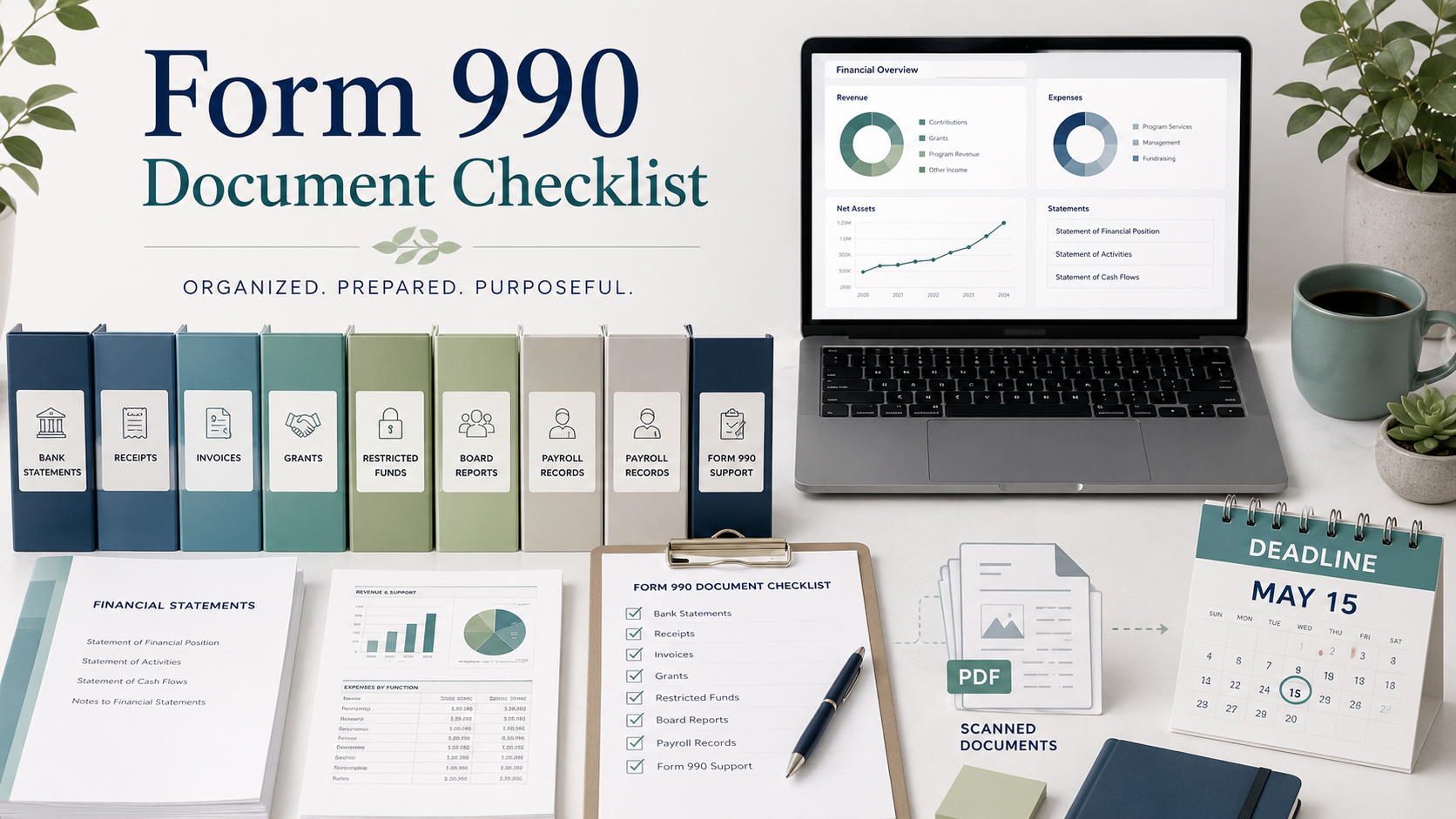
Practical Form 990 Document Checklist
Use this checklist as a practical starting point. Your nonprofit may need additional records depending on its tax year, organization type, activities, state requirements, funding sources, and filing form.
- Confirm the required filing. Review whether the organization may need Form 990-N, 990-EZ, 990, 990-PF, or another return.
- Gather prior-year filings. Save prior Form 990-series filings, confirmations, and related schedules.
- Pull year-end financial reports. Include profit and loss, balance sheet, general ledger, and budget versus actual reports.
- Reconcile bank and credit card accounts. Confirm all accounts agree to statements.
- Organize income support. Separate donations, grants, program revenue, fundraising income, membership dues, and other receipts.
- Organize expense support. Gather invoices, receipts, reimbursements, payroll reports, contractor records, and credit card support.
- Review grant and restricted fund records. Confirm grant agreements, restrictions, spending, and remaining balances.
- Review board and governance records. Gather minutes, approved budgets, policies, and board financial reports.
- Review payroll and contractor reporting. Make sure payments are categorized and documented properly.
- Check for old or unclear balances. Review receivables, payables, loans, assets, liabilities, and suspense accounts.
- Prepare questions before filing support begins. Flag missing records and unclear transactions early.
Red Flags Your Nonprofit Is Not Ready for Filing Support
Your nonprofit may need bookkeeping cleanup before Form 990 support if several of these issues apply:
- Bank accounts are not reconciled.
- QuickBooks Online does not match bank statements.
- Large amounts are in uncategorized income or expense.
- Donations, grants, and program revenue are mixed together.
- Restricted funds are not tracked separately.
- Receipts and invoices are missing.
- Grant reports do not tie to QuickBooks.
- Board reports are manually prepared and do not match the books.
- Old balance sheet items cannot be explained.
- Prior-year filings are missing or inconsistent.
If the books are messy, it may be better to clean up the records before relying on them for annual filing support.
When to Get Professional Help
Some nonprofits can gather Form 990 support internally when the books are simple and organized. Professional help may be useful when the organization has messy QuickBooks records, grants, restricted funds, multiple programs, payroll, contractors, or unclear prior-year records.
Consider getting help if:
- Your nonprofit is behind on monthly bookkeeping.
- QuickBooks Online needs cleanup before reports can be trusted.
- You are unsure which Form 990-series filing applies.
- Grant and restricted fund records are incomplete.
- The board needs clearer financial reports before filing support begins.
- You have missing receipts, invoices, or reimbursement support.
- A deadline is approaching and the books are not ready.
- You want a better monthly process going forward.
For service details, visit our nonprofit bookkeeping services page. If your organization needs help quickly, you can contact Small Business Accounting Inc.
FAQ: Form 990 Document Checklist
1. What documents are needed for Form 990?
Common documents include prior-year filings, financial statements, bank statements, reconciliation reports, donation records, grant documents, expense support, payroll reports, contractor records, board minutes, and restricted fund schedules. The exact list depends on the organization’s facts and filing requirement.
2. Should a nonprofit clean up QuickBooks before Form 990 filing support?
Yes, if the books are incomplete, unreconciled, or unclear. Clean QuickBooks records can help support gross receipts, expenses, year-end assets, grant tracking, restricted funds, and board review.
3. Do small nonprofits need a document checklist if they file Form 990-N?
Yes. Even small nonprofits should keep organized records to support gross receipts, basic organization information, filing history, and tax-exempt compliance. Form 990-N is shorter, but recordkeeping still matters.
4. What if our nonprofit is missing receipts or invoices?
Start by gathering available bank statements, vendor records, email confirmations, reimbursement forms, and duplicate receipts where possible. Missing records should be documented and reviewed carefully before relying on the books for filing support.
5. Can Form 990 document organization be handled remotely?
Yes. Many nonprofits can organize Form 990 support remotely using QuickBooks Online, secure document sharing, bank statements, financial reports, grant records, and structured follow-up questions.
Simple Compliance Note
This article provides general educational information and is not legal advice. Nonprofit recordkeeping, Form 990 requirements, filing deadlines, extension options, tax-exempt status issues, state filings, grant reporting, and donor restrictions can vary depending on the organization’s tax year, exemption type, gross receipts, assets, funding sources, and activities. Always confirm current IRS and state requirements before filing or making compliance decisions.
Need help getting your nonprofit books organized?
Small Business Accounting Inc. helps nonprofits with bookkeeping cleanup, QuickBooks Online organization, board financial reports, grant tracking, restricted fund bookkeeping, and Form 990 support. Remote support is available nationwide. Hawaii and Oahu clients may request local appointment availability when appropriate.
Learn more about nonprofit bookkeeping support:
https://smallbusinessaccountingfirm.com/nonprofit-bookkeeping/
Ready to request help?
https://smallbusinessaccountingfirm.com/contact/
Want to start with a checklist?
https://smallbusinessaccountingfirm.com/nonprofit-bookkeeping-checklist-pdf/