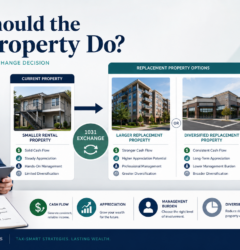
A replacement property should match more than the exchange rules. It should match the investor’s cash flow needs, appreciation goals, and lifestyle.
One investor may want dependable income. Another may want long-term growth. Another may want less management. The same property will not fit every investor.
Strategy question: What matters most in the next stage: income, growth, simplicity, flexibility, or legacy?
Cash Flow Fit
Cash flow matters because real estate is not only about value on paper. The investor must consider net income after debt service, repairs, reserves, vacancy, insurance, property taxes, management, and other costs.
A replacement property with strong gross rent can still produce weak net cash flow if expenses and debt are too high.
Appreciation Fit
Some investors care more about long-term growth than immediate cash flow. They may be willing to accept lower current income if the property has strong appreciation potential.
But appreciation-focused investing requires patience, liquidity, and risk tolerance. Investors should be careful not to assume appreciation will solve a weak property decision.
Lifestyle Fit
Lifestyle fit is often ignored, but it can determine whether the investment is sustainable.
A property that requires frequent decisions, repairs, tenant turnover, local involvement, or regulatory monitoring may not fit an investor who wants a lower-management life.
Planning warning: A property can look attractive financially but still be a poor fit if it creates the wrong workload or stress for the owner.
Match the Property to the Investor’s Stage
An investor in accumulation mode may want growth and leverage. A retiring landlord may want lower management and more predictable income. A family-focused investor may care about simplicity and future ownership structure.
The replacement property should fit the investor’s current stage, not just the investor’s past strategy.
Questions to Ask
- Do you need income now or growth over time?
- How much management burden are you willing to accept?
- What level of debt risk fits your goals?
- How important are reserves and cash flow stability?
- Would this property still fit your life five years from now?
- Does the property support retirement or future family planning?
Learn How to Match Replacement Property to Your Strategy
The AssetWise Institute course helps investors compare cash flow, appreciation, management burden, diversification, retirement income, and long-term planning before choosing replacement property.
View the 1031 Exchange Strategy CourseUse Tools to Compare Fit
Replacement property workbooks can help investors compare cash flow, holding costs, debt, management burden, appreciation assumptions, and lifestyle fit side by side.
Looking for 1031 replacement property tools?
Final Takeaway
The best replacement property is not always the one with the highest projected return. It is the one that fits the investor’s cash flow needs, growth goals, risk tolerance, management capacity, and life stage.
Before identifying replacement property, define what kind of ownership experience you are actually trying to build.
Important Educational Disclaimer
This article is for general educational purposes only and does not provide tax, legal, financial, investment, lending, real estate, or qualified intermediary advice. 1031 exchange rules are complex and time-sensitive. Before selling, refinancing, exchanging, identifying replacement property, changing ownership structure, or making any tax or investment decision, consult your own CPA, tax advisor, attorney, qualified intermediary, lender, financial advisor, and real estate professionals.
Official references: IRS Like-Kind Exchanges Real Estate Tax Tips and IRS Instructions for Form 8824.