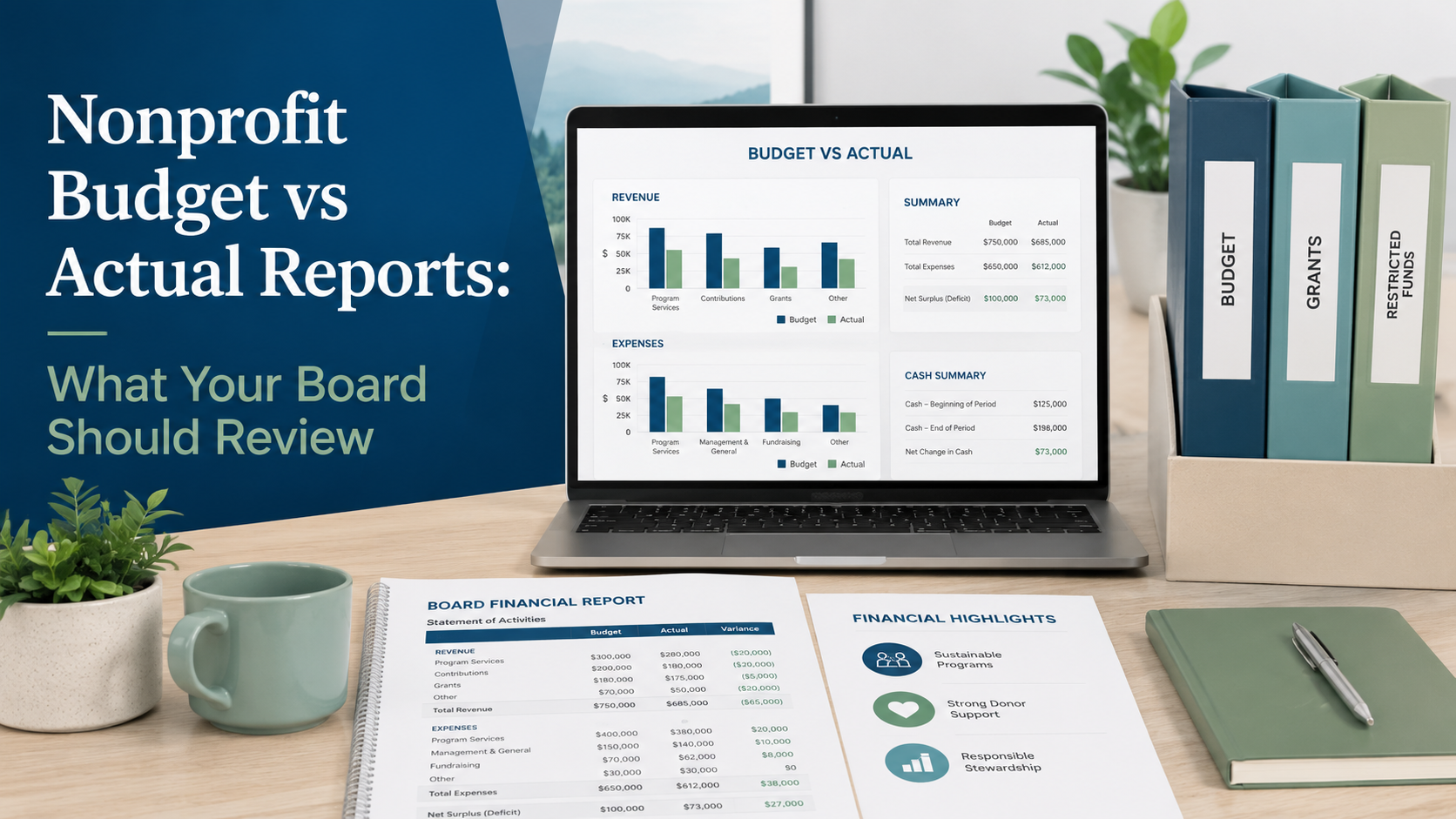
Nonprofit Budget vs Actual Reports: What Your Board Should Review
A nonprofit budget is only useful if leadership reviews it against what is actually happening.
That is where the budget vs actual report becomes one of the most important financial reports your board can receive. It helps board members, executive directors, treasurers, and finance committee members understand whether the organization is on track, where revenue may be falling short, where expenses are running high, and whether action is needed before a small issue becomes a bigger problem.
For many small nonprofits, churches, foundations, scholarship funds, and grant-funded organizations, the challenge is not that leaders do not care about the budget. The challenge is that the reports are often hard to read, late, incomplete, or not explained in plain English.
This guide explains what a nonprofit budget vs actual report should include, how your board should review it, what red flags to watch for, and when professional bookkeeping support may help create clearer reports.
If your nonprofit is reviewing its books before board meetings, year-end, or Form 990 preparation, you can download the free nonprofit bookkeeping checklist to help identify records that may need cleanup.
What Is a Nonprofit Budget vs Actual Report?
A budget vs actual report compares the budget your nonprofit approved to the actual income and expenses recorded in the books.
It helps answer practical questions such as:
- Are donations, grants, and program income coming in as expected?
- Are expenses staying within the approved budget?
- Are some programs spending faster than planned?
- Are major variances caused by timing or a true budget issue?
- Does the organization need to adjust spending, fundraising, or cash planning?
The report is most useful when the books are current and bank accounts are reconciled. If the underlying bookkeeping is messy, the budget vs actual report may not be reliable.
Small Business Accounting Inc. provides nonprofit bookkeeping support for organizations that need cleanup, QuickBooks Online organization, board financial reports, grant tracking, restricted fund bookkeeping, and Form 990 support.
Why Budget vs Actual Reports Matter for Board Oversight
Board members do not need to manage every transaction. But they do need to understand whether the nonprofit is operating within the financial plan that was approved.
A clear budget vs actual report helps the board:
- Monitor financial performance throughout the year
- Spot revenue shortfalls early
- Review whether expenses are aligned with mission priorities
- Understand cash flow pressure before it becomes urgent
- Evaluate whether grant spending is on track
- Support more informed board and finance committee discussions
- Prepare for year-end reporting and Form 990 support, when applicable
The report should not simply be handed to the board without explanation. A good budget vs actual report should include notes for major variances so board members understand what changed and why it matters.
What Should Be Included in a Nonprofit Budget vs Actual Report?
A strong nonprofit budget vs actual report should be clear enough for non-accountants and detailed enough to support meaningful oversight.
1. Approved Budget Amounts
The report should show the budget that was approved by the board or leadership. Without the budget column, board members cannot compare planned activity to actual results.
The budget should usually be organized by major income and expense categories, such as donations, grants, program revenue, payroll, rent, program supplies, fundraising costs, and administrative expenses.
2. Actual Income and Expenses
The report should show actual income and expenses from the bookkeeping system. These numbers should be based on current records and reconciled accounts whenever possible.
If the books are not fully reconciled, the report should be marked as preliminary so the board understands that numbers may change.
3. Variance Amounts
The variance shows the difference between the budget and actual results. It may be shown as a dollar amount, a percentage, or both.
For example, if the organization budgeted $50,000 in donations but has received $40,000 year to date, the report should show a $10,000 shortfall. That does not automatically mean there is a crisis, but it does mean the board should understand the reason.
4. Year-to-Date Results
For board oversight, year-to-date reporting is often more useful than looking only at the current month. A single month can be unusual because of timing, seasonal fundraising, grant payments, or one-time expenses.
Year-to-date numbers help the board see the bigger trend.
5. Notes Explaining Major Variances
The most helpful budget vs actual reports include short notes explaining major differences.
Examples of useful notes may include:
- A grant payment was delayed but is expected next month
- Fundraising event income was higher than budgeted
- Payroll is over budget because of temporary staffing
- Program supplies increased due to higher participation
- Professional fees are higher because bookkeeping cleanup is in progress
- Rent or insurance increased after renewal
The notes help the board focus on decisions instead of trying to interpret raw numbers alone.
How Your Board Should Review Budget vs Actual Reports
A budget vs actual report is most useful when the board reviews it consistently. The goal is not to criticize every variance. The goal is to understand what the numbers are telling leadership.
1. Start With the Big Picture
Before reviewing individual line items, the board should look at the overall financial picture.
Ask:
- Is total revenue above or below budget?
- Are total expenses above or below budget?
- Is the organization operating at a surplus or deficit?
- Is the result expected based on timing?
- Does cash flow support the current spending level?
This helps the board avoid getting lost in small details before understanding the overall situation.
2. Review Revenue Variances
Revenue variances deserve close attention because many nonprofits depend on donations, grants, fundraising events, or program fees that may not arrive evenly throughout the year.
The board should review:
- Donations compared with budget
- Grant income compared with expected timing
- Program service revenue
- Fundraising event income
- Membership or sponsorship income
If revenue is below budget, the board should understand whether the shortfall is temporary, seasonal, or a real concern that requires action.
3. Review Expense Variances
Expense variances help the board understand whether spending is aligned with the approved plan.
Focus on:
- Payroll and contractor costs
- Program expenses
- Fundraising expenses
- Rent, utilities, insurance, and technology
- Professional fees
- Travel, events, and outreach costs
Some expenses may be higher because the organization is serving more people or running a planned program. Others may indicate overspending or a need to adjust the budget.
4. Look at Program, Grant, and Restricted Fund Activity
For nonprofits with grants or restricted funds, the budget vs actual review should not stop at the general operating budget.
The board should also understand:
- Whether grant spending is on track
- Whether restricted funds are being used for the correct purpose
- Whether any grant is overspent or underspent
- Whether reporting deadlines are approaching
- Whether remaining restricted fund balances are accurate
Clear grant tracking and restricted fund bookkeeping can help leadership understand which funds are available for general operations and which funds are limited to a specific purpose.
5. Connect the Report to Cash Flow
A budget vs actual report does not always show the full cash picture. A nonprofit may be on budget but still have cash flow strain if grant payments are delayed or receivables are unpaid.
The board should review the budget vs actual report alongside a cash balance summary. This is especially important for organizations with payroll, rent, grants, or seasonal fundraising cycles.
For a broader monthly self-check, you can use our free nonprofit bookkeeping checklist when reviewing records before board meetings or filing season.
Common Budget vs Actual Report Mistakes
Even when a nonprofit prepares a budget vs actual report, the report may not be useful if the setup is unclear or the books are not current.
Using Reports From Unreconciled Books
If bank and credit card accounts are not reconciled, actual results may be incomplete or inaccurate. The board should know whether reports are final or preliminary.
Not Explaining Major Variances
A large variance without a note can create confusion. Board members may not know whether the issue is timing, a reporting error, or a true financial concern.
Using Too Many Line Items
Too much detail can make reports harder to read. The board usually needs a clear summary, while the treasurer or finance committee may review more detailed reports separately.
Ignoring Restricted Funds
If restricted funds are not shown clearly, the board may assume money is available for general operations when it is actually limited to a specific purpose.
Comparing Actual Results to an Outdated Budget
If the organization’s operations have changed significantly, the board may need to discuss whether the budget should be revised or whether a forecast should be added.
Red Flags Your Budget vs Actual Reports Need Cleanup
Your nonprofit may need reporting cleanup if any of these issues sound familiar:
- The board does not receive budget vs actual reports regularly
- Reports are difficult for non-accountants to understand
- Large variances are not explained
- QuickBooks categories do not match the approved budget
- Grant and restricted fund activity is not separated
- Reports include large uncategorized income or expenses
- Bank accounts are not reconciled before reports are prepared
- The treasurer manually rebuilds reports every month
- The executive director is unsure how to explain the financial packet
- Form 990 preparation is stressful because financial records are hard to use
These issues do not mean your nonprofit is failing. They usually mean the bookkeeping and reporting process needs better structure.
How QuickBooks Can Help With Budget vs Actual Reporting
QuickBooks Online can create useful budget vs actual reports, but the setup needs to match the nonprofit’s reporting needs.
Common QuickBooks issues include:
- The chart of accounts does not match the board-approved budget
- Programs or grants are not tracked separately
- Restricted funds are mixed with unrestricted activity
- Budget information was not entered into QuickBooks
- Classes, projects, or locations are used inconsistently
- Bank feeds have uncategorized or duplicate transactions
A nonprofit QuickBooks cleanup and reporting support process can help organize the chart of accounts, clean up old transactions, reconcile accounts, and create reports that are more useful for board review.
How Budget Reports Support Form 990 Readiness
Budget vs actual reports are primarily internal management tools, but clean monthly reporting can also make year-end work smoother.
The IRS provides resources for exempt organization filing requirements and Form 990-series returns. Filing requirements and deadlines can vary depending on the organization’s facts, gross receipts, assets, exempt status, and tax year. In general, the IRS states that Form 990, Form 990-EZ, or Form 990-PF is due by the 15th day of the 5th month after the organization’s accounting period ends, and Form 8868 may be used to request an automatic extension for many exempt organization returns when filed properly and timely.
The IRS also explains that organizations that fail to file required annual returns or notices for three consecutive years can automatically lose tax-exempt status.
You can review IRS information about annual exempt organization return due dates, extensions of time to file exempt organization returns, and automatic revocation of exemption.
This article is for general educational purposes and is not legal advice. Nonprofits should confirm their specific filing requirements, deadlines, return type, and extension options with current IRS guidance and qualified professional support when needed.
When budget reports are prepared from clean books throughout the year, Form 990 and board reporting support becomes more efficient because income, expenses, grants, programs, and restricted fund activity are easier to review.
When to Get Professional Help
Some nonprofits can prepare budget vs actual reports internally, especially when activity is simple and the books are current. But professional support may be helpful when reports are late, confusing, or difficult to reconcile with QuickBooks.
Consider getting help if:
- The board is not receiving clear budget reports
- QuickBooks reports do not match the approved budget
- Bank and credit card accounts are not reconciled monthly
- Grant and restricted fund reporting is unclear
- The treasurer is manually rebuilding reports outside the accounting system
- Budget variances are not explained
- The organization is preparing for filing and records are messy
- The board wants more consistent monthly financial reporting
If your nonprofit needs clearer budget reports or your books are already messy, you can get help with your nonprofit books from Small Business Accounting Inc.
FAQ: Nonprofit Budget vs Actual Reports
1. What is a nonprofit budget vs actual report?
A nonprofit budget vs actual report compares the organization’s approved budget to actual income and expenses. It helps the board see whether the nonprofit is on track financially.
2. How often should a nonprofit board review budget vs actual reports?
Many nonprofit boards review budget vs actual reports monthly or quarterly, depending on how often the board meets and how active the organization is. Monthly review is often helpful for organizations with grants, payroll, or tight cash flow.
3. What should the board look for in a budget vs actual report?
The board should review major revenue and expense variances, cash flow concerns, grant activity, restricted funds, and whether explanations are provided for significant differences from the budget.
4. Can QuickBooks prepare budget vs actual reports for nonprofits?
Yes. QuickBooks can prepare budget vs actual reports, but the chart of accounts, budget setup, classes, projects, or other tracking tools need to be organized properly for nonprofit reporting.
5. Are budget vs actual reports the same as audited financial statements?
No. Budget vs actual reports are generally internal management and board reports unless otherwise agreed. They are not the same as CPA audit, review, or compilation reports.
Need Help Getting Your Nonprofit Books Organized?
Small Business Accounting Inc. helps nonprofits with bookkeeping cleanup, QuickBooks Online organization, board financial reports, grant tracking, restricted fund bookkeeping, and Form 990 support.
Remote support is available nationwide. Hawaii and Oahu clients may request local appointment availability when appropriate.
Learn more about nonprofit bookkeeping support: https://smallbusinessaccountingfirm.com/nonprofit-bookkeeping/
Ready to request help? https://smallbusinessaccountingfirm.com/contact/
Want to start with a checklist? https://smallbusinessaccountingfirm.com/nonprofit-bookkeeping-checklist-pdf/