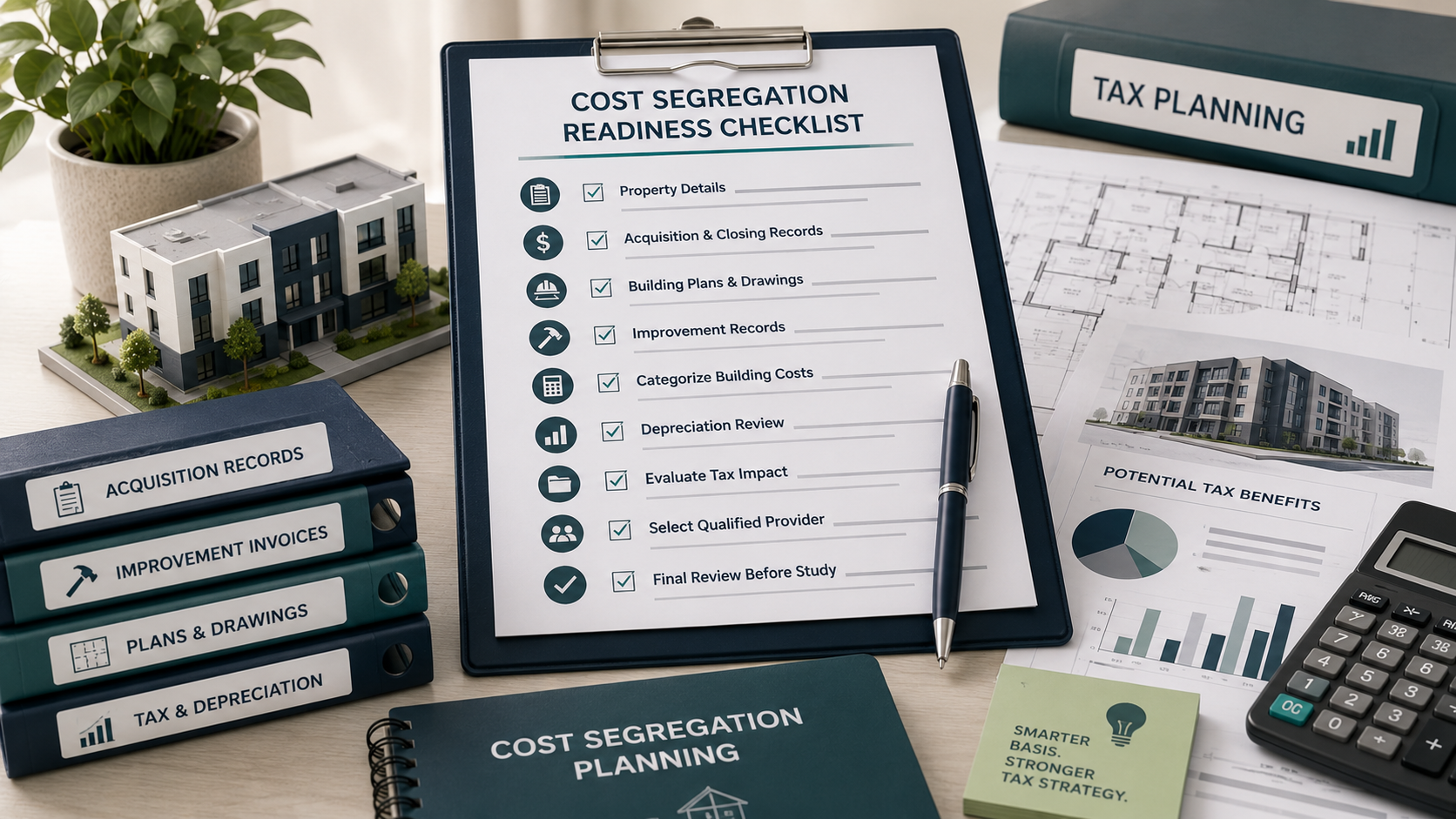
Cost Segregation Readiness Checklist Before Paying for a Formal Study
A cost segregation study can be a valuable tax planning tool for some real estate investors, but it is not the right next step for every property. Before paying for a formal study, owners should review the property records, tax position, basis, improvements, depreciation schedules, and likely planning benefit.
This readiness checklist helps landlords, short-term rental owners, commercial property owners, and real estate investors organize the key questions before deciding whether a formal study is worth pursuing.
Quick Summary
Before paying for a formal cost segregation study, review whether the property, records, timing, and tax position support the cost and effort.
- Gather purchase and closing records
- Review building basis and land allocation
- Organize improvement and renovation invoices
- Check depreciation schedules for existing assets
- Evaluate income, passive activity, and timing questions
- Prepare provider questions before ordering a formal study
Why Cost Segregation Readiness Matters
Cost segregation is a specialized depreciation planning strategy. A formal study may identify building components and land improvements that could be depreciated over shorter recovery periods than the building itself.
But a study should be supported by good records and a practical tax planning reason. If purchase documents are missing, basis is unclear, improvements are not organized, or the owner may not be able to use the additional depreciation, it may be better to complete a readiness review first.
What Is a Cost Segregation Readiness Review?
A readiness review is a pre-study review designed to answer a practical question: does it make sense to move forward with a formal cost segregation study now?
The review does not replace an engineering-based cost segregation study. Instead, it helps organize records, identify tax questions, estimate whether the property may be a good candidate, and determine what information a third-party provider will likely need.
Cost Segregation Readiness Checklist
Use this checklist before paying for a formal study. The goal is to make sure the decision is based on clean records, realistic expectations, and a tax strategy that fits your facts.
Free Checklist: Review Rental Tax Savings Before Filing
Cost segregation planning works best when the rest of the rental tax records are organized. Use the free Rental Property Tax Savings Checklist to review basis, depreciation, improvements, repairs, expenses, and records before filing.
Step 1: Confirm the Property Details
Cost segregation questions start with the property itself. A single-family rental, short-term rental, apartment building, mixed-use property, office building, retail property, warehouse, or commercial buildout may all require different levels of review.
Before ordering a study, gather the basic property facts so a tax advisor and third-party cost segregation provider can understand the scope.
Property Details to Gather
- Property address and property type
- Purchase date and placed-in-service date
- Original purchase price and closing statement
- Land and building allocation support
- Rental use, business use, or mixed-use details
- Major renovation or improvement history
- Current depreciation schedule
- Future sale, refinance, or holding-period plans
Step 2: Organize Acquisition and Closing Records
A formal cost segregation study needs reliable basis information. That usually starts with the purchase records, closing statement, settlement statement, title fees, transfer taxes, loan records, and any adjustments that affected the property basis.
If the original basis is unclear, the study may be less useful or require additional cleanup before it can be properly used for tax filing.
| Record Type | Examples | Why It Matters |
|---|---|---|
| Closing Records | Closing disclosure, settlement statement, purchase agreement | Helps support total acquisition cost and basis. |
| Land Allocation | County assessment, appraisal, purchase allocation, valuation support | Land is not depreciable and must be separated from building basis. |
| Loan Records | Loan costs, points, lender fees, escrow details | Financing costs may need different treatment than building costs. |
| Improvement Records | Renovation invoices, contractor bills, architectural plans, permits | May affect depreciable basis and asset classifications. |
| Prior Depreciation | Fixed asset schedule, Form 4562 support, prior-year returns | Helps identify what has already been depreciated. |
Step 3: Review Improvement and Renovation History
Improvements are often one of the most important readiness areas. If a property had a renovation, remodel, tenant improvement, roof replacement, HVAC project, flooring upgrade, furniture package, or exterior work, those records should be organized before the study conversation begins.
A clean project summary can help separate repairs, capital improvements, land improvements, building components, furniture, appliances, and equipment.
Step 4: Review Depreciation Schedules Before Ordering a Study
Before paying for a formal cost segregation study, review the existing depreciation schedule. This helps determine whether assets were already separated, whether improvements were missed, and whether prior-year depreciation needs attention.
A readiness review may identify issues such as missing assets, incorrect land allocation, improvement costs entered as repairs, or assets that were already classified separately.
Depreciation Questions to Ask
- Was the building basis calculated from the correct purchase records?
- Was land separated from depreciable building basis?
- Were improvements added to the depreciation schedule?
- Were furniture, appliances, or equipment already recorded separately?
- Were any assets disposed of, replaced, sold, or abandoned?
- Do prior-year schedules match the current books and records?
Step 5: Evaluate Whether the Timing Makes Sense
A cost segregation study can accelerate depreciation deductions, but timing matters. Before ordering a study, consider whether the property owner can use the additional depreciation, how long the property may be held, and whether there are passive activity or income limitations.
The tax benefit may look different for a long-term landlord, short-term rental owner, real estate professional, commercial property owner, or investor with suspended passive losses.
Need Help Deciding Whether Cost Segregation Is Worth Reviewing?
Small Business Accounting Inc. helps rental property owners and real estate investors review property records, depreciation schedules, basis, improvements, and tax planning questions before deciding whether to move forward with a formal study.
When a formal study appears appropriate, we can help coordinate with a qualified third-party provider and help use the final report for tax planning and filing.
Questions to Ask Before Choosing a Cost Segregation Provider
The provider selection process matters. A low-cost report with weak documentation may create more problems than it solves. Before paying for a formal study, ask how the provider will analyze the property, document classifications, and support the final report.
Provider Questions to Consider
- Who prepares the study, and what experience do they have?
- Will the study include a site visit, virtual review, or document-based review?
- What records are needed before the work begins?
- How are building components and land improvements identified?
- How does the report support asset classifications and cost allocations?
- Will the report reconcile allocated costs to total actual costs?
- What happens if the property is sold, refinanced, or improved later?
- How will the final report be used for tax preparation?
When Bookkeeping Cleanup Should Come First
If the books are messy, bookkeeping cleanup may need to happen before a meaningful cost segregation readiness review. For example, improvement invoices may be mixed with repairs, closing costs may be entered as one expense, or assets may not match the depreciation schedule.
Cleanup can help organize acquisition costs, loan records, repairs, improvements, owner transfers, construction costs, asset purchases, and property-level reporting.
For help organizing rental records, visit our Rental Property Bookkeeping Cleanup page.
How This Connects to a Depreciation and Tax Savings Review
A cost segregation readiness review often overlaps with a broader depreciation and tax savings review. If the property has unclear basis, missing assets, major improvements, short-term rental furnishings, or prior-year depreciation concerns, it may be worth reviewing the depreciation schedule before ordering a formal study.
Learn more about our Real Estate Depreciation & Tax Savings Review service.
Related Real Estate Tax Services
Depending on your property records and tax planning needs, these related services may be helpful:
Frequently Asked Questions
Do I need a cost segregation study for every rental property?
No. A cost segregation study is not necessary for every property. It may be worth reviewing when the property value, improvement costs, tax position, and likely depreciation benefit justify the cost and complexity of a formal study.
What records should I gather before ordering a cost segregation study?
Gather the closing statement, purchase agreement, land and building allocation support, improvement invoices, renovation records, depreciation schedules, fixed asset listings, and any construction or blueprint records available.
Does Small Business Accounting Inc. prepare formal cost segregation studies?
No. Small Business Accounting Inc. does not prepare engineering-based cost segregation studies in-house. When a formal study is appropriate, the firm can help clients understand the tax impact, coordinate with a qualified third-party provider, and use the final report for tax planning and filing.
Can cost segregation create immediate tax savings?
It may, but results depend on the property, income, passive activity rules, filing status, ownership structure, basis, and other facts. A readiness review helps evaluate whether the strategy may be useful before paying for a formal study.
What if my depreciation schedule is already messy?
If the depreciation schedule is unclear, a depreciation review or bookkeeping cleanup may be needed before ordering a study. Otherwise, the formal report may not connect cleanly to the tax return.
When should I request cost segregation tax planning help?
Consider requesting help before paying for a study if you recently purchased property, completed major improvements, converted property to rental use, acquired a commercial building, or have questions about whether additional depreciation may be usable.
Final Step: Review the Records Before Paying for a Formal Study
Cost segregation planning should start with clean records, clear basis, organized improvement invoices, accurate depreciation schedules, and a realistic understanding of the owner’s tax position.
Small Business Accounting Inc. can help real estate investors review the tax planning side before deciding whether a formal third-party study is the right next step.