Short Term Rental Material Participation: What Airbnb Owners Should Discuss With a Tax Professional
Material participation can be one of the most misunderstood short-term rental tax topics. If you own an Airbnb or STR, the right tax treatment may depend on your records, services provided, average guest stay, personal use, activity hours, and whether your participation is properly documented.
Quick Summary
Airbnb and short-term rental owners should discuss material participation with a tax professional before assuming STR losses are nonpassive or currently deductible. The discussion should include activity hours, who performed the work, what services were provided, average guest stay, personal use days, bookkeeping records, depreciation, and whether the activity belongs on Schedule E or Schedule C.
The key question is not just whether you worked on the rental. The better question is whether your records support the tax position being taken on the return.
Why Material Participation Matters for Short-Term Rentals
Short-term rentals are often discussed differently from traditional long-term rentals because STR owners may be more involved in guest communication, cleaning coordination, repairs, bookings, pricing, supply management, and day-to-day operations.
However, being involved does not automatically mean the tax result is simple. Material participation is a technical tax concept. It may affect whether an activity is treated as passive or nonpassive, but it must be evaluated together with the type of rental activity, services provided, personal use, income, losses, and supporting records.
For Airbnb owners, this is an area where professional review can be especially helpful because the facts matter. A host who self-manages everything may have a different recordkeeping story than a host who uses a property manager, co-host, cleaner, or automated systems.
Start With the Rental Property Tax Savings Checklist
Use the free checklist to review short-term rental tax records, depreciation, Airbnb income, expenses, bookkeeping red flags, cost segregation readiness, and discussion items to bring to your tax professional.
What Airbnb Owners Should Discuss With a Tax Professional
Before relying on material participation for tax reporting, discuss the full STR fact pattern. These questions can help organize the conversation.
1. How Many Hours Did You Actually Spend on the STR?
Your tax professional may ask how many hours you spent on guest communication, cleaning coordination, maintenance, pricing, bookkeeping, supply management, listing updates, repairs, and other operational work.
2. Who Else Worked on the Property?
Material participation is not only about your hours. It may also matter whether cleaners, co-hosts, contractors, employees, family members, or property managers performed work on the activity.
3. What Services Did You Provide to Guests?
STR owners should discuss whether they provided basic rental services only or more significant guest services. Guest services, cleaning arrangements, linen changes, meals, concierge-style support, or hotel-like services may affect the tax analysis.
4. What Was the Average Guest Stay?
Average length of stay can be an important discussion point for short-term rentals. Your tax professional may ask for booking reports showing check-in dates, check-out dates, nights stayed, cancellations, and direct bookings.
5. Did You Use the Property Personally?
Personal use days can affect rental expense allocation and tax reporting. Airbnb owners should track owner stays, family use, discounted stays, maintenance stays, and any periods when the property was unavailable for rental.
6. Are Your Books Clean Enough to Support the Tax Position?
Material participation is only one part of the STR tax picture. Your books should also support income, platform fees, cleaning costs, repairs, furniture, supplies, depreciation, mortgage interest, taxes, insurance, and owner transfers.
How to Track STR Material Participation Hours
Your records do not need to be complicated, but they should be clear enough to tell the story of your participation. A calendar, spreadsheet, task log, appointment book, narrative summary, or bookkeeping notes may help support the time spent on the activity.
Common STR Tasks to Track
- Guest messaging and booking management
- Cleaning coordination and quality checks
- Supply ordering and inventory
- Repairs, maintenance, and vendor coordination
- Pricing updates and listing management
- Calendar management and availability review
- Bookkeeping and record organization
- Property inspections and setup work
Helpful Support Records
- Booking calendar
- Guest message history
- Cleaner and contractor invoices
- Maintenance notes
- Supply receipts
- Travel or mileage records
- Pricing change notes
- Monthly activity summaries
Services Provided to Guests Can Affect the STR Tax Discussion
Airbnb owners should describe the services they provide in plain language. The tax professional needs to know whether the owner is simply renting space or providing additional services that are primarily for the guest’s convenience.
| Service or Activity | Why It Matters | Records to Gather |
|---|---|---|
| Guest Messaging | Shows owner involvement in bookings, check-in, issues, and guest support. | Message logs and calendar notes |
| Cleaning Coordination | May show who handled turnover and whether cleaning was owner-managed or outsourced. | Cleaner invoices and schedules |
| Linen Changes | May be relevant when discussing guest services and operational involvement. | Service notes and invoices |
| Repairs and Maintenance | Helps document owner involvement and property operations. | Vendor invoices and task logs |
| Pricing and Listing Updates | Can show active management of the STR activity. | Pricing notes and listing changes |
| Co-Host or Property Manager Support | May affect the participation analysis because another person performed part of the work. | Agreements and statements |
| Guest Amenities or Concierge Support | May affect whether services are basic rental services or more substantial guest services. | Service descriptions |
Need Help Reviewing Your STR Tax Position?
Small Business Accounting Inc. helps Airbnb and short-term rental owners review material participation questions, activity records, Schedule E versus Schedule C issues, 1099-K reporting, depreciation, and bookkeeping cleanup.
View Airbnb & STR Tax Services Contact Small Business Accounting Inc.
Schedule E vs Schedule C: Why STR Owners Should Not Guess
Many rental real estate activities are reported on Schedule E, but some short-term rental facts may require additional review. If significant services are provided primarily for guests, the activity may need to be discussed differently from a traditional rental.
This is why Airbnb owners should not rely only on the platform report or 1099-K. The tax professional needs to understand the activity: how guests use the property, who provides services, how often guests stay, whether the owner materially participates, and how the income and expenses are tracked.
A clear tax position starts with clear facts and clear records.
Material Participation, STR Losses, and Tax Planning
Material participation often matters most when the STR activity shows a loss. Some owners assume that short-term rental losses can automatically offset other income, but the answer depends on the facts and the passive activity rules.
Your tax professional may need to review whether the activity is passive or nonpassive, whether losses are limited, whether depreciation or cost segregation planning changes the outcome, and whether the records support the tax position.
Questions to Review
- Did the STR show a profit or loss?
- How much depreciation was claimed?
- Were furniture and appliances tracked?
- Were repairs and improvements separated?
- Were personal use days allocated properly?
- Did the owner materially participate?
Records That Help
- Profit and loss report
- Depreciation schedule
- Activity hour log
- Booking calendar
- Platform payout report
- Receipts and invoices
If depreciation, furniture, appliances, or cost segregation readiness are part of the discussion, review the Real Estate Depreciation Tax Savings Review.
How Bookkeeping Cleanup Supports Material Participation Review
Clean books do not prove material participation by themselves, but they help support the overall STR tax story. Bookkeeping records can show what was paid, who did the work, when expenses happened, and how the property was operated.
Income Records
Track platform income, direct bookings, refunds, adjustments, cleaning fees, local taxes, and payout deposits.
Expense Records
Separate cleaning, repairs, supplies, furniture, appliances, professional fees, utilities, insurance, and management fees.
Activity Support
Connect owner time logs to real activity, such as guest messages, vendor coordination, repairs, cleaning checks, and supply runs.
If your STR books have duplicate income, uncategorized expenses, missing platform reconciliation, unclear owner transfers, or mixed personal and rental costs, review Rental Property Bookkeeping Cleanup.
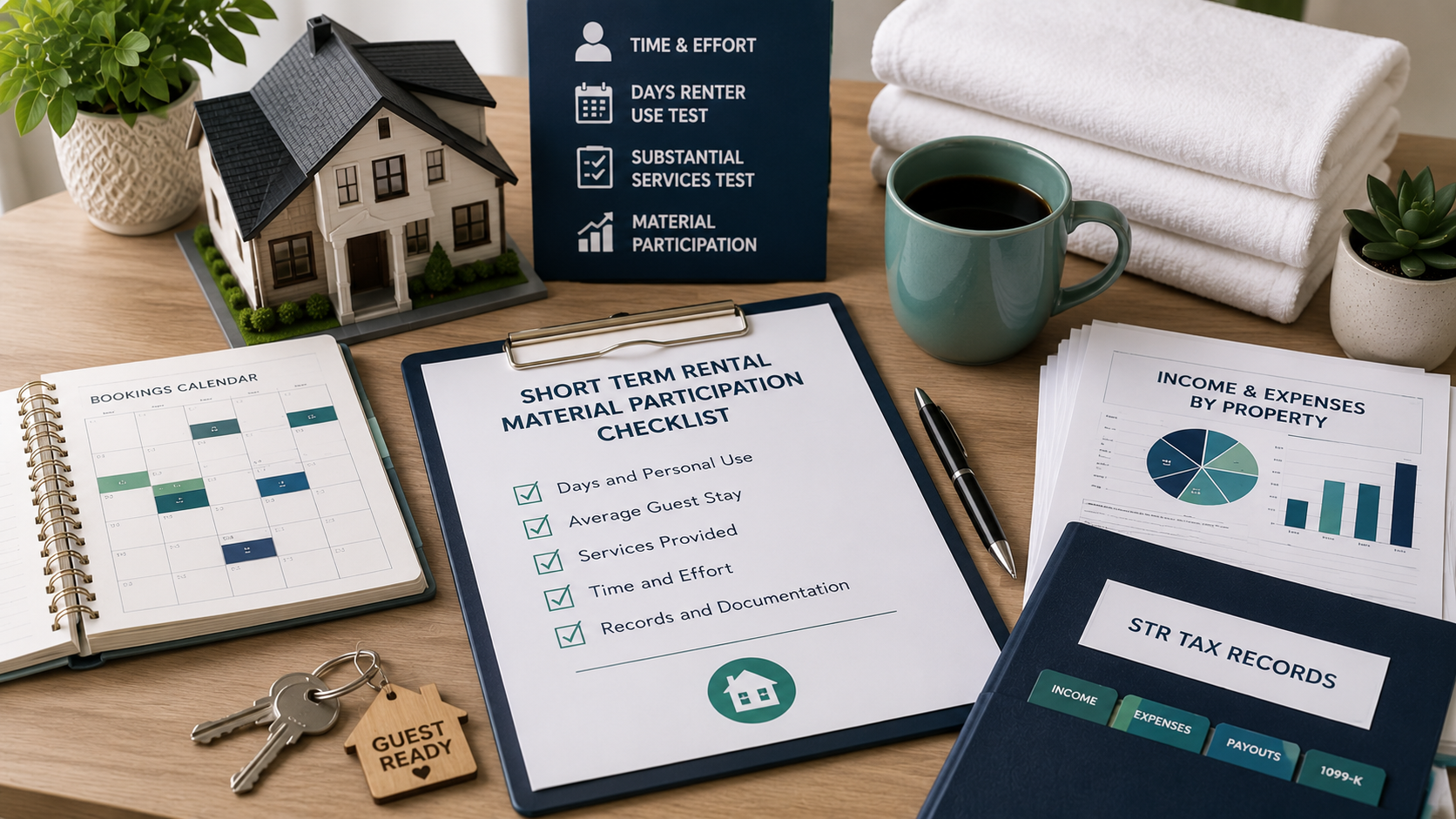
Short-Term Rental Material Participation Discussion Checklist
Use this checklist before talking with a tax professional about STR material participation.
| Discussion Item | Why It Matters | Helpful Records |
|---|---|---|
| Activity Hours | Helps review whether owner participation may meet a material participation test. | Time log, calendar, summaries |
| Who Did the Work | Important when co-hosts, cleaners, contractors, or property managers were involved. | Invoices and agreements |
| Average Guest Stay | May affect how the STR activity is analyzed. | Booking reports |
| Services Provided | Helps review Schedule E versus Schedule C questions and guest-service facts. | Service descriptions |
| Personal Use Days | May affect expense allocation and rental reporting. | Owner calendar |
| Income Reconciliation | Supports accurate reporting of platform income, payouts, refunds, and fees. | 1099-K, platform reports |
| Depreciation Records | Important when STR losses involve building, furniture, appliances, and improvements. | Depreciation schedule |
| Bookkeeping Cleanup | Helps confirm whether the books are ready for tax preparation. | P&L, general ledger, receipts |
When to Request Professional STR Tax Help
Consider professional help if you have STR losses, depreciation, cost segregation questions, unclear activity hours, personal use days, multiple platforms, a co-host or property manager, significant guest services, or uncertainty about Schedule E versus Schedule C.
A review does not guarantee a specific tax result. It helps organize the facts, review the records, and determine what tax position may be supportable based on your circumstances.
Helpful Service Pages for Airbnb and STR Owners
Depending on your facts and records, one of these service areas may be the best next step:
Airbnb & STR Tax Services
For material participation questions, Schedule E versus Schedule C review, 1099-K reporting, and STR tax preparation.
Tax Savings Review
For depreciation, repairs, improvements, cost segregation readiness, and STR tax red flag review.
Rental Bookkeeping Cleanup
For messy books, platform payout reconciliation, owner transfers, uncategorized expenses, and tax-ready STR records.
Rental Tax Preparation
For annual tax preparation involving rental income, expenses, depreciation, Schedule E, and rental reporting.
Real Estate Tax & Accounting
For broader tax and accounting support for landlords, investors, STR owners, and property owners.
Free Checklist
Use the checklist to review STR records, depreciation, bookkeeping, repairs, improvements, and missing documents.
Frequently Asked Questions
What is material participation for a short-term rental?
Material participation is a tax concept used to evaluate the owner’s involvement in an activity. For short-term rentals, it should be reviewed with activity hours, services provided, who performed the work, average guest stay, and the overall tax reporting position.
Does owning an Airbnb automatically mean I materially participate?
No. Owning the property does not automatically prove material participation. Your tax professional needs to review what work you performed, how much time you spent, whether others performed work, and whether your records support the position.
What records should I keep for STR material participation?
Helpful records include time logs, calendars, guest message history, booking reports, cleaner invoices, co-host records, repair notes, vendor invoices, supply receipts, and monthly summaries of tasks performed.
Should an Airbnb be reported on Schedule E or Schedule C?
Many rental real estate activities are reported on Schedule E, but some short-term rental situations require additional review. Significant services, guest-service facts, and the nature of the activity may affect whether Schedule E or Schedule C is appropriate.
Can material participation make STR losses deductible?
Material participation may be part of the loss analysis, but it does not automatically make every STR loss deductible. Passive activity rules, at-risk rules, personal use, depreciation, and the facts of the activity all need to be reviewed.
Can Small Business Accounting Inc. help review STR material participation questions?
Yes. Small Business Accounting Inc. helps Airbnb and short-term rental owners review STR tax records, material participation questions, depreciation, bookkeeping cleanup, Schedule E versus Schedule C issues, and tax preparation support.
Ready to Discuss Your STR Tax Position?
If you own an Airbnb or short-term rental and are unsure how material participation, losses, depreciation, personal use, or Schedule E versus Schedule C applies to your situation, Small Business Accounting Inc. can help you review the next step.
Contact Small Business Accounting Inc. Download the Free Checklist
Disclaimer: This article is for general educational purposes only and does not provide legal, tax, accounting, investment, or engineering advice. Reading this article or contacting the firm does not create a client relationship. Tax results depend on each client’s facts and circumstances.