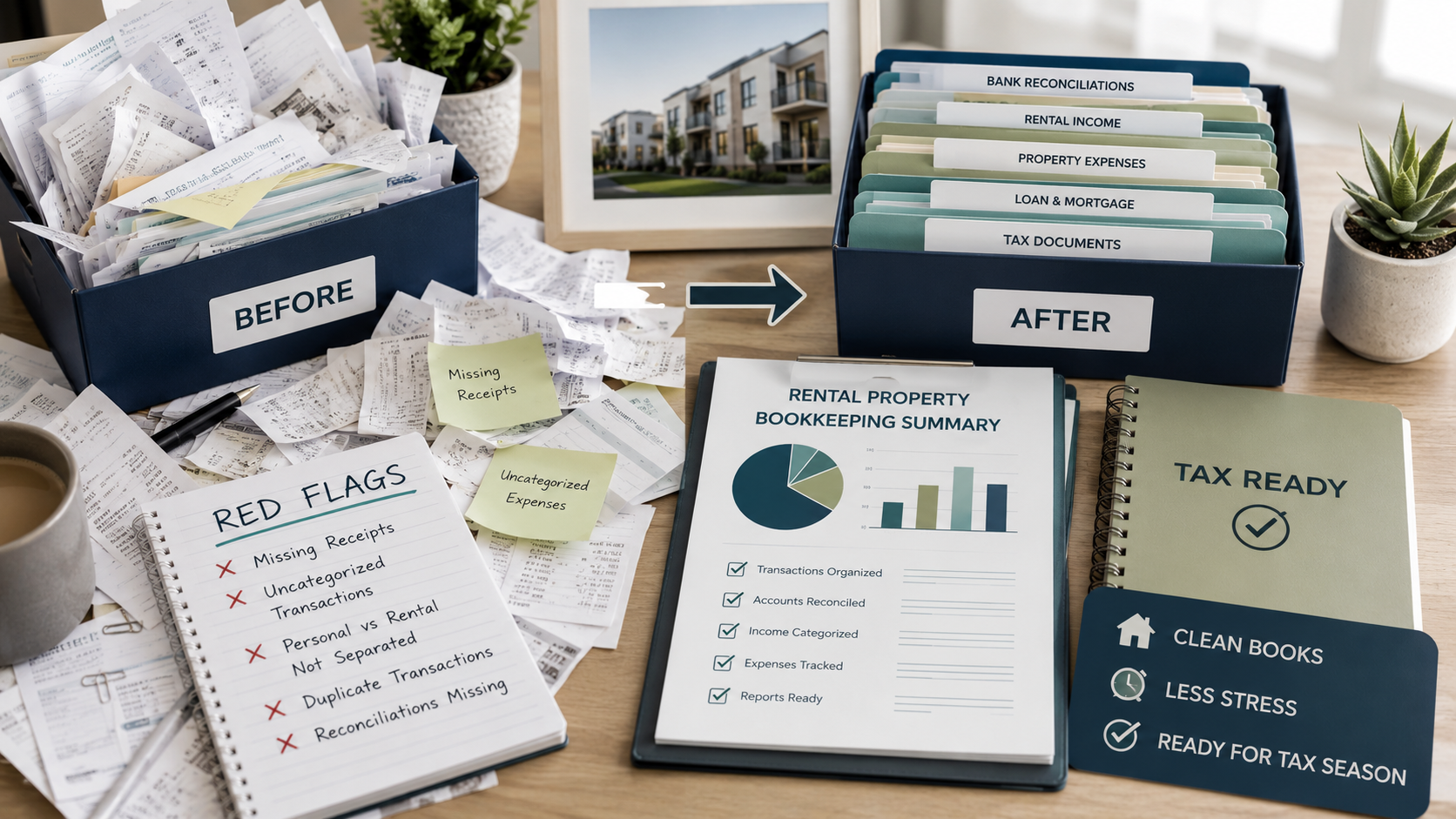
Rental Property Bookkeeping Red Flags That Can Delay Tax Preparation
Rental tax preparation becomes much harder when the books are not clean. If income, expenses, deposits, mortgage payments, repairs, and property records are mixed together, your tax preparer may need extra time before the return can be completed.
Rental property bookkeeping does not need to be perfect before tax season, but it does need to be clear enough for your tax preparer to understand what happened during the year. When the books are messy, tax preparation can slow down because the preparer has to stop and ask follow-up questions, request missing documents, or correct categories before Schedule E can be prepared.
The biggest issue is not always the size of the mistake. Small bookkeeping problems can create large delays when they affect rental income, mortgage interest, escrow, repairs, improvements, depreciation, owner transfers, or multiple-property tracking.
This guide explains the most common rental property bookkeeping red flags that can delay tax preparation and what rental owners can do before filing season. If your books need cleanup, Small Business Accounting Inc. offers Rental Property Bookkeeping Cleanup services for landlords, Airbnb owners, short-term rental owners, and real estate investors nationwide.
Quick Guide
Why Rental Bookkeeping Matters Before Tax Preparation
Rental property tax preparation depends on accurate income, expense, depreciation, and ownership records. If the books are not organized, the tax return may still be possible, but the process can take longer and require more clarification.
For most individual rental property owners, rental income and expenses are generally reported on Schedule E. That means the preparer needs a clear view of income, mortgage interest, property taxes, insurance, repairs, supplies, utilities, management fees, cleaning, travel, depreciation, and any other rental-related activity.
Clean bookkeeping helps answer basic tax questions faster:
- How much rental income was actually received?
- Which expenses belong to each property?
- Were any expenses personal instead of rental-related?
- Were repairs separated from improvements?
- Were mortgage payments split between principal, interest, and escrow?
- Were security deposits, owner contributions, and transfers handled correctly?
Rental Property Bookkeeping Red Flags That Can Delay Tax Preparation
These red flags do not always mean the tax return is wrong. They mean the records may need cleanup or clarification before the return can be prepared efficiently.
1. Too Many Uncategorized Transactions
Uncategorized transactions are one of the most common bookkeeping issues. If a large number of bank or credit card transactions are sitting in “uncategorized expense,” “ask my accountant,” “miscellaneous,” or a similar category, the tax preparer cannot easily determine what should be deducted.
Rental property owners should review these transactions before sending the books. Even simple notes such as “plumbing repair,” “tenant supplies,” “personal charge,” or “mortgage payment” can help reduce back-and-forth questions.
2. Personal and Rental Expenses Are Mixed Together
Mixing personal and rental activity can create confusion. If the same bank account or credit card is used for groceries, personal travel, rental repairs, mortgage payments, and owner spending, the preparer may need more time to separate business and personal items.
This is especially important for owners who self-manage rentals and pay expenses from personal accounts. The more mixed the activity is, the more important it becomes to provide clear notes and supporting documents.
3. Rental Income Does Not Match Bank Deposits or Platform Reports
Rental income can come from tenants, property managers, payment apps, booking platforms, direct deposits, checks, or third-party processors. If the books do not reconcile to the actual deposits or year-end reports, tax preparation may be delayed.
For long-term rentals, the preparer may ask for a rent roll, lease summary, or tenant payment history. For short-term rentals, the preparer may need payout reports, platform summaries, cleaning fee details, host fees, refunds, and occupancy-related charges.
4. Mortgage Payments Are Not Split Correctly
A full mortgage payment usually includes more than interest. It may include principal, interest, property taxes, insurance escrow, mortgage insurance, or other charges. For tax preparation, the full payment should not automatically be treated as one deductible expense.
If mortgage payments were booked as one lump amount all year, the preparer may need Form 1098, escrow statements, year-end mortgage statements, or a loan history report to separate the tax categories properly.
5. Repairs and Improvements Are Not Separated
A common delay happens when repairs, maintenance, renovations, upgrades, appliances, flooring, painting, remodeling, and major improvements are all placed in one category. Some costs may be currently deductible, while others may need to be capitalized and depreciated.
The tax treatment depends on the facts. A clean description, invoice, date, amount, and property address can help your preparer review the item more efficiently.
6. Security Deposits Are Treated Like Rental Income Without Review
Security deposits can create confusion when they are recorded as income, transfers, liabilities, or owner contributions. The correct treatment depends on what happened to the deposit and whether it was refundable, retained, applied to rent, or used for damages.
If you collected, returned, or kept tenant deposits during the year, provide a simple deposit summary so the preparer does not have to guess.
7. Transfers Are Recorded as Income or Expenses
Transfers between bank accounts, credit cards, loan accounts, and owner accounts are often miscategorized as rental income or deductible expenses. This can make the profit and loss statement look inaccurate.
Common examples include moving money from personal checking to the rental account, paying a credit card from the rental bank account, transferring funds to savings, or moving money between property accounts.
Want a Cleaner Rental Tax Prep File?
Download the free Rental Property Tax Savings Checklist to help organize income, expenses, repairs, improvements, depreciation records, and tax prep documents before filing season.
Special Red Flags for Owners With Multiple Rental Properties
Bookkeeping becomes more complex when one owner has several rental units, properties, or entities. A total profit and loss statement may not be enough if the tax return needs income and expenses separated by property.
No Property-by-Property Tracking
If all rental income and expenses are combined into one set of books, the preparer may need extra time to allocate expenses between properties.
Shared Expenses Are Not Allocated
Insurance, utilities, repairs, supplies, travel, and professional fees may need to be assigned to the correct property or allocated reasonably.
One Mortgage Covers Multiple Units
If one loan, escrow account, or insurance policy covers more than one unit, the records should clearly show how amounts were assigned.
Property Improvements Are Not Linked to a Specific Property
Major improvements should be connected to the correct property so depreciation and basis records can be reviewed properly.
If you own several rentals and the books are difficult to follow, a bookkeeping cleanup project can help organize the records before year-end tax preparation. Learn more about our Rental Property Bookkeeping Cleanup service.
Short-Term Rental and Airbnb Bookkeeping Red Flags
Short-term rentals often have more transaction activity than long-term rentals. Payouts, refunds, cleaning fees, platform fees, occupancy-related charges, supplies, repairs, furnishings, and guest-related expenses can create extra bookkeeping work.
If you operate an Airbnb or short-term rental, pay special attention to these red flags:
- Platform payouts are recorded as gross income without separating host fees, refunds, or adjustments.
- Cleaning fees are not clearly separated from cleaning expenses paid to cleaners.
- Furniture, appliances, linens, décor, and supplies are all grouped together without detail.
- Owner stays, personal use days, and rental days are not tracked clearly.
- Local taxes, occupancy taxes, or pass-through charges are not separated from rental income.
- Multiple booking platforms are used, but only one platform report is provided at tax time.
For short-term rental owners, clean records are especially important because the tax reporting may involve more questions than a simple long-term rental. You can learn more on our Airbnb & Short-Term Rental Tax Services page.
Rental Bookkeeping Cleanup Checklist Before Tax Preparation
Before sending your records for tax preparation, use this checklist to reduce delays and make your file easier to review.
- Confirm that all rental bank and credit card accounts are reconciled through year-end.
- Review uncategorized transactions and add clear descriptions where possible.
- Separate rental income from owner transfers, refunds, deposits, and loan proceeds.
- Gather Form 1098 mortgage interest statements and year-end escrow statements.
- Provide property tax bills, insurance statements, and HOA statements if applicable.
- Separate repairs from improvements and provide invoices for large projects.
- Identify any new appliances, furniture, flooring, renovations, or major capital items.
- Provide rental platform reports, 1099-K forms, or property manager statements.
- Track security deposits collected, returned, retained, or applied to rent.
- Separate each property if you own more than one rental.
- Provide prior-year depreciation schedules if you are a new client.
- Make notes for unusual transactions instead of waiting for tax-time questions.
How Small Business Accounting Inc. Can Help
Small Business Accounting Inc. helps rental property owners organize their books before tax preparation. We work with landlords, real estate investors, Airbnb owners, short-term rental owners, commercial property owners, and property managers who need cleaner records and a more tax-ready file.
Rental Bookkeeping Cleanup
We help review messy rental books, categorize transactions, clean up transfers, and organize records so tax preparation can move forward more efficiently.
Rental Tax Preparation
We help prepare rental tax returns using organized income, expense, depreciation, and property records for Schedule E and related tax reporting.
Depreciation Review
We can review rental depreciation schedules, property basis, improvements, and possible tax planning questions through our real estate depreciation review service.
Real Estate Tax Planning
We help property owners think through cleanup, tax preparation, depreciation, cost segregation coordination, and future planning questions.
If your books are not ready for tax season, start with our Rental Property Bookkeeping Cleanup service. If your concern is depreciation or tax savings opportunities, you may also want to review our Real Estate Depreciation Tax Savings Review.
When Bookkeeping Cleanup Should Happen
Ideally, rental bookkeeping cleanup should happen before tax season, not during the final filing rush. If the books are cleaned up earlier, the tax preparer has more time to review unusual items, depreciation questions, repairs versus improvements, missing documents, and planning opportunities.
Cleanup is especially helpful if you bought a new rental property, converted a personal home to a rental, started a short-term rental, changed property managers, refinanced, completed renovations, or switched tax preparers.
For broader support, visit our Real Estate Tax & Accounting hub page.
Messy Rental Books Can Be Cleaned Up Before Tax Time
If your rental property records are incomplete, mixed together, or difficult to follow, Small Business Accounting Inc. can help you organize the books and prepare a cleaner file for tax preparation.
Frequently Asked Questions
What bookkeeping issues delay rental property tax preparation the most?
Common delays include uncategorized transactions, missing mortgage statements, mixed personal and rental expenses, unclear rental income deposits, missing platform reports, untracked security deposits, and repairs or improvements that are not described clearly.
Do I need separate books for each rental property?
If you own more than one rental property, it is very helpful to track income and expenses by property. This makes Schedule E reporting, depreciation review, and property-level planning much easier.
What records should I provide for rental bookkeeping cleanup?
Helpful records include bank statements, credit card statements, mortgage statements, Form 1098, property tax bills, insurance records, rent rolls, lease summaries, property manager statements, platform reports, repair invoices, improvement invoices, and prior-year depreciation schedules.
Can you help if my rental books are mixed with personal expenses?
Yes. Mixed accounts are common for small landlords. Cleanup may involve reviewing transactions, identifying personal items, categorizing rental expenses, documenting owner contributions, and separating transfers from income and expenses.
Should I clean up bookkeeping before or after tax preparation?
It is usually better to clean up the books before tax preparation. Clean records can reduce back-and-forth questions, improve the quality of the tax file, and help identify issues before filing.
Does Small Business Accounting Inc. work with rental owners nationwide?
Yes. Small Business Accounting Inc. provides remote tax and accounting services nationwide for rental property owners, landlords, short-term rental owners, and real estate investors. Hawaii and Oahu clients may ask about local appointment availability when appropriate.