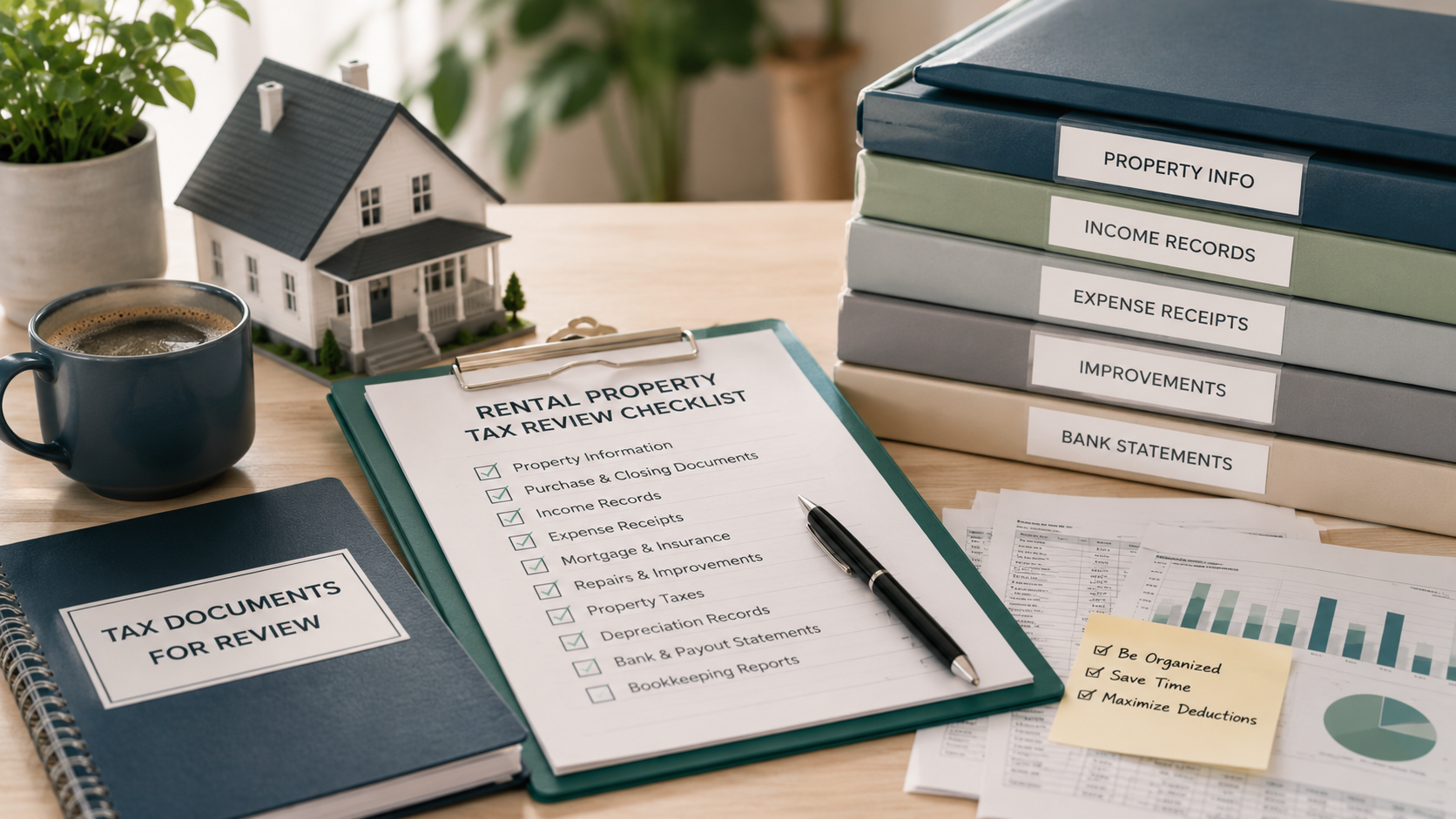
What Documents Do You Need for a Rental Property Tax Review?
A rental property tax review is much easier when your documents are organized before the review begins. The right records can help your tax professional review depreciation, repairs, improvements, income, expenses, bookkeeping, and possible tax savings opportunities with more confidence.
Quick Summary
For a rental property tax review, gather your prior tax returns, depreciation schedules, closing statement, mortgage records, income reports, bank statements, repair receipts, improvement invoices, property manager statements, Airbnb or short-term rental reports if applicable, and bookkeeping records.
These documents help identify whether rental income was reported correctly, whether expenses were categorized properly, whether depreciation was missed or miscalculated, and whether repairs or improvements need a closer look.
Why Document Prep Matters Before a Rental Property Tax Review
A rental property tax review is not just a quick glance at one line on Schedule E. A helpful review often looks at the full story behind the property: when it was purchased, how it was placed in service, how land and building value were separated, what improvements were made, how income was collected, and how expenses were tracked.
Good records help connect the tax return to the real facts. Without them, it can be difficult to know whether depreciation was handled correctly, whether a repair should have been capitalized, whether an Airbnb 1099-K was reconciled properly, or whether bookkeeping cleanup is needed before filing.
Small Business Accounting Inc. helps landlords, Airbnb owners, short-term rental owners, and real estate investors with rental property tax preparation, rental bookkeeping cleanup, depreciation review, and real estate tax planning nationwide.
Start With the Rental Property Tax Savings Checklist
Before gathering every document, use the free Rental Property Tax Savings Checklist to identify the areas most likely to need review, including depreciation, repairs, improvements, cost segregation readiness, Airbnb tax issues, and bookkeeping red flags.
Core Documents Needed for a Rental Property Tax Review
These are the documents most rental property owners should gather before requesting a review.
1. Prior-Year Tax Returns
Prior-year tax returns show how the rental property was reported in earlier years. They help identify whether rental income, expenses, depreciation, passive losses, carryovers, and property details were reported consistently.
2. Depreciation Schedule
The depreciation schedule is one of the most important documents for a rental property review. It shows the assets being depreciated, the dates placed in service, cost basis, recovery periods, prior depreciation, and current depreciation.
3. Closing Statement or Settlement Statement
The closing statement helps review the property’s original cost, loan costs, prepaid items, property taxes, credits, and closing costs. It can also help determine whether land and building value were separated properly.
4. Property Information and Use History
Your tax professional may need to know when the property was purchased, when it was available for rent, whether it was used personally, whether it was converted from personal use, and whether it was a long-term rental, short-term rental, mixed-use property, or commercial property.
Documents Needed to Review Depreciation
Depreciation can be one of the biggest areas to review because rental owners often have more than one depreciable asset. A property may include the building, appliances, furniture, improvements, flooring, fixtures, equipment, and other items.
Gather These Records
- Depreciation schedule for each rental property
- Closing statement and purchase records
- Land and building allocation support
- Appraisal or property tax assessment if available
- Appliance and furniture purchase records
- Improvement invoices and placed-in-service dates
- Prior-year Form 4562 details if available
Why They Matter
- Confirm whether land was excluded from depreciation
- Review whether building value was reasonable
- Identify missing assets or lumped-together items
- Review whether improvements were added in the correct year
- Support future sale, disposition, or depreciation correction review
- Evaluate whether cost segregation planning may be worth discussing
If you are not sure whether depreciation was handled correctly, review the Real Estate Depreciation Tax Savings Review service page.
Documents Needed to Review Rental Income
Rental income records help confirm whether the income reported on the tax return matches leases, platform reports, property manager statements, bank deposits, and direct booking records.
| Document | Why It Matters | Applies To |
|---|---|---|
| Lease Agreements | Support expected rent, security deposits, tenant terms, and rental periods. | Long-Term Rentals |
| Rent Roll | Shows monthly rent by tenant and property, especially for multi-property owners. | Landlords |
| Bank Statements | Help reconcile deposits, transfers, direct rent, platform payouts, and property manager deposits. | All Rentals |
| Property Manager Statements | Show rent collected, fees, repairs, reserves, and owner payouts. | Managed Properties |
| 1099-K, 1099-MISC, or 1099-NEC | Help compare reported income or payments to bookkeeping and tax records. | STR and Rentals |
| Airbnb, VRBO, or Booking Platform Reports | Show gross bookings, platform fees, cleaning fees, refunds, and payout details. | Short-Term Rentals |
| Direct Booking Records | Support income collected outside third-party platforms. | STR and Direct Rentals |
Documents Needed to Review Expenses, Repairs, and Improvements
Expense documents help determine whether rental costs were properly categorized, whether repairs were separated from improvements, and whether major projects need depreciation or capitalization review.
Repairs and Maintenance
Gather receipts, invoices, contractor descriptions, photos if available, and payment records for ordinary repairs and maintenance. Examples may include plumbing repairs, minor electrical repairs, appliance service, cleaning, pest control, landscaping, and routine maintenance.
Improvements and Renovations
Gather detailed invoices and project descriptions for remodels, flooring replacement, roof replacement, HVAC replacement, kitchen upgrades, bathroom renovations, additions, and other major work. These items may need a closer look because they may not be treated the same as routine repairs.
Appliances, Furniture, and Equipment
Gather purchase receipts and placed-in-service dates for appliances, furniture, smart locks, security systems, hot tubs, outdoor improvements, and equipment. This is especially important for furnished short-term rentals.
Mortgage, Taxes, Insurance, and HOA
Gather Form 1098, lender statements, escrow statements, property tax bills, insurance invoices, HOA statements, and loan balance details. These documents help prevent common bookkeeping mistakes, such as deducting loan principal or duplicating escrow expenses.
Messy Records Can Make Tax Review Harder
If your rental records are mixed with personal transactions, uncategorized expenses, duplicate income, or unclear owner transfers, bookkeeping cleanup may be the better first step before tax preparation or tax planning.
Bookkeeping Records to Prepare for Review
Bookkeeping records help connect the documents to the numbers on the tax return. If the books are clean, your tax professional can usually review the property more efficiently. If the books are messy, the review may reveal cleanup work that needs to happen first.
Bank and Credit Card Records
Gather year-end bank statements, credit card statements, loan statements, and records for all accounts used for rental activity.
Bookkeeping Reports
Gather profit and loss reports, balance sheets, general ledgers, transaction detail reports, and property-by-property reports if available.
Reconciliation Support
Gather bank reconciliation reports, property manager reconciliations, platform payout reconciliations, and notes on transfers.
Rental owners with multiple properties should ideally separate income and expenses by property. This helps with Schedule E reporting, depreciation review, property-level profitability, and future planning.
Extra Documents for Airbnb and Short-Term Rental Owners
Airbnb and short-term rental owners often need additional records because platform reports, 1099-K totals, bank deposits, cleaning fees, refunds, local taxes, and direct bookings may not match automatically.
STR Income Records
- Airbnb, VRBO, Booking.com, or other platform reports
- 1099-K forms if received
- Gross booking reports
- Payout reports
- Refund and cancellation records
- Direct booking records
- Bank deposit records for all payout accounts
STR Expense and Use Records
- Cleaning invoices and cleaner payment records
- Platform fee records
- Supplies, linens, furniture, and guest amenity receipts
- Personal use day tracking
- Rental day tracking
- Local tax reports, if applicable
- Co-host or property manager payment records
For STR-specific help, review Airbnb & Short-Term Rental Tax Services.
Cost Segregation Readiness Documents
Not every rental property needs a cost segregation study, but some properties may deserve a readiness review before the owner pays for a formal study. This is especially true for higher-value properties, major renovations, furnished short-term rentals, or properties with substantial building components and improvements.
Small Business Accounting Inc. does not prepare engineering-based cost segregation studies in-house. When a formal study is appropriate, the firm can help clients understand the tax impact, coordinate with a qualified third-party provider, and properly use the final report for tax planning and filing.
Helpful Cost Seg Documents
- Closing statement and purchase contract
- Appraisal or insurance replacement cost data
- Renovation invoices and contractor invoices
- Floor plans, photos, and inspection reports
- Furniture, appliance, and equipment list
- Placed-in-service dates
Planning Questions
- Was the property recently purchased or improved?
- Were major renovations completed?
- Is the property furnished or used as an STR?
- Can you use additional deductions under your tax facts?
- Do passive loss rules limit your rental losses?
- Would the potential benefit justify the study cost?
For more information, visit Cost Segregation Tax Planning.
Rental Property Tax Review Document Checklist
Use this checklist as a practical starting point before requesting a rental property tax review.
| Category | Documents to Gather | Why It Helps |
|---|---|---|
| Prior Tax Filing | Prior-year tax returns, Schedule E, depreciation schedules, carryover worksheets | Helps review what was previously reported and whether depreciation or losses need attention. |
| Purchase Records | Closing statement, purchase contract, appraisal, property tax assessment | Supports basis, land/building allocation, and closing cost review. |
| Income Records | Leases, rent roll, bank deposits, platform reports, 1099-K, property manager statements | Helps reconcile reported income to actual records. |
| Expense Records | Receipts, invoices, credit card statements, vendor payments, utility bills | Supports deductible expenses and helps find miscategorizations. |
| Repairs and Improvements | Contractor invoices, project descriptions, photos, warranties, placed-in-service dates | Helps decide what may need to be expensed, capitalized, or depreciated. |
| Debt and Escrow | Form 1098, lender statements, escrow statements, property tax bills, insurance records | Helps separate mortgage interest, principal, taxes, insurance, and escrow activity. |
| Bookkeeping | Profit and loss, balance sheet, general ledger, transaction detail, reconciliation reports | Shows whether the books are tax-ready or need cleanup. |
| Short-Term Rental | Platform reports, booking calendar, cleaning records, local tax reports, personal use days | Supports STR tax reporting, 1099-K review, and Schedule E versus Schedule C questions. |
When to Request a Professional Rental Property Tax Review
Consider requesting a professional review if you are missing a depreciation schedule, had a large renovation, bought or sold a property, started an Airbnb, received a 1099-K that does not match deposits, have unclear bookkeeping, or are not sure whether repairs and improvements were handled correctly.
A review can help organize the facts, identify areas that need cleanup, and determine whether tax planning or tax return preparation support may be appropriate. It does not guarantee tax savings, but it can help you understand whether your rental property records are complete enough for filing and planning.
View the Tax Savings Review Contact Small Business Accounting Inc.
Helpful Service Pages for Rental Property Owners
Depending on what your documents show, one of these service areas may be the best next step:
Real Estate Tax & Accounting
For broad tax and accounting support for landlords, real estate investors, STR owners, and property owners.
Tax Savings Review
For depreciation, repairs, improvements, cost segregation readiness, and rental tax red flag review.
Rental Tax Preparation
For annual tax preparation support involving Schedule E, rental expenses, depreciation, and rental reporting.
Rental Bookkeeping Cleanup
For messy books, uncategorized expenses, duplicate income, property-level tracking, and reconciliation issues.
Airbnb & STR Tax Services
For short-term rental income, 1099-K reporting, platform payouts, personal use days, and STR tax questions.
Free Checklist
Use the free checklist to review documents, depreciation, repairs, STR issues, and bookkeeping red flags.
Frequently Asked Questions
What documents do I need for a rental property tax review?
Start with prior tax returns, depreciation schedules, closing statements, mortgage records, income records, bank statements, repair receipts, improvement invoices, property manager statements, and bookkeeping reports. Airbnb and short-term rental owners should also gather platform reports, 1099-K forms if received, payout records, cleaning records, and personal use day tracking.
Do I need a depreciation schedule for a rental property review?
A depreciation schedule is extremely helpful because it shows what assets are being depreciated, when they were placed in service, and how much depreciation has already been claimed. If you do not have one, a review may still be possible, but additional reconstruction may be needed.
Why does my tax professional need the closing statement?
The closing statement helps review the original purchase cost, closing costs, loan costs, property tax prorations, credits, and potential land/building allocation. It can be important for depreciation and basis review.
Should I gather receipts for repairs and improvements?
Yes. Receipts and invoices help determine whether a cost may be a repair, maintenance expense, improvement, renovation, appliance, furniture item, or other asset. The description of the work is often just as important as the amount paid.
What if my rental books are messy?
If the books contain uncategorized expenses, duplicate income, unclear owner transfers, or mortgage payments that were not split properly, bookkeeping cleanup may be needed before tax preparation or a deeper tax review.
Can Small Business Accounting Inc. help with rental property document review?
Yes. Small Business Accounting Inc. helps rental property owners, Airbnb owners, landlords, and real estate investors with rental tax preparation, bookkeeping cleanup, depreciation review, tax savings review, and real estate tax planning support.
Ready to Organize Your Rental Property Tax Records?
If you have missing depreciation schedules, unclear repairs, Airbnb income questions, messy bookkeeping, or major improvements to review, Small Business Accounting Inc. can help you determine the next step.
Contact Small Business Accounting Inc. Download the Free Checklist
Disclaimer: This article is for general educational purposes only and does not provide legal, tax, accounting, investment, or engineering advice. Reading this article or contacting the firm does not create a client relationship. Tax results depend on each client’s facts and circumstances.

1 Comment
ExoWatts
Great content! Keep up the good work!