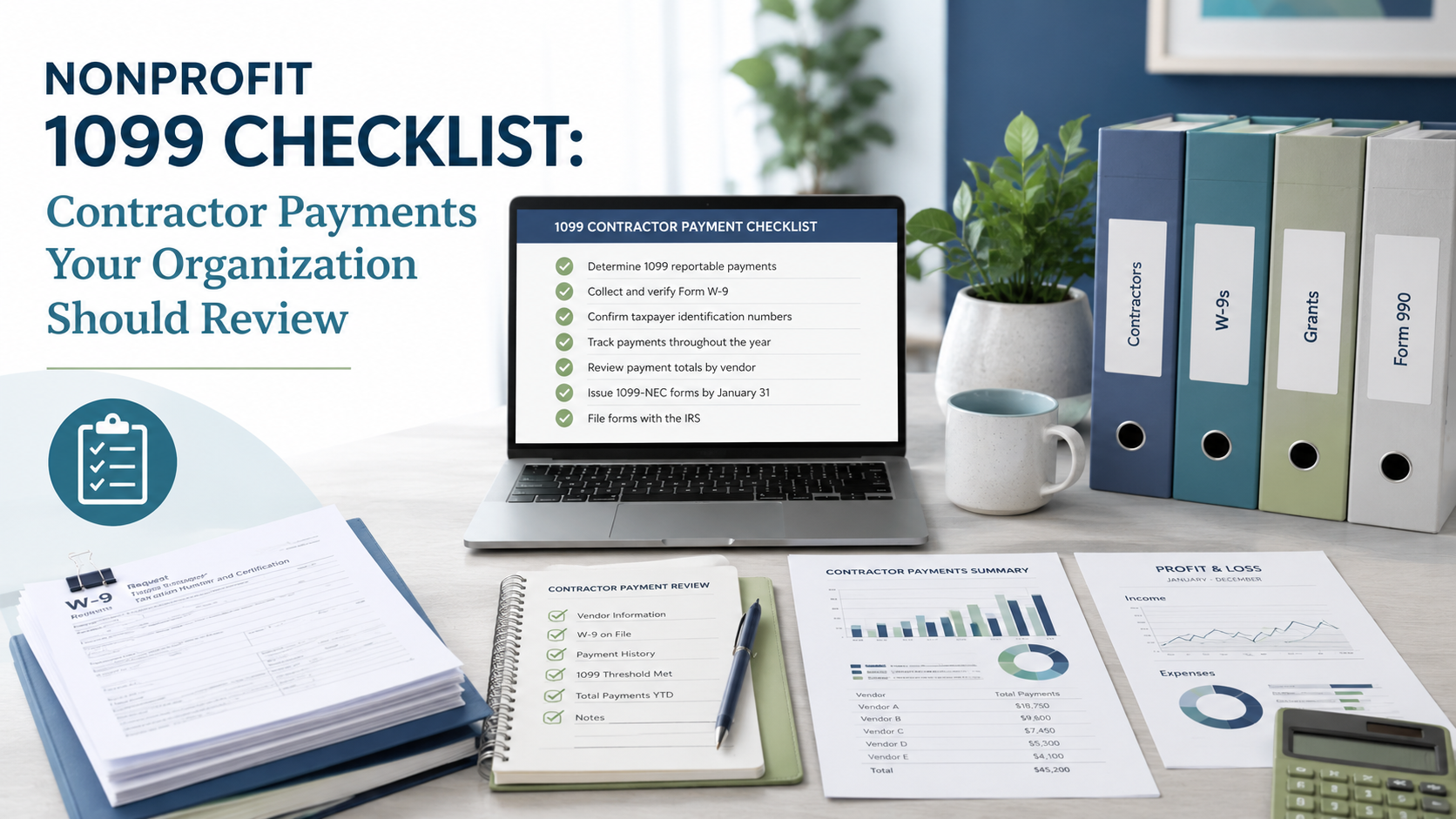
Nonprofit 1099 Checklist: Contractor Payments Your Organization Should Review
Nonprofits often rely on contractors, consultants, bookkeepers, grant writers, speakers, musicians, web designers, program support providers, maintenance workers, and other outside vendors. Those payments can be easy to make during the year, but harder to organize when year-end reporting arrives.
If contractor records are incomplete, your nonprofit may have to rush to collect W-9 forms, review payment totals, clean up QuickBooks categories, and figure out which vendors may need a Form 1099. That last-minute scramble can create stress for the executive director, treasurer, finance committee, and anyone responsible for year-end records.
A clear nonprofit 1099 checklist helps your organization review contractor payments before deadlines get close. It also supports cleaner bookkeeping, better board reporting, and smoother Form 990 preparation when annual filing applies.
This guide explains what contractor payment records your nonprofit should review, what common mistakes to avoid, and when professional bookkeeping support may be helpful.
If your nonprofit is reviewing year-end records, you can download the free nonprofit bookkeeping checklist to help identify bookkeeping items that may need cleanup before filing season.
Why 1099 Review Matters for Nonprofits
Many nonprofit leaders assume 1099 reporting is only a business issue. However, nonprofits may also have information reporting responsibilities when they pay certain contractors, service providers, vendors, attorneys, or other payees in the course of the organization’s activities.
A good 1099 review helps your nonprofit:
- Identify vendors and contractors who may need Form 1099-NEC or Form 1099-MISC
- Confirm W-9 forms are on file before year-end
- Review contractor payment totals
- Clean up QuickBooks vendor records
- Separate contractor payments from employee wages
- Support board and finance committee oversight
- Reduce year-end bookkeeping stress
- Prepare cleaner records for Form 990 support when applicable
Small Business Accounting Inc. provides nonprofit bookkeeping support for organizations that need QuickBooks cleanup, contractor payment review, board financial reports, grant tracking, restricted fund bookkeeping, and Form 990 support.
What Is Form 1099-NEC?
Form 1099-NEC is generally used to report nonemployee compensation. For many nonprofits, this may include payments to independent contractors or service providers who are not employees.
Common nonprofit examples may include payments to:
- Grant writers
- Consultants
- Bookkeepers
- Guest speakers
- Program instructors
- Musicians or event support providers
- Marketing or website contractors
- Technology support providers
- Maintenance or repair contractors
- Professional service providers
The IRS instructions generally refer to Form 1099-NEC for services performed by someone who is not your employee when payments meet the reporting threshold. Nonprofits should verify the current year IRS instructions and review the facts before deciding whether a payment is reportable.
You can review current IRS information about Form 1099-NEC and the Instructions for Forms 1099-MISC and 1099-NEC.
What Is Form 1099-MISC?
Form 1099-MISC may apply to certain other types of payments, such as rents, prizes and awards, certain legal-related payments, and other miscellaneous information reporting categories.
For nonprofits, Form 1099-MISC may be relevant when the organization has payments such as:
- Rent payments
- Certain prizes or awards
- Certain gross proceeds paid to attorneys
- Other reportable miscellaneous payments, depending on the facts
Because 1099-MISC and 1099-NEC have different reporting boxes and deadlines, nonprofits should not assume every vendor payment belongs on the same form.
Nonprofit 1099 Checklist: Contractor Payments to Review
Use the following checklist to review contractor and vendor payment records before year-end.
1. Pull a Vendor Payment Report
Start by pulling a vendor payment report from QuickBooks or your bookkeeping system. The report should show all vendors paid during the year and total payments by vendor.
Review vendors such as:
- Contractors
- Consultants
- Professional service providers
- Program support workers
- Grant writers
- Speakers and instructors
- Legal service providers
- Rent or facility providers
- Maintenance and repair providers
If vendor names are duplicated or entered inconsistently, the payment totals may be wrong. For example, “ABC Consulting,” “ABC Consulting LLC,” and “A.B.C. Consulting” may appear as separate vendors even though they represent the same payee.
2. Review Which Vendors Were Paid $600 or More
The IRS instructions generally refer to a $600 threshold for many Form 1099-NEC and Form 1099-MISC reporting categories, but the correct treatment depends on the payment type and facts.
Your nonprofit should review vendors with payments at or above the threshold and determine whether the payments may be reportable. Be careful not to rely only on the total amount. You also need to review what the payment was for, who received it, and how the vendor is classified.
3. Confirm W-9 Forms Are on File
Form W-9 helps your organization collect the vendor’s legal name, business name, tax classification, address, and taxpayer identification number.
Before year-end, review whether you have W-9 forms for vendors who may need a 1099.
Good practice is to request a W-9 before paying a contractor, not after year-end. Waiting until January can create delays if the contractor does not respond quickly.
4. Separate Contractors From Employees
Nonprofits should not treat employees and contractors the same way for reporting. Employee wages are generally reported through payroll forms, while independent contractor payments may be reported on Form 1099-NEC when requirements are met.
Worker classification can be fact-specific. If there is uncertainty about whether someone should be treated as an employee or contractor, the organization should seek qualified guidance before year-end.
5. Review Payment Methods
Payment method can matter for 1099 review. Some payments made by credit card or certain third-party payment networks may be handled differently than payments made by check, ACH, or direct bank transfer.
Your nonprofit should review how each contractor was paid and avoid double reporting when another reporting system may apply.
This is an area where professional support can be helpful, especially if your organization uses multiple payment platforms.
6. Clean Up QuickBooks Vendor Records
QuickBooks can help with 1099 review, but only if vendor records and expense categories are clean.
Review whether:
- Vendor names are entered consistently
- Duplicate vendors are cleaned up carefully
- W-9 information is recorded where appropriate
- Payments are coded to the correct expense categories
- Contractor payments are not mixed with employee wages
- Grant-funded contractor payments are tracked correctly
- Payment totals agree with bank and credit card records
If your QuickBooks file is messy, nonprofit QuickBooks cleanup and reporting support can help organize contractor records before filing season.
7. Review Grant-Funded Contractor Payments
If your nonprofit uses grant funds to pay contractors, those payments should be reviewed both for 1099 purposes and grant tracking purposes.
For each grant-funded contractor payment, confirm:
- The contractor name is correct
- The payment was coded to the correct grant or program
- The expense is allowable under the grant terms
- Receipts, invoices, or agreements are saved
- The payment is included in the correct reporting period
- The payment is included in vendor 1099 review when applicable
Clear grant tracking and restricted fund bookkeeping can help your organization connect contractor payments to the right grant, program, or restricted purpose.
8. Save Support for Payments
Contractor payments should be supported by clear records. Helpful documents may include:
- Invoices
- Contracts or engagement letters
- Approved payment requests
- Board approvals, if applicable
- Grant budget support
- Proof of payment
- W-9 forms
Good documentation can help your nonprofit respond to questions from the board, grantors, tax professionals, or vendors.
For a broader year-end review, you can use our free nonprofit bookkeeping checklist alongside your 1099 review.
Important 1099 Deadline Considerations
The IRS generally states that Form 1099-NEC must be filed with the IRS and furnished to recipients by January 31. Form 1099-MISC may have different filing deadlines depending on whether it is filed on paper or electronically. If a deadline falls on a weekend or legal holiday, the due date may move to the next business day.
Because 1099 rules, deadlines, thresholds, electronic filing requirements, and form instructions can change, nonprofits should verify current IRS guidance before filing. You can review IRS information about Forms 1099-MISC and 1099-NEC instructions and employment tax due dates.
This article is for general educational purposes and is not legal advice. Nonprofits should work with qualified tax or payroll professionals when they need help determining filing requirements, worker classification, backup withholding, or reporting deadlines.
Common Nonprofit 1099 Mistakes to Avoid
Most 1099 problems are not intentional. They usually happen because vendor records are incomplete or year-end review starts too late.
Waiting Until January to Request W-9 Forms
Trying to collect W-9s after the year is over can delay 1099 preparation. Request W-9 forms before paying new contractors whenever possible.
Relying on Memory Instead of Reports
Do not guess which vendors were paid. Use QuickBooks, bank records, credit card statements, and payment processor reports to review actual payment totals.
Ignoring Legal Payments
Payments to attorneys may have special reporting rules, including situations involving attorney fees or gross proceeds. Nonprofits should review legal payments carefully before filing.
Mixing Employee and Contractor Payments
Employee wages and contractor payments are not reported the same way. If someone was misclassified during the year, the organization should get qualified guidance before filing.
Using Messy Vendor Names in QuickBooks
Duplicate vendor names can cause payment totals to be understated. Clean vendor records help the organization review 1099 totals more accurately.
Red Flags Your Nonprofit 1099 Records Need Cleanup
Your nonprofit may need 1099 cleanup support if any of these issues sound familiar:
- W-9 forms are missing for contractors
- Vendor names are duplicated in QuickBooks
- Contractor payments are coded inconsistently
- Payments were made through several platforms
- Grant-funded contractor costs are hard to identify
- Legal payments were made and need review
- Board reports do not clearly show contractor or professional service costs
- Bank and credit card accounts are not reconciled
- Form 990 preparation is delayed because contractor records are messy
- No one is sure which vendors may need a Form 1099
These issues are common for small and growing nonprofits. The key is to clean up vendor records before filing deadlines are too close.
How 1099 Review Supports Board Reports and Form 990 Readiness
Contractor payment review is not just about preparing Forms 1099. It also supports better financial reporting.
When contractor and vendor records are clean, your nonprofit can prepare clearer reports showing:
- Professional fees
- Program contractor costs
- Grant-funded contractor expenses
- Fundraising event support costs
- Administrative and management costs
- Legal and accounting fees
Board financial reports are generally for internal management and board use unless otherwise agreed. They are not the same as CPA audit, review, or compilation reports.
Clean contractor records can also support Form 990 and board reporting support because professional fees, independent contractor costs, program expenses, and grant-related expenses are easier to review.
When to Get Professional Help
Some nonprofits can review contractor payments internally, especially when there are only a few vendors and QuickBooks is current. But professional support may be useful when records are messy, vendor information is incomplete, or filing deadlines are approaching.
Consider getting help if:
- Your nonprofit paid many contractors during the year
- W-9 forms are missing
- QuickBooks vendor records are messy
- Payments were made through multiple platforms
- Bank reconciliations are behind
- Grant-funded contractor payments need review
- You are unsure which vendors may need 1099s
- Year-end filing preparation is becoming stressful
If your nonprofit contractor records are messy or you need help before year-end, you can request nonprofit bookkeeping support from Small Business Accounting Inc.
FAQ: Nonprofit 1099 Checklist
1. Do nonprofits need to issue 1099s to contractors?
Nonprofits may need to issue Forms 1099 to certain contractors or vendors when reporting requirements are met. The correct form and reporting treatment depend on the payment type, amount, vendor classification, and current IRS rules.
2. What records should nonprofits collect from contractors?
Nonprofits should generally collect a completed Form W-9 before paying contractors. They should also keep invoices, contracts, payment records, approvals, and any grant-related support connected to the contractor payment.
3. What is the deadline for Form 1099-NEC?
The IRS generally states that Form 1099-NEC is due to the IRS and recipients by January 31. If the date falls on a weekend or legal holiday, the deadline may shift. Nonprofits should verify current IRS instructions each year.
4. Can QuickBooks help prepare nonprofit 1099s?
Yes. QuickBooks can help track vendors and contractor payments, but the setup must be clean. Vendor names, W-9 details, payment categories, and reconciliations should be reviewed before relying on reports.
5. When should a nonprofit start reviewing 1099 records?
Ideally, nonprofits should review contractor records throughout the year and complete a detailed review before year-end. Waiting until January can make it harder to collect missing W-9 forms or correct vendor records.
Need Help Getting Your Nonprofit Books Organized?
Small Business Accounting Inc. helps nonprofits with bookkeeping cleanup, QuickBooks Online organization, board financial reports, grant tracking, restricted fund bookkeeping, and Form 990 support.
Remote support is available nationwide. Hawaii and Oahu clients may request local appointment availability when appropriate.
Learn more about nonprofit bookkeeping support: https://smallbusinessaccountingfirm.com/nonprofit-bookkeeping/
Ready to request help? https://smallbusinessaccountingfirm.com/contact/
Want to start with a checklist? https://smallbusinessaccountingfirm.com/nonprofit-bookkeeping-checklist-pdf/