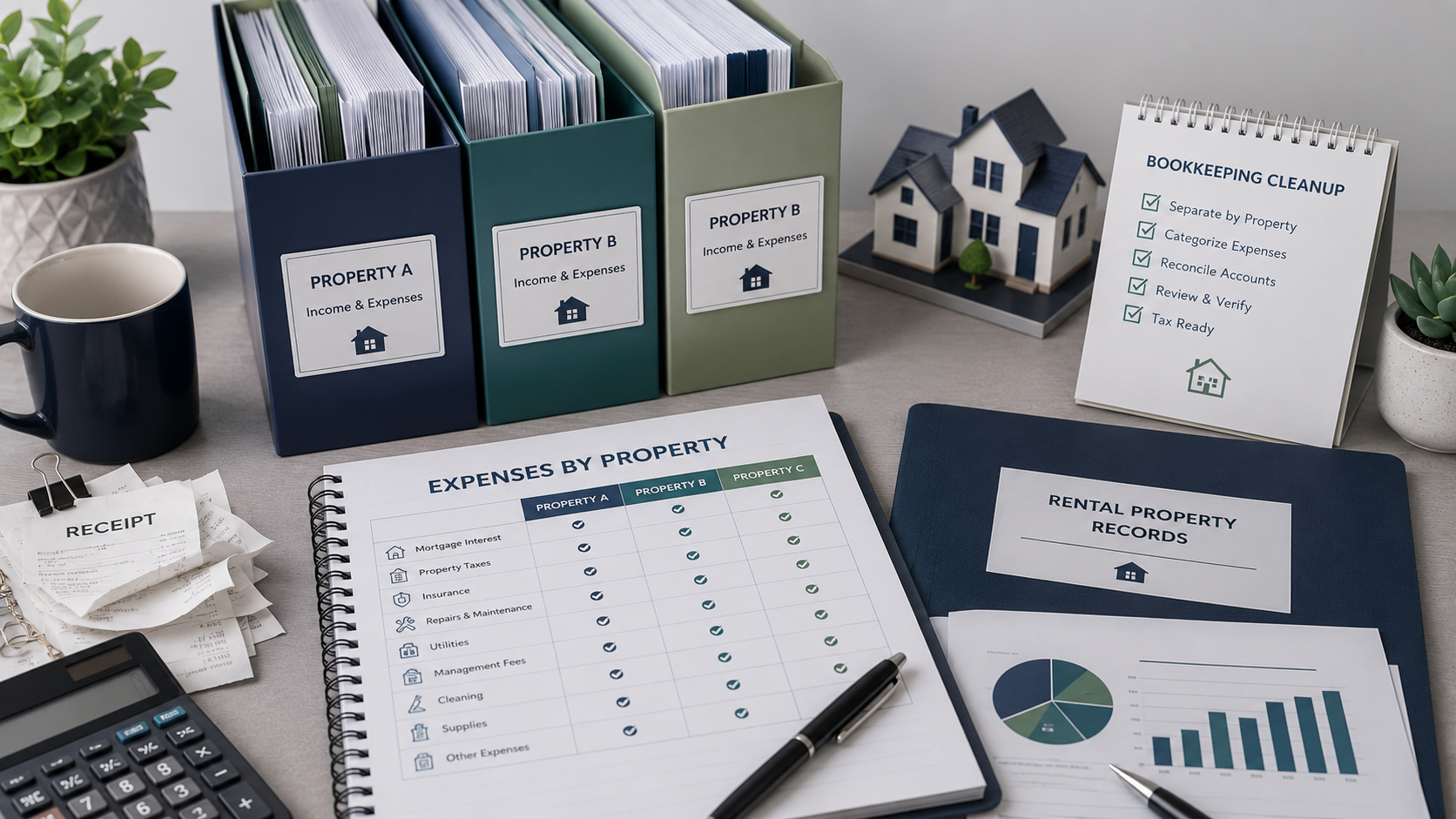
How to Separate Rental Property Expenses by Property Before Tax Time
If you own more than one rental property, one of the most helpful things you can do before tax time is separate income, expenses, mortgage payments, repairs, improvements, and owner transfers by property. Clean property-level records can make Schedule E reporting, depreciation review, and bookkeeping cleanup much easier.
Quick Summary
Rental property owners should separate expenses by property before tax time so each rental has clear income, expenses, mortgage interest, property taxes, insurance, repairs, improvements, depreciation records, and supporting documents.
This is especially important if you own multiple rentals, use one bank account for several properties, have property manager statements, receive Airbnb or short-term rental payouts, or have large repairs and improvements that need review.
Why Separating Rental Expenses by Property Matters
When rental expenses are mixed together, it becomes harder to prepare an accurate tax return, review profitability, reconcile income, and identify tax planning opportunities. If one property had a roof repair, another had new furniture, and another had vacancy expenses, those details should not be buried in one combined total.
Property-level tracking helps your tax professional see the real activity for each rental. It also helps you review whether each property has its own income, mortgage interest, property taxes, insurance, repairs, improvements, depreciation, and bookkeeping support.
Small Business Accounting Inc. helps landlords, Airbnb owners, short-term rental owners, and real estate investors with rental bookkeeping cleanup, rental tax preparation, depreciation review, and real estate tax planning support.
Use the Rental Property Tax Savings Checklist Before Tax Time
Before you organize every receipt, use the free checklist to review bookkeeping red flags, missing documents, depreciation issues, repairs versus improvements, and rental tax savings opportunities.
How to Set Up Rental Expense Tracking by Property
The goal is to create a system where each transaction can be tied to the correct rental property. This does not need to be overly complicated, but it does need to be consistent.
1. Create a Property List
Start with a simple list of every rental property you own. Include the property nickname, address, ownership type, rental type, and whether it is a long-term rental, Airbnb, short-term rental, mixed-use property, or commercial property.
2. Assign Every Income and Expense to a Property
Each rental income deposit, repair bill, utility payment, cleaning fee, insurance premium, property tax payment, mortgage interest amount, and supply purchase should be assigned to the property it belongs to.
3. Use Separate Classes, Tags, Locations, or Property Columns
Depending on your bookkeeping system, you may be able to use classes, tags, locations, projects, properties, or a spreadsheet column to separate each property. The exact tool matters less than the consistency of the system.
4. Keep Shared Expenses Separate
Some costs may apply to multiple properties, such as software, professional fees, mileage, bookkeeping, or portfolio-level expenses. Track these separately and document how they were allocated if you split them across properties.
5. Reconcile Each Property Before Tax Preparation
Before sending your tax records to a preparer, review each property for missing income, uncategorized expenses, duplicate transactions, owner transfers, loan payments, and large repair or improvement costs.
Rental Expense Categories to Separate by Property
A clean rental bookkeeping system should help you see the major expense categories for each property. This makes it easier to prepare tax returns, review performance, and spot unusual activity.
| Category | Why It Matters | Helpful Records |
|---|---|---|
| Rental Income | Helps reconcile rent, platform payouts, property manager deposits, and direct payments. | Rent roll, bank deposits, platform reports |
| Mortgage Interest | Should be separated from loan principal and escrow activity. | Form 1098, lender statements |
| Property Taxes | May be paid directly or through escrow and should be tied to the correct property. | Tax bills, escrow statements |
| Insurance | Policies may cover one property or multiple properties and may need allocation. | Insurance invoices, policy details |
| Repairs and Maintenance | Routine repair costs should be tracked separately from improvements and renovations. | Receipts, invoices, project notes |
| Utilities | Utilities may vary by property, vacancy, tenant terms, or short-term rental use. | Utility bills, account statements |
| Cleaning and Turnover | Important for Airbnb and short-term rentals with frequent guest turnover. | Cleaner invoices, platform reports |
| Management Fees | Property manager fees should be matched to property manager statements. | Owner statements, fee reports |
| Supplies and Furnishings | May need review as supplies, furniture, appliances, equipment, or depreciable assets. | Receipts, asset lists, photos |
| Legal and Professional Fees | May apply to a specific property or the full rental portfolio. | Invoices, allocation notes |
Mortgage Payments Need Special Attention
A mortgage payment is often made as one monthly payment, but it may include several different pieces. Part may be interest, part may reduce loan principal, and part may go to escrow for property taxes or insurance.
For tax and bookkeeping purposes, the full mortgage payment should not simply be entered as mortgage interest or as a rental expense. Loan principal generally reduces the loan balance, while interest, property taxes, and insurance may need separate review.
Break Out These Pieces
- Mortgage interest
- Loan principal
- Escrow deposits
- Property tax payments
- Insurance payments
- Loan fees, if applicable
Helpful Documents
- Form 1098
- Monthly lender statements
- Year-end mortgage statement
- Escrow analysis statement
- Property tax bills
- Insurance invoices
Need Help Cleaning Up Rental Books Before Tax Time?
Small Business Accounting Inc. helps rental property owners separate income and expenses by property, clean up bank feeds, reconcile property manager statements, review mortgage splits, and prepare tax-ready rental records.
View Rental Bookkeeping Cleanup Contact Small Business Accounting Inc.
Separate Repairs, Improvements, and Assets by Property
Repairs and improvements should not be mixed together without review. A small plumbing repair may be different from a full bathroom remodel. Replacing one appliance may be different from renovating the kitchen. Buying furniture for a short-term rental may need different treatment than buying ordinary supplies.
When these items are separated by property, it becomes easier to review depreciation, cost segregation readiness, repairs versus improvements, and tax preparation support.
Repairs
Track routine maintenance and repair expenses by property with receipts, vendor names, descriptions, and payment records.
Improvements
Track larger projects with invoices, project descriptions, photos, placed-in-service dates, and property assignment.
Assets
Track appliances, furniture, equipment, and short-term rental setup items separately when practical.
If you made large improvements or purchased major assets, you may also want to review the Real Estate Depreciation Tax Savings Review.
Common Rental Bookkeeping Mistakes That Make Tax Time Harder
Most rental bookkeeping problems are fixable, but they take more time to correct when they are not identified until tax preparation begins.
Income and Transfer Mistakes
- Owner contributions recorded as rental income
- Owner draws recorded as rental expenses
- Transfers counted twice
- Property manager deposits not reconciled
- Airbnb or STR payouts recorded only as net bank deposits
- Security deposits treated incorrectly
Expense and Balance Sheet Mistakes
- Mortgage principal deducted as an expense
- Repairs and improvements mixed together
- Furniture and appliances buried in supplies
- Expenses assigned to the wrong property
- Uncategorized transactions left unresolved
- Loan balances or asset accounts that do not make sense
How Airbnb and Short-Term Rental Owners Should Separate Expenses
Short-term rentals often require more detailed tracking than traditional long-term rentals. Platform payouts, cleaning fees, supplies, guest amenities, furniture, local taxes, refunds, and co-host payments can make the books harder to review if everything is grouped together.
STR owners should track each property separately and keep supporting reports for gross bookings, platform fees, refunds, cleaning fees, local taxes, payouts, and direct booking income.
STR Income Records
- Platform reports
- 1099-K forms, if received
- Gross booking reports
- Payout reports
- Refund and cancellation records
- Direct booking records
STR Expense Records
- Cleaning invoices
- Guest supplies
- Furniture and appliances
- Repairs and improvements
- Platform fees
- Co-host or management fees
For short-term rental-specific support, visit Airbnb & Short-Term Rental Tax Services.
Rental Property Expense Cleanup Checklist
Use this checklist before sending your rental records for tax preparation or review.
| Cleanup Step | Why It Helps | Priority |
|---|---|---|
| Create a property list | Gives each rental a consistent name for reporting and review. | High |
| Assign every transaction to a property | Helps produce property-level income and expense reports. | High |
| Reconcile bank accounts | Helps catch missing, duplicate, or miscategorized transactions. | High |
| Split mortgage payments | Prevents loan principal from being deducted as an expense. | High |
| Reconcile property manager statements | Helps match income, fees, repairs, reserves, and owner payouts. | High |
| Separate repairs from improvements | Supports depreciation and tax treatment review. | Medium |
| Review owner transfers | Helps prevent contributions, draws, and transfers from being reported incorrectly. | Medium |
| Attach receipts or save support | Helps document expenses, assets, repairs, and improvements. | Medium |
| Run a profit and loss by property | Shows whether each property is ready for tax preparation. | High |
When to Request Professional Bookkeeping Cleanup
Consider requesting help if you cannot produce a clear profit and loss report by property, have large uncategorized expenses, use one bank account for multiple rentals, have property manager statements that do not match your books, or are unsure whether mortgage payments, repairs, improvements, and owner transfers were recorded correctly.
Professional cleanup does not guarantee tax savings, but it can help make your records clearer, more complete, and easier to use for tax preparation and planning.
Helpful Service Pages for Rental Property Owners
Depending on what your books show, one of these service areas may be the best next step:
Rental Bookkeeping Cleanup
For messy books, property-level expense tracking, bank feed cleanup, reconciliation issues, and tax-ready records.
Rental Tax Preparation
For annual rental tax preparation involving Schedule E, rental expenses, depreciation, and property-level reporting.
Tax Savings Review
For depreciation, repairs, improvements, cost segregation readiness, and rental property tax red flag review.
Airbnb & STR Tax Services
For short-term rental income, 1099-K reporting, platform payouts, guest fees, and STR tax questions.
Real Estate Tax & Accounting
For broader tax and accounting support for landlords, real estate investors, STR owners, and property owners.
Free Checklist
Use the checklist to review bookkeeping red flags, depreciation issues, repairs, improvements, and missing documents.
Frequently Asked Questions
Why should rental expenses be separated by property?
Separating rental expenses by property helps support Schedule E reporting, property-level profitability review, depreciation tracking, bookkeeping cleanup, and tax preparation. It also helps prevent expenses from being assigned to the wrong rental.
What if I use one bank account for multiple rentals?
You can still separate expenses by property, but you need a consistent tracking system. Each transaction should be tagged, classed, coded, or otherwise assigned to the correct rental property. If the records are already mixed together, bookkeeping cleanup may be needed.
Should mortgage payments be entered as rental expenses?
The full mortgage payment should not usually be entered as one rental expense. The payment may include loan principal, mortgage interest, escrow deposits, property taxes, and insurance. These pieces should be separated and reviewed.
How should repairs and improvements be tracked?
Repairs and improvements should be tracked by property with receipts, invoices, project descriptions, vendor names, payment records, and placed-in-service dates when applicable. Larger projects may need tax treatment and depreciation review.
Do Airbnb owners need to separate expenses by property?
Yes, especially if the owner has more than one short-term rental or uses multiple platforms. Airbnb and STR owners should separate platform payouts, cleaning fees, supplies, furniture, repairs, improvements, and local tax records by property.
Can Small Business Accounting Inc. help clean up rental bookkeeping?
Yes. Small Business Accounting Inc. helps landlords, Airbnb owners, short-term rental owners, and real estate investors clean up rental books, reconcile records, separate expenses by property, and prepare tax-ready bookkeeping reports.
Ready to Separate Rental Expenses by Property?
If your rental records are mixed together, missing property-level tracking, or not ready for tax preparation, Small Business Accounting Inc. can help review the cleanup needed before filing or planning.
Contact Small Business Accounting Inc. Download the Free Checklist
Disclaimer: This article is for general educational purposes only and does not provide legal, tax, accounting, investment, or engineering advice. Reading this article or contacting the firm does not create a client relationship. Tax results depend on each client’s facts and circumstances.