Nonprofit Bookkeeping Mistakes That Can Create Form 990 Problems
For many nonprofit leaders, Form 990 feels like a once-a-year filing task. But the quality of the Form 990 often depends on bookkeeping decisions made throughout the year.
If donations are not categorized clearly, restricted funds are not tracked, grant expenses are mixed with general expenses, or board reports do not match the books, Form 990 preparation can become stressful very quickly. Even if your organization has good intentions and careful volunteers, messy bookkeeping can make it harder to explain revenue, expenses, programs, and governance in a clear and accurate way.
This is especially important because Form 990 is more than a tax filing. Donors, grantors, board members, lenders, journalists, and the public may review it. A clean Form 990 starts with clean nonprofit books.
If your nonprofit is preparing for year-end or wants to review its records before filing, you can download the free nonprofit bookkeeping checklist to help identify common gaps before they become bigger problems.
Why Bookkeeping Mistakes Matter for Form 990
Form 990 preparation relies on more than a profit and loss report. It may require clear information about revenue sources, functional expenses, program service activity, grants, compensation, fundraising, governance, related-party activity, and balance sheet items.
When the books are not organized, the return preparer may need to spend extra time cleaning up categories, asking follow-up questions, reconciling bank activity, reviewing donor records, and identifying what belongs where. That can delay the filing process and increase the risk of incomplete or inconsistent reporting.
For calendar-year organizations, Form 990-series returns are generally due on the 15th day of the 5th month after the year ends, but deadlines can vary depending on the organization’s tax year and filing facts. Some organizations may also request an extension using Form 8868 when eligible. Because rules, forms, thresholds, and penalties can change, nonprofit leaders should confirm current requirements before relying on any general deadline discussion.
Common Nonprofit Bookkeeping Mistakes That Can Create Form 990 Problems
1. Mixing Restricted and Unrestricted Funds
One of the biggest nonprofit bookkeeping mistakes is treating all money the same. Donations, grants, and other support may come with restrictions. Some funds may be restricted for a specific program, scholarship, building project, mission activity, or time period.
If restricted and unrestricted funds are not tracked separately, your organization may struggle to answer basic questions such as:
- How much restricted funding remains unused?
- Which expenses were paid from grant funds?
- Did the organization spend restricted donations according to donor intent?
- Do the board reports match the actual fund balances?
This can create confusion during Form 990 preparation and can also affect board decision-making during the year.
2. Using Too Many Vague Expense Categories
Categories like “miscellaneous,” “general expense,” “program expense,” and “other” may seem convenient during the year, but they create problems later. Form 990 often requires expenses to be reported in a more meaningful way. If the organization has too many vague categories, someone may need to go back through receipts, bank statements, credit card charges, and vendor names to determine what actually happened.
Better bookkeeping uses clear, consistent categories. For example, a nonprofit may need separate categories for program supplies, office expenses, professional fees, fundraising costs, occupancy, insurance, software, payroll, contractor payments, travel, and grant-specific costs.
3. Not Separating Program, Management, and Fundraising Expenses
Many nonprofit leaders look at total expenses, but Form 990 reporting may require expenses to be presented by function. That usually means separating program service expenses, management and general expenses, and fundraising expenses.
If bookkeeping does not capture this information during the year, the organization may have to estimate or reconstruct the allocation later. That is not ideal. A better system tracks functional expense activity as part of regular bookkeeping, especially for nonprofits with multiple programs, fundraising campaigns, or grant-funded activities.
4. Poor Donation and Revenue Tracking
Nonprofit revenue can come from many sources: individual donations, grants, fundraising events, membership dues, program service fees, sponsorships, in-kind support, investment income, and other activities. If all revenue is posted into one general income account, Form 990 preparation becomes harder.
Revenue should be tracked in a way that helps the organization understand where support came from and whether the funds have restrictions. This is also useful for board reports, donor stewardship, grant reporting, and cash flow planning.
5. Ignoring In-Kind Contributions
Some nonprofits receive donated goods, supplies, professional services, auction items, or use of facilities. These in-kind contributions may need special review. Not every donated service is recorded the same way, and some items may require additional documentation.
When in-kind contributions are not tracked properly, the organization may understate activity, miss important disclosures, or create inconsistencies between fundraising records, donor acknowledgments, and financial reports.
6. Not Reconciling Bank and Credit Card Accounts Monthly
Monthly reconciliation is one of the simplest ways to prevent year-end problems. If bank accounts, credit cards, PayPal, Stripe, donor platforms, and other accounts are not reconciled, the books may include duplicate income, missing expenses, old uncleared transactions, or incorrect balances.
Unreconciled books make Form 990 preparation less reliable. They also make it harder for the board to trust financial reports during the year.
7. Forgetting About Balance Sheet Accounts
Many nonprofit bookkeeping systems focus heavily on the profit and loss report. But the balance sheet matters too. Form 990 may require information about cash, receivables, prepaid expenses, fixed assets, accounts payable, loans, restricted net assets, and other balances.
If balance sheet accounts are ignored all year, year-end cleanup can take much longer. Old balances may need to be investigated, loans may need to be reconciled, and fixed assets may need to be reviewed for additions, disposals, or depreciation.
8. Recording Grant Activity Without Enough Detail
Grant-funded organizations need strong tracking. A grant may require the organization to show how funds were spent, which expenses were allowable, whether matching funds were required, and whether the grant period was followed.
If grant income and expenses are not tracked by grant, project, program, or class, the organization may have difficulty preparing grant reports and Form 990 support schedules. This can be especially challenging when one expense benefits multiple programs or grants.
9. Waiting Until Year-End to Clean Up QuickBooks
QuickBooks Online can be a useful tool for nonprofits, but it still needs thoughtful setup and maintenance. Common QuickBooks problems include duplicate bank feed transactions, expenses posted to the wrong category, old undeposited funds, incorrect opening balances, personal charges mixed with nonprofit expenses, and unclear class or project tracking.
Waiting until the Form 990 deadline to clean up QuickBooks can create unnecessary pressure. A midyear or quarterly review is usually much easier than a rushed year-end cleanup.
Red Flags That Your Books May Not Be Form 990 Ready
Your nonprofit may need bookkeeping cleanup before Form 990 preparation if any of these red flags apply:
- The bank accounts have not been reconciled every month.
- The balance sheet includes old or unexplained balances.
- Restricted funds are not tracked separately.
- Grant income and grant expenses are not connected clearly.
- Board reports do not match the QuickBooks reports.
- Many expenses are categorized as “miscellaneous” or “uncategorized.”
- Fundraising event income and expenses are mixed with general activity.
- Credit card transactions are missing receipts or descriptions.
- Payroll, contractor payments, or reimbursements are not clearly documented.
- The organization is behind on bookkeeping and the filing deadline is approaching.
If several of these apply, it may be time to review your books before the Form 990 process begins. Small Business Accounting Inc. provides nonprofit bookkeeping support for organizations that need cleaner books, better reports, and more organized year-end records.
A Practical Checklist to Help Prevent Form 990 Bookkeeping Problems
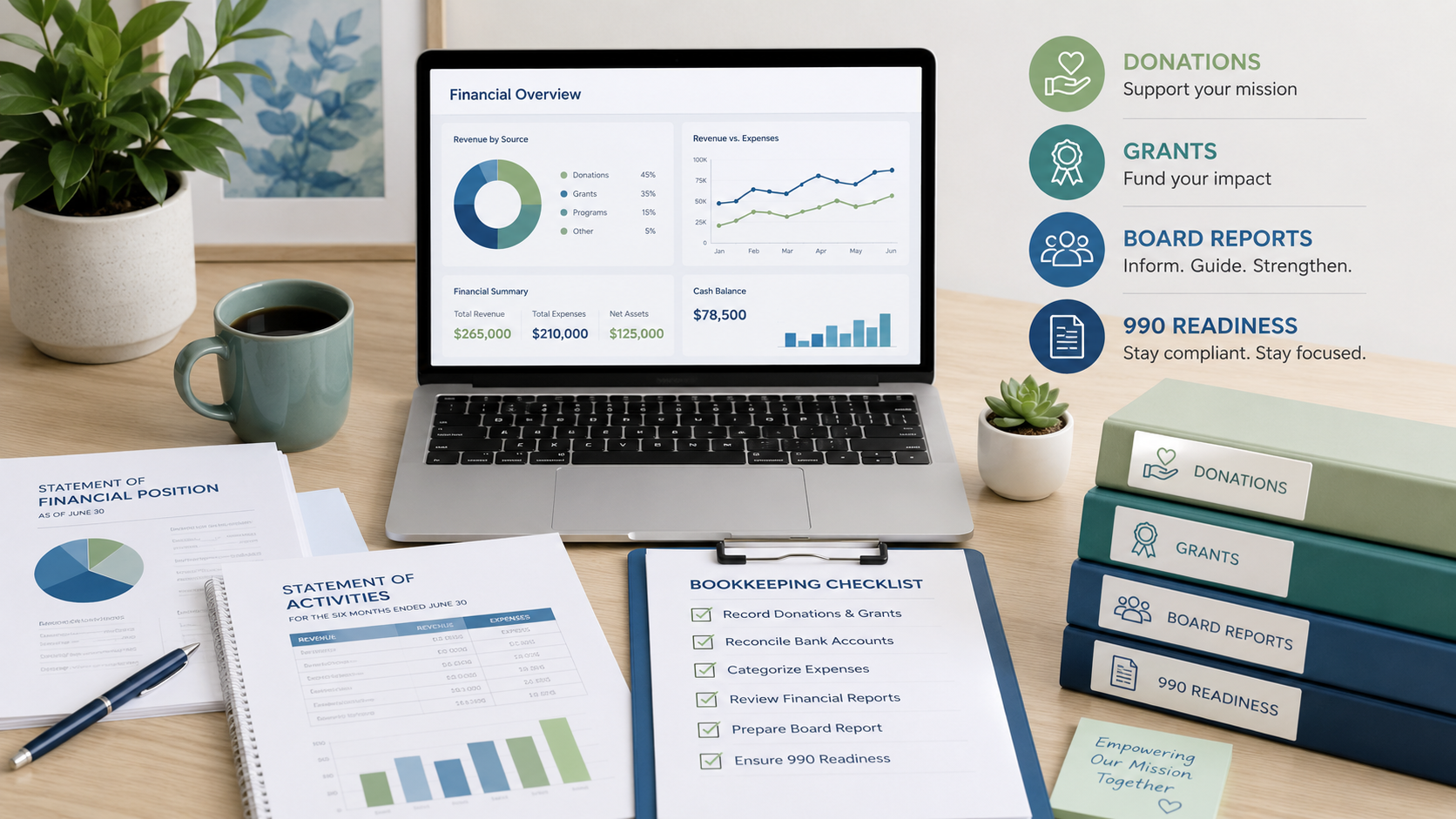
Nonprofit bookkeeping does not need to be complicated, but it does need to be consistent. Use this practical checklist to improve Form 990 readiness throughout the year.
Monthly Bookkeeping Review
- Reconcile all bank and credit card accounts.
- Review uncategorized income and expenses.
- Check donor deposits against donor platform reports.
- Review grant-related expenses for proper tracking.
- Confirm restricted fund activity is separated from unrestricted activity.
- Attach or store receipts, invoices, reimbursement forms, and approval notes.
Quarterly Board Reporting Review
- Prepare a profit and loss report by program or class when useful.
- Review the balance sheet for unusual or unexplained balances.
- Compare actual activity to the budget.
- Review cash flow and upcoming obligations.
- Discuss restricted funds and grant balances with the board or finance committee.
Year-End Form 990 Readiness Review
- Confirm that all accounts are reconciled through year-end.
- Review revenue categories for donations, grants, program income, events, and other support.
- Review expense categories for accuracy and consistency.
- Identify large or unusual transactions that may need explanation.
- Gather board minutes, officer information, compensation details, and governance updates.
- Review whether the organization may need Form 990, Form 990-EZ, Form 990-N, Form 990-PF, Form 8868, or other filings based on its facts.
For a more organized self-review, you can get the free Form 990 bookkeeping checklist before starting year-end cleanup.
How Better Bookkeeping Supports Better Board Reports
Good bookkeeping is not only for tax filing. It also helps the board make better decisions. Board members need clear financial reports that show whether the organization has enough cash, whether programs are financially sustainable, whether restricted funds are being used properly, and whether the organization is staying on budget.
Clean books can support reports such as:
- Statement of activity or profit and loss report
- Statement of financial position or balance sheet
- Budget versus actual report
- Grant tracking report
- Restricted fund report
- Cash flow summary
- Program or class-based financial report
These reports can help the board see financial issues earlier instead of discovering them during Form 990 preparation. Unless otherwise agreed, board financial reports prepared for management and board use are internal reports and are not CPA audits, reviews, or compilations.
When to Get Professional Help
Some bookkeeping issues can be handled internally with a careful checklist and monthly review process. But some situations are more complex and may require outside support.
Your nonprofit should consider getting professional help if:
- Your books are behind by several months or more.
- Your Form 990 deadline is approaching and the records are not ready.
- You have restricted donations or multiple grant-funded programs.
- Your QuickBooks Online file has duplicate transactions or incorrect balances.
- The board needs clearer financial reports.
- Your prior Form 990 does not appear to match your books.
- You changed treasurers, bookkeepers, or executive directors during the year.
- You are unsure whether income or expenses are being classified correctly.
Professional support can help your nonprofit clean up the books, organize documentation, improve QuickBooks reporting, and prepare better information for Form 990. If your organization needs help soon, you can contact Small Business Accounting Inc. to request support.
How Small Business Accounting Inc. Helps Nonprofits
Small Business Accounting Inc. helps nonprofits with practical bookkeeping, cleanup, reporting, and Form 990 preparation support. The goal is to make the financial records clearer, more organized, and easier for leadership to understand.
Support may include:
- QuickBooks Online cleanup and organization
- Monthly or catch-up bookkeeping
- Restricted fund tracking
- Grant income and expense tracking
- Board financial report preparation for internal use
- Year-end bookkeeping review
- Form 990 preparation support
- Coordination of records needed for nonprofit compliance
Remote support is available nationwide. Hawaii and Oahu clients may request local appointment availability when appropriate. To learn more about service scope, visit the Form 990 and board reporting support page.
Frequently Asked Questions
Can bookkeeping mistakes affect Form 990?
Yes. Form 990 depends on accurate revenue, expense, balance sheet, governance, and program information. If the books are incomplete or poorly categorized, Form 990 preparation may take longer and may require cleanup before filing.
What bookkeeping reports are helpful before preparing Form 990?
Helpful reports may include a reconciled profit and loss report, balance sheet, general ledger, donation detail, grant tracking report, restricted fund report, payroll reports, contractor payment records, and board-approved financial statements for internal review.
Do small nonprofits still need organized books if they file Form 990-N?
Yes. Even if a smaller organization is eligible for Form 990-N, it should still maintain accurate records. Good bookkeeping supports board oversight, donor confidence, grant applications, and future filing requirements if the organization grows.
How often should a nonprofit review its QuickBooks file?
At a minimum, nonprofits should review and reconcile QuickBooks monthly. A quarterly review can also help catch classification issues, restricted fund problems, and grant tracking gaps before year-end.
When should a nonprofit start preparing for Form 990?
Preparation should begin before year-end, not after the deadline is near. Nonprofits should review reconciliations, revenue categories, expense classifications, restricted funds, grants, and board records early enough to resolve questions before filing.
Need Help Getting Your Nonprofit Books Organized?
Small Business Accounting Inc. helps nonprofits with bookkeeping cleanup, QuickBooks Online organization, board financial reports, grant tracking, restricted fund bookkeeping, and Form 990 support. Remote support is available nationwide. Hawaii and Oahu clients may request local appointment availability when appropriate.
Learn more about nonprofit bookkeeping support:
https://smallbusinessaccountingfirm.com/nonprofit-bookkeeping/
Ready to request help?
https://smallbusinessaccountingfirm.com/contact/
Want to start with a checklist?
https://smallbusinessaccountingfirm.com/nonprofit-bookkeeping-checklist-pdf/
Important note: This article is for general educational purposes only and is not legal advice. Nonprofit filing requirements, deadlines, extensions, penalties, and reporting obligations can vary based on the organization’s tax year, exemption type, activities, revenue, assets, and facts. Board financial reports discussed here are generally intended for internal management and board use unless otherwise agreed, and they are not CPA audit, review, or compilation services.