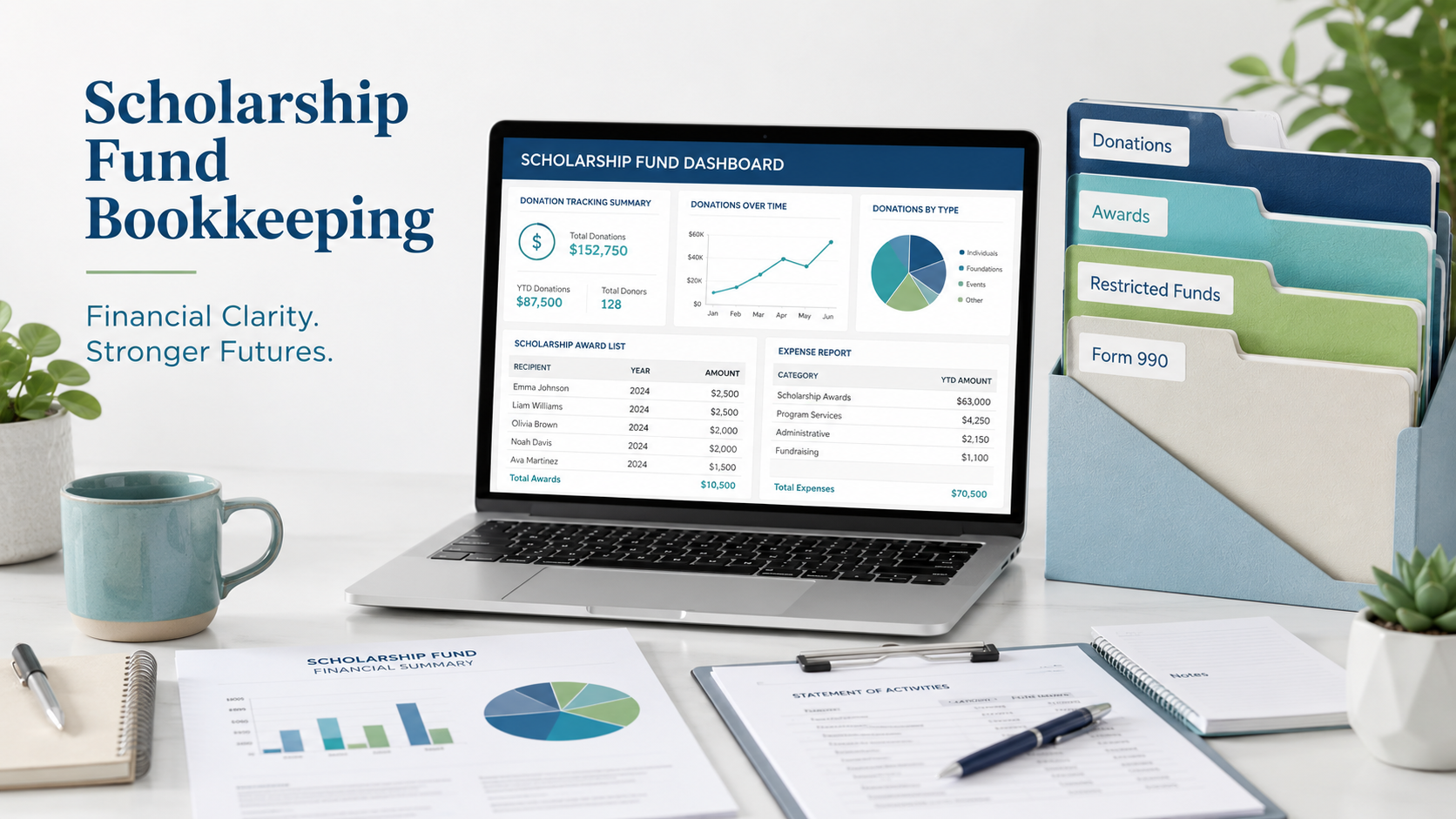
Scholarship Fund Bookkeeping: Tracking Donations, Awards, and Expenses
Scholarship funds are built on trust. Donors want to know their contributions are being used for the intended purpose. Board members want clear records. Students and families need accurate award communication. And the organization needs bookkeeping that can support reporting, planning, and year-end review.
Whether your scholarship fund is part of a nonprofit, foundation, church, school-affiliated organization, community group, or donor-supported program, clean bookkeeping matters. It helps leadership track donations, awards, restricted funds, administrative costs, and available balances without having to rebuild records from scattered spreadsheets and bank statements.
The challenge is that scholarship fund bookkeeping can become messy quickly. Donations may be restricted for a specific scholarship. Awards may be paid directly to schools or, in some cases, to recipients. Expenses may be mixed with general nonprofit costs. Board reports may not show how much is truly available for future awards.
This guide explains how scholarship funds can track donations, awards, and expenses more clearly, what records should be organized, what mistakes to avoid, and when professional bookkeeping support may help.
If your scholarship fund is reviewing records before board reporting, year-end, or filing season, you can download the free nonprofit bookkeeping checklist to help identify bookkeeping areas that may need cleanup.
Why Scholarship Fund Bookkeeping Matters
Scholarship funds often handle money that was given for a very specific purpose. That makes clear recordkeeping especially important.
Good scholarship fund bookkeeping helps your organization:
- Track donations by donor, campaign, or scholarship purpose
- Separate restricted scholarship funds from general operating funds
- Monitor awards approved, awarded, paid, and still pending
- Review scholarship-related expenses
- Prepare clearer reports for the board or scholarship committee
- Support donor communication and stewardship
- Prepare cleaner records for Form 990 support when annual filing applies
- Reduce confusion when leadership, volunteers, or treasurers change
When records are unclear, leadership may not know how much is available for awards, whether restricted funds were used correctly, or whether prior-year balances are still accurate.
Small Business Accounting Inc. provides nonprofit bookkeeping support for scholarship funds and nonprofit organizations that need bookkeeping cleanup, QuickBooks Online organization, board reports, grant tracking, restricted fund bookkeeping, and Form 990 support.
What Should Scholarship Funds Track?
A scholarship fund should be able to follow money from the time it is received to the time it is awarded, paid, and reported.
At a minimum, the organization should track:
- Donation income
- Grant or foundation support
- Restricted scholarship funds
- Board-designated scholarship funds
- Scholarship applications or award approvals
- Scholarship awards payable or paid
- Payments to schools, institutions, or recipients
- Administrative and program expenses
- Fundraising costs, if applicable
- Remaining scholarship fund balances
The goal is not to overcomplicate the books. The goal is to create a clean system that helps the board, treasurer, executive director, or scholarship committee understand what funds were received, what was promised, what was paid, and what remains available.
Scholarship Fund Bookkeeping Checklist
Use the following checklist to organize scholarship fund records and improve reporting.
1. Track Donations by Source and Purpose
Scholarship donations should be recorded clearly so the organization can identify the source and purpose of the funds.
Useful donation details may include:
- Donor name
- Date received
- Payment method
- Donation amount
- Scholarship campaign or fund
- Whether the donation is restricted or unrestricted
- Any donor instructions or purpose restrictions
- Receipt or acknowledgment status
If donations are restricted for a specific scholarship, memorial fund, school, student category, or award purpose, those restrictions should be tracked separately from general funds.
2. Separate Restricted Scholarship Funds
Many scholarship funds receive restricted donations. For example, a donor may give money only for nursing students, local high school graduates, first-generation college students, or a named memorial scholarship.
The organization should be able to show:
- Beginning balance by scholarship fund
- New donations received
- Awards approved
- Awards paid
- Expenses charged to the fund, if allowed
- Ending available balance
Clear grant tracking and restricted fund bookkeeping helps prevent scholarship money from being mixed with general operating cash.
3. Maintain an Award Approval Record
Scholarship bookkeeping should connect to the award approval process. The finance records should show not only that a payment was made, but that the award was approved properly.
Useful award records may include:
- Student or recipient name
- Scholarship fund or award name
- Award amount
- Award approval date
- Committee or board approval record
- School or institution name
- Payment instructions
- Payment status
- Any conditions or documentation requirements
For privacy and security, scholarship funds should also think carefully about where sensitive student information is stored and who has access to it.
4. Track Award Payments Carefully
Scholarship awards may be paid directly to an educational institution or handled according to the scholarship fund’s procedures. The payment method and recipient should be documented clearly.
For each payment, keep records showing:
- Date paid
- Amount paid
- Recipient or institution paid
- Scholarship fund charged
- Check number, ACH record, or payment confirmation
- Invoice, award letter, or payment request
- Approval support
Scholarship payment records help leadership reconcile awards approved to awards actually paid. They also help the board understand whether funds are still committed but unpaid.
5. Review Administrative and Program Expenses
Scholarship funds may have expenses beyond award payments. These costs should be tracked clearly so the board can understand how much of the fund is used for scholarships versus administration, fundraising, or program operations.
Common expenses may include:
- Application platform or software costs
- Printing, mailing, or outreach expenses
- Professional fees
- Bank or merchant fees
- Fundraising event costs
- Website or technology costs
- Scholarship review meeting expenses
- Bookkeeping or administrative support
Some restricted funds may limit whether administrative expenses can be charged to the fund. The organization should review donor restrictions, grant terms, board policies, and other governing documents before allocating expenses.
6. Reconcile Bank and Investment Accounts
Scholarship funds may hold money in checking accounts, savings accounts, investment accounts, or restricted fund accounts. These accounts should be reconciled regularly.
Reconciliations help confirm that:
- Deposits were recorded correctly
- Award payments cleared the bank
- Transfers were not recorded as income or expenses
- Fees and interest were recorded
- Investment activity was reviewed, if applicable
- Cash balances agree with statements
Unreconciled accounts can make scholarship fund balances unreliable and may cause board reports to change after decisions have already been made.
7. Prepare Board-Ready Scholarship Fund Reports
The board or scholarship committee should receive reports that are clear enough to support decisions.
A useful scholarship fund report may include:
- Beginning fund balance
- Donations received
- Investment or interest income, if applicable
- Awards approved
- Awards paid
- Awards committed but not yet paid
- Administrative expenses
- Ending available balance
- Notes about restrictions or upcoming award cycles
Board financial reports are generally for internal management and board use unless otherwise agreed. They are not the same as CPA audit, review, or compilation reports.
For a broader self-review before reporting or filing season, you can use our free nonprofit bookkeeping checklist to identify records that may need cleanup.
QuickBooks Tips for Scholarship Fund Bookkeeping
QuickBooks can support scholarship fund bookkeeping, but the setup must match the organization’s reporting needs. A regular business setup may not provide enough visibility for restricted scholarship funds, award tracking, or board reporting.
Depending on the organization, QuickBooks may need:
- Separate income categories for donations, grants, and investment income
- Expense categories for scholarship awards and administrative costs
- Tracking by class, project, customer, location, tag, or fund
- Clear restricted fund or net asset reporting
- Vendor or payee records for schools or institutions
- Reports for scholarship funds, award cycles, or programs
- Monthly bank reconciliations
A nonprofit QuickBooks cleanup and reporting support process can help organize categories, clean up balances, improve fund tracking, and create reports that are easier for leadership to review.
Common Scholarship Fund Bookkeeping Mistakes
Scholarship funds often become messy because the records are spread across donation platforms, spreadsheets, bank statements, committee notes, and QuickBooks reports.
Mixing Restricted Funds With General Funds
If restricted scholarship donations are not tracked separately, leadership may not know how much is available for each purpose.
Tracking Awards Only in Spreadsheets
Spreadsheets can be useful, but they should agree with the bookkeeping records. If the award spreadsheet and QuickBooks do not match, the organization may not know which report is correct.
Not Tracking Awards Approved but Not Paid
An award may be approved before it is paid. The board should know which amounts are committed, even if the payment has not cleared the bank yet.
Ignoring Administrative Expenses
Scholarship funds should understand the cost of running the program, including application tools, outreach, bank fees, fundraising, and bookkeeping support.
Waiting Until Year-End to Review Records
Scholarship fund records are easier to clean up monthly or quarterly than at the end of the year. Waiting too long can make missing information harder to find.
Scholarship Tax and Compliance Considerations
Scholarship tax and compliance rules can depend on the recipient, the organization, the payment purpose, and the scholarship fund’s structure.
The IRS explains that scholarships, fellowship grants, and other grants may be tax-free to recipients only when specific conditions are met. For example, the recipient generally must be a candidate for a degree at an eligible educational institution, and the funds must be used for qualified education expenses.
For certain private foundations, IRS guidance on grants to individuals may involve additional requirements, including objective and nondiscriminatory procedures approved in advance by the IRS. Not every scholarship fund has the same requirements, so organizations should not assume one rule applies to every structure.
You can review IRS information about scholarships, fellowship grants, and other grants, tax benefits for education, and grants to individuals.
This article is for general educational purposes and is not legal advice. Scholarship funds should work with qualified tax and legal professionals when reviewing scholarship procedures, recipient tax treatment, private foundation rules, donor restrictions, and filing requirements.
How Scholarship Fund Records Support Form 990 Readiness
Scholarship fund bookkeeping can also support annual filing preparation when the organization has a filing requirement.
The IRS provides annual filing guidance for exempt organizations, and requirements can vary depending on the organization’s facts, gross receipts, assets, tax year, exempt status, and return type. In general, Form 990, Form 990-EZ, or Form 990-PF is due by the 15th day of the 5th month after the organization’s accounting period ends, and Form 8868 may be used to request an automatic extension for many exempt organization returns when filed properly and timely.
The IRS also notes that organizations that fail to file required annual returns or notices for three consecutive years can automatically lose tax-exempt status.
You can review IRS information about annual exempt organization return due dates, extensions of time to file exempt organization returns, and automatic revocation of exemption.
Clean scholarship fund records can make Form 990 and board reporting support more efficient because donations, awards, expenses, restrictions, and available balances are easier to review.
Red Flags Your Scholarship Fund Books Need Cleanup
Your scholarship fund may need bookkeeping cleanup if any of these issues sound familiar:
- Donation records do not match bank deposits
- Restricted scholarship funds are unclear
- Award approvals are tracked separately from payments
- Scholarship awards paid do not match the award list
- QuickBooks reports do not show balances by scholarship fund
- Administrative expenses are not tracked clearly
- Bank or investment accounts are not reconciled regularly
- Board reports are difficult to explain
- Form 990 preparation is stressful because records are incomplete
- Leadership does not know how much is available for the next award cycle
These issues are common, especially when scholarship programs grow or when bookkeeping has been handled by several volunteers over time. The important thing is to clean up the process before the next award cycle or filing deadline.
When to Get Professional Help
Some scholarship funds can manage bookkeeping internally when activity is simple and records are current. But outside support may be helpful when donations, awards, restricted funds, QuickBooks reports, and board reporting are becoming difficult to manage.
Consider professional help if:
- Multiple scholarship funds or restrictions need tracking
- QuickBooks is not set up for fund reporting
- Donation records, award records, and bank records do not agree
- Scholarship awards are approved in one system and paid from another
- The board needs clearer reports before approving new awards
- Year-end filing support is becoming stressful
- The treasurer, bookkeeper, or scholarship administrator has changed
- The organization wants a better process before the next award cycle
If your scholarship fund records are messy or leadership needs clearer reports, you can request nonprofit bookkeeping support from Small Business Accounting Inc.
FAQ: Scholarship Fund Bookkeeping
1. What records should a scholarship fund keep?
A scholarship fund should keep donation records, donor restrictions, award approvals, payment records, recipient or institution payment details, expense records, bank statements, reconciliations, and board reports.
2. How should restricted scholarship donations be tracked?
Restricted scholarship donations should be tracked by fund or purpose. Reports should show beginning balance, donations received, awards approved, awards paid, expenses charged, and remaining available balance.
3. Can QuickBooks be used for scholarship fund bookkeeping?
Yes. QuickBooks can be used for scholarship fund bookkeeping, but it should be set up carefully to track donations, awards, restricted funds, expenses, and board reports clearly.
4. Are scholarship awards taxable to recipients?
Scholarship tax treatment depends on the facts. IRS guidance explains that scholarships may be tax-free only when specific requirements are met, including qualified education expense rules. Recipients and organizations should review current IRS guidance and seek professional advice when needed.
5. When should a scholarship fund get bookkeeping help?
A scholarship fund should consider help when restricted balances are unclear, awards do not match payments, QuickBooks reports are confusing, bank accounts are not reconciled, or the board needs cleaner reports before approving awards.
Need Help Getting Your Nonprofit Books Organized?
Small Business Accounting Inc. helps nonprofits with bookkeeping cleanup, QuickBooks Online organization, board financial reports, grant tracking, restricted fund bookkeeping, and Form 990 support.
Remote support is available nationwide. Hawaii and Oahu clients may request local appointment availability when appropriate.
Learn more about nonprofit bookkeeping support: https://smallbusinessaccountingfirm.com/nonprofit-bookkeeping/
Ready to request help? https://smallbusinessaccountingfirm.com/contact/
Want to start with a checklist? https://smallbusinessaccountingfirm.com/nonprofit-bookkeeping-checklist-pdf/