Nonprofit Bookkeeping for Foundations: What Records Matter Most
Foundation bookkeeping needs more detail than basic income and expense tracking. Whether your organization is a private foundation, family foundation, scholarship foundation, grantmaking foundation, or small community-focused foundation, the records behind the numbers matter.
Foundation leaders often need to track grants, investment income, charitable distributions, board approvals, restricted funds, administrative expenses, contractor payments, and year-end filing support. If the records are scattered across bank statements, brokerage portals, emails, spreadsheets, and board minutes, year-end reporting can quickly become stressful.
This guide explains the foundation bookkeeping records that matter most and how a better monthly process can support clearer board reports, grant tracking, Form 990-PF or Form 990 support, and year-end readiness.
If your foundation is reviewing its records before year-end, you can download the free nonprofit bookkeeping checklist as a helpful starting point.
Why Foundation Bookkeeping Needs More Detail
Foundations often have fewer transactions than operating charities, but those transactions may require more careful tracking. A foundation may receive investment income, approve grants, make distributions, reimburse board or staff expenses, pay professional fees, and review investment activity. Each item needs to be recorded in a way that supports board oversight and annual filing support.
For private foundations, recordkeeping is especially important because Form 990-PF may involve investment income, charitable distributions, grant activity, excise tax-related items, and foundation-specific compliance questions. Public charities and other nonprofit foundations may have different filing requirements, but they still need organized books and support documents.
Good foundation bookkeeping helps answer practical questions such as:
- How much investment income did the foundation receive?
- Which grants were approved, paid, or still outstanding?
- Were grant payments supported by board approval and recipient information?
- Which expenses were administrative, investment-related, program-related, or grant-related?
- Do bank and investment statements match QuickBooks Online or the bookkeeping records?
- Are board reports clear enough for decision-making?
- Are records organized for Form 990-PF or Form 990 support?
Start With the Foundation’s Filing Type
Before building a recordkeeping system, confirm what type of foundation you have and what annual filing support may be needed. A private foundation generally has different reporting needs from a public charity, community foundation, or supporting organization.
Many private foundations file Form 990-PF rather than Form 990 or Form 990-EZ. Form 990-PF can require more detailed support for investment income, assets, grantmaking, charitable distributions, and certain foundation compliance issues. Other nonprofit foundations may use a different Form 990-series filing depending on their facts.
Because the filing type affects the records needed, do not wait until filing season to confirm the foundation’s filing pattern. Review prior-year filings, IRS determination records, exemption classification, and tax year before year-end.
Compliance note: This article provides general educational information and is not legal or tax advice for any specific foundation. Filing requirements can vary based on the foundation’s exemption type, private foundation status, public charity status, tax year, assets, activities, grants, and facts.
Foundation Records That Matter Most
Foundations should keep a practical but complete record system. The goal is not to save everything randomly. The goal is to organize records so the board, treasurer, bookkeeper, tax preparer, and leadership can find what they need.
1. Bank and Investment Statements
Foundation bookkeeping should start with complete bank, brokerage, and investment statements. These records help support cash balances, investment income, realized gains and losses, unrealized activity, fees, deposits, grants paid, and other transactions.
Investment records are especially important for private foundations because Form 990-PF reporting may involve investment income and asset-related information. The bookkeeping should clearly connect statements, deposits, transfers, and year-end balances.
2. Grantmaking Records
Grantmaking records should show who received funds, how much was approved, when it was paid, what purpose the grant supports, and what documentation was reviewed before approval.
Useful grant records may include grant applications, board approval minutes, award letters, payment confirmations, recipient details, grant agreements, purpose restrictions, and follow-up reports when required.
3. Board Minutes and Approval Records
Board minutes are important for documenting major financial decisions. These may include grant approvals, investment policy decisions, budget approvals, compensation approvals, major contracts, related-party matters, and restricted fund actions.
When a financial decision appears in the books, the supporting approval should be easy to locate.
4. Expense and Professional Fee Support
Foundations may pay professional fees, investment advisory fees, legal fees, bookkeeping fees, tax preparation fees, software costs, insurance, administrative expenses, and program-related costs.
Invoices, contracts, receipts, engagement letters, and payment confirmations should be saved and coded consistently in the bookkeeping system.
5. Restricted Fund and Designated Fund Records
Some foundations manage restricted, designated, scholarship, endowment, or program-specific funds. These balances should not be treated as one general pool without tracking.
Records should show the source of funds, purpose, restrictions, board designations, spending activity, and remaining balance.
Grant Tracking for Foundations
For many foundations, grantmaking is the heart of the organization’s mission. But grant tracking should be more than a list of checks written.
A strong grant tracking process should include:
- Grantee legal name and address
- Grant amount approved
- Grant amount paid
- Date approved and date paid
- Purpose or program supported
- Board approval reference
- Grant agreement or award letter
- Payment method and confirmation
- Follow-up report requirements, if applicable
- Notes about restrictions, deadlines, or special conditions
This information helps the board understand the foundation’s charitable activity and helps support annual filing preparation. It also reduces confusion when grants are approved in one period but paid in another.
Need a more organized grant tracking process? Small Business Accounting Inc. provides nonprofit bookkeeping support, including grant tracking, restricted fund bookkeeping, QuickBooks Online organization, and board financial report support.
Investment and Asset Records
Foundations often hold cash, brokerage accounts, investment assets, real estate, or other assets. These records need careful organization because they affect financial statements, board reports, and annual filing support.
Important investment and asset records may include:
- Monthly or quarterly brokerage statements
- Year-end investment statements
- Interest, dividend, and capital gain information
- Investment advisory fee support
- Realized gain and loss reports
- Asset purchase and sale records
- Investment policy statements
- Board minutes related to investment decisions
- Transfers between bank and investment accounts
Investment activity should be reconciled to statements. If investment balances, income, or fees are entered only once at year-end, the board may not have timely information during the year.
QuickBooks Online Setup for Foundation Bookkeeping
QuickBooks Online can support foundation bookkeeping when the setup is designed around the foundation’s reporting needs. A generic small business chart of accounts may not provide enough clarity for grants, investment activity, restricted funds, and board reports.
Depending on the foundation, bookkeeping may need to track:
- Investment income and fees
- Grants approved and grants paid
- Administrative expenses
- Professional fees
- Program-related expenses
- Restricted or designated funds
- Board-approved reserves
- Bank and investment balances
- Form 990-PF or Form 990 support categories
If the foundation’s QuickBooks file is messy, unreconciled, or too generic, annual reporting may require major cleanup. Small Business Accounting Inc. provides nonprofit QuickBooks cleanup and reporting support for foundations and other nonprofit organizations nationwide.
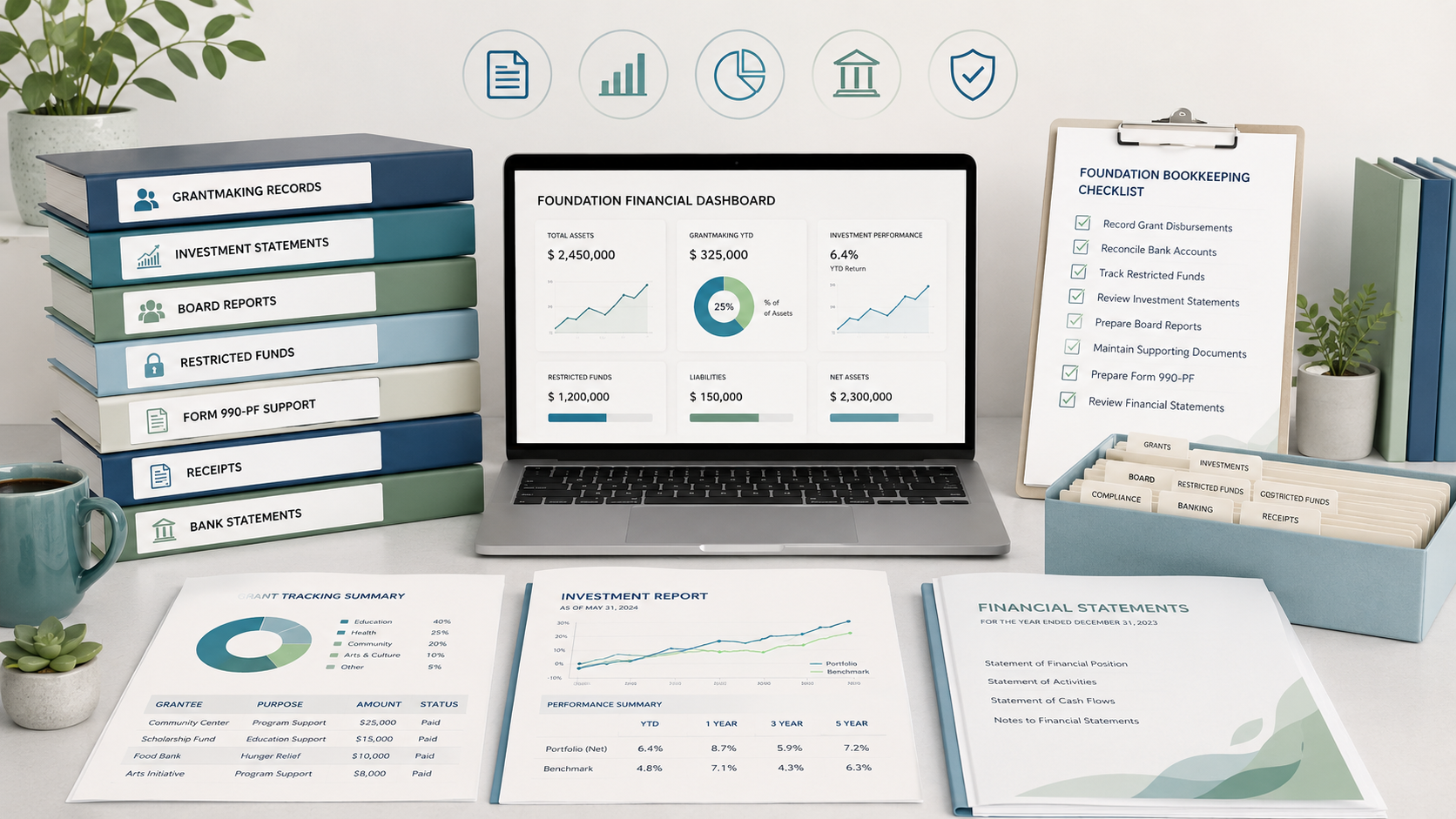
Foundation Bookkeeping Checklist
Use this checklist to review whether your foundation’s records are ready for board reporting, grant tracking, and annual filing support.
- Confirm the filing type. Determine whether the foundation files Form 990-PF, Form 990, Form 990-EZ, or another return.
- Gather prior-year filings. Save prior returns, schedules, and filing confirmations.
- Reconcile bank accounts. Confirm bank activity agrees to the bookkeeping records.
- Reconcile investment accounts. Tie brokerage and investment balances to statements.
- Organize grant records. Save applications, approvals, award letters, payment confirmations, and follow-up reports.
- Review charitable distributions. Confirm grant and distribution records are complete and categorized clearly.
- Track investment income and fees. Separate interest, dividends, gains, losses, and advisory fees where appropriate.
- Review expense support. Gather invoices, receipts, contracts, professional fee records, and reimbursement support.
- Review board minutes. Make sure major financial decisions are documented.
- Track restricted or designated funds. Separate funds by purpose, restriction, or board designation when needed.
- Review old balances. Identify old receivables, payables, liabilities, or unclear equity/net asset balances.
- Prepare board reports. Review financial statements before annual filing support begins.
For a broader self-review, you can use our free nonprofit bookkeeping checklist before year-end.
Red Flags That Foundation Records Need Cleanup
Your foundation may need bookkeeping cleanup if any of these issues sound familiar:
- Bank or investment accounts have not been reconciled.
- Grant approvals are not tied to board minutes.
- Grants paid are tracked only by bank withdrawals.
- Investment income and fees are entered only at year-end.
- QuickBooks categories are too generic for foundation reporting.
- Restricted or designated funds are not tracked clearly.
- Board reports do not show grants, assets, and available cash clearly.
- Old balances appear on the balance sheet with no explanation.
- Professional fee invoices and contracts are hard to find.
- Form 990-PF or Form 990 support requires major reconstruction each year.
These red flags do not always mean something is wrong. They often mean the foundation has outgrown its informal system and needs a more organized monthly process.
When to Get Professional Help
Some foundations can manage simple records internally. Professional support may be helpful when the foundation has investment activity, multiple grants, restricted funds, unclear prior records, messy QuickBooks files, or upcoming annual filing deadlines.
Consider getting help if:
- Your foundation needs cleaner grant tracking.
- Bank or investment reconciliations are behind.
- Form 990-PF or Form 990 support has been stressful in prior years.
- Investment income, gains, losses, or fees are not organized.
- Board reports are not clear or timely.
- Restricted or designated fund balances are unclear.
- QuickBooks Online needs cleanup or better setup.
- The foundation recently changed treasurers, bookkeepers, advisors, or board leadership.
Professional bookkeeping support can help your foundation organize records, clean up QuickBooks Online, track grants, reconcile bank and investment activity, prepare board reports for internal management use, and support year-end filing preparation.
For service details, visit our nonprofit bookkeeping services page. If your foundation records are already messy or a filing deadline is approaching, you can request nonprofit bookkeeping support.
Board report note: Board financial reports prepared as part of bookkeeping support are generally for internal management and board use unless a different engagement is specifically agreed to in writing. Small Business Accounting Inc. does not claim to provide CPA audit, review, or compilation services.
FAQ: Foundation Bookkeeping Records
1. What records should a foundation keep for bookkeeping?
A foundation should keep bank statements, investment statements, grant records, board minutes, expense support, professional fee invoices, restricted or designated fund records, prior filings, and year-end financial reports.
2. Do private foundations file Form 990 or Form 990-PF?
Private foundations generally file Form 990-PF. Other nonprofit foundations may have different filing requirements depending on their classification and facts. Review prior filings and current IRS guidance before assuming which form applies.
3. Why are investment records important for foundation bookkeeping?
Investment records help support income, fees, gains, losses, transfers, asset balances, and board reports. For private foundations, investment information may also support Form 990-PF preparation.
4. Should foundation grants be tracked separately?
Yes. Grant records should show the recipient, amount, approval date, payment date, purpose, restrictions, payment confirmation, and reporting requirements when applicable.
5. Can foundation bookkeeping be handled remotely?
Yes. Many foundation bookkeeping projects can be handled remotely using QuickBooks Online, bank statements, investment statements, grant records, board minutes, secure document sharing, and organized follow-up questions.
Simple Compliance Note
This article provides general educational information and is not legal advice. Foundation bookkeeping, Form 990-PF requirements, Form 990 requirements, private foundation rules, grantmaking rules, investment reporting, excise tax issues, state filings, and recordkeeping requirements can vary depending on the foundation’s facts, tax year, exemption status, assets, activities, grants, and transactions. Always confirm current IRS and state requirements before filing or making compliance decisions.
Need help getting your nonprofit books organized?
Small Business Accounting Inc. helps nonprofits with bookkeeping cleanup, QuickBooks Online organization, board financial reports, grant tracking, restricted fund bookkeeping, and Form 990 support. Remote support is available nationwide. Hawaii and Oahu clients may request local appointment availability when appropriate.
Learn more about nonprofit bookkeeping support:
https://smallbusinessaccountingfirm.com/nonprofit-bookkeeping/
Ready to request help?
https://smallbusinessaccountingfirm.com/contact/
Want to start with a checklist?
https://smallbusinessaccountingfirm.com/nonprofit-bookkeeping-checklist-pdf/