Nonprofit Internal Controls: Simple Steps for Small Organizations
Internal controls may sound like something only large nonprofits need, but small organizations need them too. A nonprofit does not need a complicated finance department to build better habits around approvals, receipts, bank reconciliations, reimbursements, restricted funds, and board reporting.
For small nonprofits, internal controls are practical steps that help protect the organization’s money, improve bookkeeping accuracy, reduce confusion, and support board oversight. They also help the organization keep better records for grant tracking, restricted funds, Form 990 support, and year-end review.
The goal is not to create unnecessary paperwork. The goal is to make sure money is received, spent, approved, recorded, and reviewed in a way that supports the nonprofit’s mission.
If your organization is reviewing its bookkeeping process, you can download the free nonprofit bookkeeping checklist as a practical starting point.
What Are Nonprofit Internal Controls?
Nonprofit internal controls are policies, procedures, and review steps that help an organization protect funds and maintain reliable financial records. They help answer simple but important questions:
- Who can approve expenses?
- Who can access bank accounts?
- Who reviews bank reconciliations?
- How are receipts and invoices saved?
- How are reimbursements approved?
- How are restricted funds and grants tracked?
- How does the board know the reports are complete?
Internal controls cannot guarantee that mistakes or misuse will never happen. But they can reduce risk, create accountability, and make problems easier to catch early.
Why Small Nonprofits Need Internal Controls
Small nonprofits often rely on a few dedicated people. One person may collect donations, pay bills, update QuickBooks Online, communicate with the board, and prepare reports. That may feel efficient, but it can create risk if no one else is reviewing the activity.
Internal controls help small nonprofits:
- Protect donations, grants, and restricted funds
- Reduce bookkeeping errors
- Improve board financial oversight
- Support grant reporting and reimbursement requests
- Keep receipts, invoices, and supporting documents organized
- Prepare clearer board financial reports
- Support Form 990 and year-end filing preparation
- Create continuity when a treasurer, bookkeeper, or executive director changes
Good controls are especially important when the organization receives grants, manages restricted donations, reimburses volunteers, uses credit cards, pays contractors, or has more than one program.
Simple Internal Controls Every Small Nonprofit Should Consider
Internal controls do not need to be complicated. Start with the areas where money enters, leaves, and gets reported.
1. Separate Duties Whenever Possible
Ideally, the same person should not handle every part of a financial transaction. For example, the person who approves a bill should not be the only person who pays it, records it, and reviews the bank statement.
Small nonprofits may not have enough staff for perfect separation of duties. In that case, add board review or treasurer review. Even a simple second set of eyes can help.
2. Require Expense Approval Before Payment
Create a clear process for approving expenses. The process may be simple, but it should be documented. The organization should know who can approve purchases, what dollar amounts require board approval, and what support is needed before payment.
For larger or unusual expenses, keep board minutes, approval emails, contracts, or written authorization with the accounting records.
3. Reconcile Bank Accounts Monthly
Bank reconciliation is one of the most important controls. It helps confirm that QuickBooks Online agrees with the bank statement and that deposits, payments, transfers, and fees are recorded properly.
Monthly reconciliation also helps catch duplicate transactions, missing deposits, old checks, bank feed errors, and expenses posted to the wrong period.
4. Review Reimbursements Carefully
Reimbursements should include a receipt, business purpose, date, amount, person reimbursed, approval, and program or fund coding. This matters for staff, volunteers, board members, and anyone else being reimbursed by the nonprofit.
A reimbursement process protects both the organization and the person requesting payment because it creates a clear record of why the expense was approved.
5. Keep Receipts, Invoices, and Support Documents Organized
Internal controls are stronger when supporting documents are easy to find. A bank charge alone may not explain what was purchased or why it was allowable.
Use consistent folders, file names, QuickBooks attachments, or a secure document system to store receipts, invoices, grant agreements, donor restriction letters, board approvals, payroll records, and contractor documents.
6. Track Restricted Funds and Grants Separately
Restricted funds need extra attention because not every dollar can be used the same way. Grant funds, donor-restricted gifts, scholarship funds, and board-designated reserves should be tracked clearly.
The board should understand which cash is available for general operations and which funds are limited by purpose, time, donor restriction, grant agreement, or board designation.
Internal Controls for Cash, Checks, and Online Payments
Any time money is received, the organization should have a process for recording it and protecting it. This is true whether funds come from checks, cash, online donations, payment processors, grants, membership dues, or fundraising events.
Consider these steps:
- Use a deposit log for checks and cash received.
- Deposit funds promptly.
- Have two people count cash after events when possible.
- Keep copies of donor reports, payment processor reports, and deposit details.
- Separate donation income, grant income, program revenue, fundraising income, and other receipts in the accounting records.
- Compare deposit records to bank statements and QuickBooks Online.
- Restrict access to payment processor accounts and online banking.
For small organizations, these steps can feel basic, but they are often where bookkeeping problems begin. Clean income tracking also helps support board reports, grant reports, and annual filing support.
Helpful next step: If your nonprofit needs a more organized monthly process, Small Business Accounting Inc. provides nonprofit bookkeeping support, QuickBooks Online organization, board financial report support, grant tracking, restricted fund bookkeeping, and Form 990 support.
Board Oversight: Keep It Simple but Consistent
The board does not need to review every receipt. But it should receive enough information to understand the organization’s financial position and ask good questions.
A practical board review process may include:
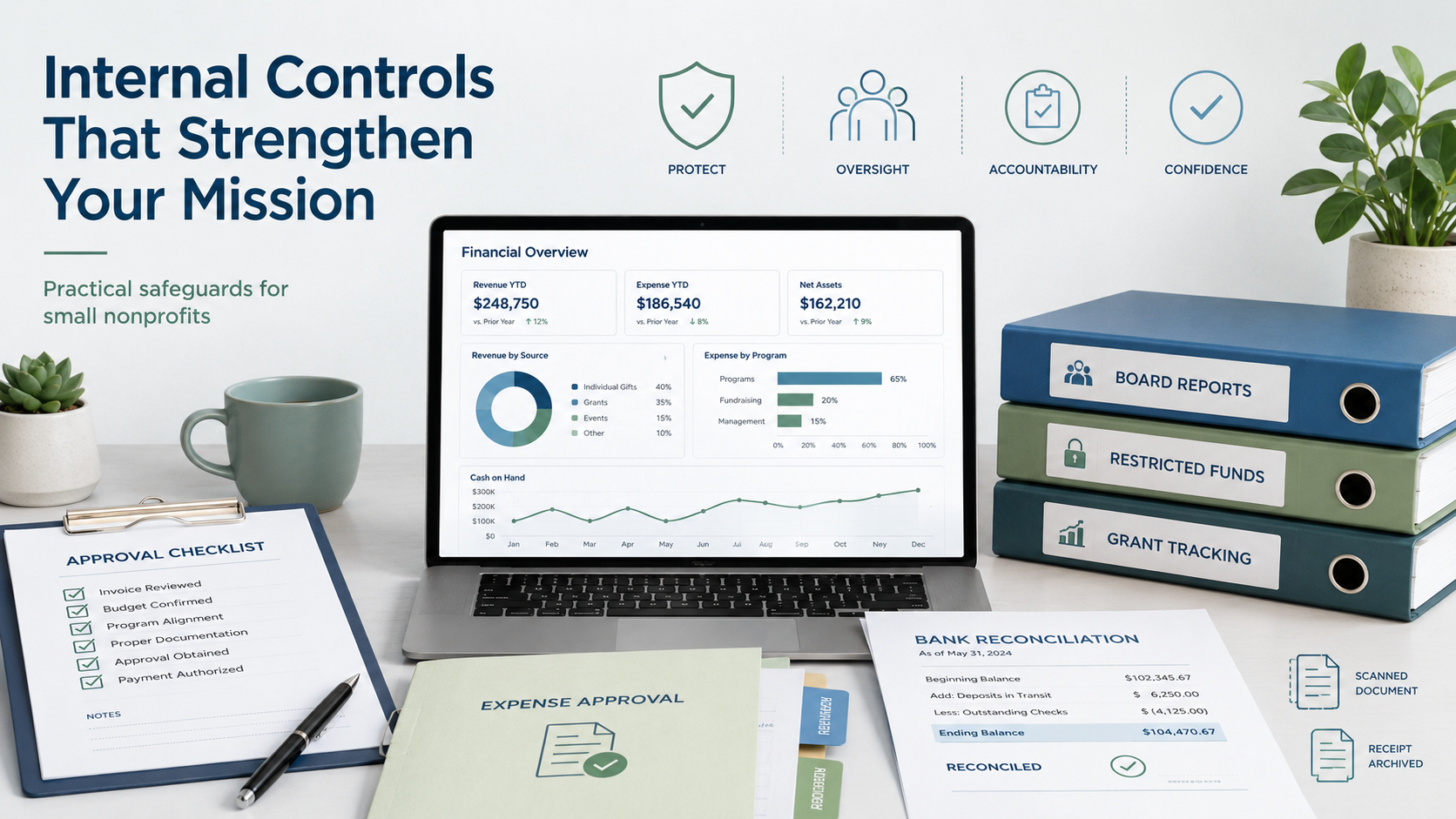
- Monthly or periodic profit and loss report
- Balance sheet
- Budget versus actual report
- Bank reconciliation status
- Restricted fund summary
- Grant activity summary
- List of unusual or large expenses
- Notes about missing documents or open questions
For organizations that file the full Form 990, the form includes governance questions about board review and certain policies. Even when a small organization is not required to answer every detailed governance question, it is still wise to keep financial review and board oversight documented.
Board report note: Board financial reports prepared as part of bookkeeping support are generally for internal management and board use unless a different engagement is specifically agreed to in writing. Small Business Accounting Inc. does not claim to provide CPA audit, review, or compilation services.
Practical Internal Controls Checklist for Small Nonprofits
Use this checklist to review whether your organization has basic controls in place. The exact controls should be adjusted based on your nonprofit’s size, staffing, funding sources, programs, and risk level.
- Assign financial roles. Clarify who enters transactions, approves payments, makes deposits, reconciles bank accounts, and reviews reports.
- Require supporting documents. Keep receipts, invoices, contracts, grant agreements, payroll records, contractor documents, and reimbursement forms.
- Use written approval rules. Document who can approve expenses and which expenses require board approval.
- Reconcile bank and credit card accounts monthly. Confirm QuickBooks Online agrees with statements.
- Review bank reconciliations. Have someone other than the person entering transactions review reconciliation reports when possible.
- Separate income categories. Track donations, grants, program revenue, fundraising income, membership dues, and other receipts clearly.
- Track restricted funds. Separate unrestricted funds, donor-restricted funds, grant-restricted funds, and board-designated funds.
- Review reimbursements. Require receipts, business purpose, approval, and proper coding.
- Limit access to bank and accounting systems. Give users only the access they need.
- Prepare regular board reports. Review financial statements before issues pile up.
- Document board decisions. Save minutes and approvals for budgets, major expenses, compensation, and restricted fund decisions.
- Review year-end readiness. Confirm the books can support Form 990, grant reporting, and board review.
For a broader self-review, you can use our free nonprofit bookkeeping checklist before year-end or before Form 990 support begins.
Red Flags That Internal Controls Need Attention
Your nonprofit may need stronger internal controls if any of these issues sound familiar:
- One person controls deposits, payments, bookkeeping, and bank reconciliation with no review.
- Bank accounts are not reconciled monthly.
- Board reports are delayed, incomplete, or difficult to explain.
- Receipts and invoices are missing.
- Reimbursements are paid without clear support or approval.
- Credit card spending is not reviewed regularly.
- Restricted funds are not separated from unrestricted funds.
- Grant reports are rebuilt manually from bank statements.
- QuickBooks Online has large uncategorized balances.
- Old balance sheet items cannot be explained.
- Board minutes do not document major financial decisions.
- Form 990 preparation requires major cleanup every year.
These red flags do not always mean something improper happened. Often, they simply mean the nonprofit has outgrown its informal process. The solution is to create simple controls that are realistic for the organization.
When to Get Professional Help
Some nonprofits can improve internal controls internally by adding monthly reconciliations, clearer approval rules, better document storage, and regular board reports. Professional help may be useful when the organization needs bookkeeping cleanup, QuickBooks Online organization, grant tracking, restricted fund reporting, or stronger monthly reporting.
Consider getting help if:
- Your nonprofit has messy or unreconciled books.
- QuickBooks Online does not produce useful board reports.
- Your board is unsure how much cash is truly available.
- Grant tracking or restricted fund records are unclear.
- Receipts, invoices, reimbursements, or approvals are missing.
- Prior-year Form 990 support required major cleanup.
- Your organization changed treasurers, bookkeepers, or executive directors.
- You want a monthly bookkeeping process that supports better oversight.
Professional bookkeeping support can help your nonprofit clean up old records, organize QuickBooks Online, improve monthly reports, and create a more reliable process for board review.
For service details, visit our nonprofit bookkeeping services page. If your organization needs help reviewing messy books or improving its monthly process, you can request nonprofit bookkeeping support.
FAQ: Nonprofit Internal Controls
1. What are internal controls for a nonprofit?
Internal controls are practical procedures that help protect nonprofit funds, improve recordkeeping, support approval processes, and make financial reports more reliable. Examples include expense approvals, bank reconciliations, document storage, and board review.
2. Do small nonprofits need internal controls?
Yes. Small nonprofits may not need a complicated system, but they still need basic controls. Even simple steps like monthly bank reconciliation, receipt collection, reimbursement approval, and board report review can reduce risk.
3. What is segregation of duties for a small nonprofit?
Segregation of duties means separating financial responsibilities so one person does not control every step of a transaction. If staffing is limited, a board member or treasurer can provide review as a practical compensating control.
4. How do internal controls help with Form 990?
Good controls help keep records organized, support income and expense categories, document board review, track restricted funds, and reduce year-end cleanup. This can make Form 990 support more organized.
5. Can internal control support be handled remotely?
Yes. Many bookkeeping, QuickBooks cleanup, document organization, board reporting, and monthly review processes can be supported remotely using QuickBooks Online, secure document sharing, bank statements, and structured follow-up.
Simple Compliance Note
This article provides general educational information and is not legal advice. Nonprofit internal controls, governance policies, recordkeeping requirements, Form 990 questions, tax-exempt status issues, state requirements, grant reporting, and donor restrictions can vary depending on the organization’s facts, size, activities, funding sources, and tax year. Always confirm current IRS and state requirements before filing or making compliance decisions.
Need help getting your nonprofit books organized?
Small Business Accounting Inc. helps nonprofits with bookkeeping cleanup, QuickBooks Online organization, board financial reports, grant tracking, restricted fund bookkeeping, and Form 990 support. Remote support is available nationwide. Hawaii and Oahu clients may request local appointment availability when appropriate.
Learn more about nonprofit bookkeeping support:
https://smallbusinessaccountingfirm.com/nonprofit-bookkeeping/
Ready to request help?
https://smallbusinessaccountingfirm.com/contact/
Want to start with a checklist?
https://smallbusinessaccountingfirm.com/nonprofit-bookkeeping-checklist-pdf/