Nonprofit Payroll and Contractor Records: What to Review Before Year-End
Payroll and contractor records are easy to overlook during the year, especially when a nonprofit is focused on programs, grants, donors, volunteers, board meetings, and community work. But when year-end arrives, missing payroll details or incomplete contractor records can quickly become a problem.
Nonprofits may need to review employee wages, payroll tax filings, contractor payments, Forms W-9, reimbursement support, grant payroll allocations, restricted fund coding, and board-approved compensation records. If these items are not organized before year-end, the organization may face delays with W-2 support, 1099 support, QuickBooks cleanup, board reporting, grant reporting, and Form 990 preparation.
This guide explains what nonprofit leaders should review before year-end so payroll and contractor records are cleaner, easier to support, and better connected to the organization’s bookkeeping system.
If your organization wants a broader year-end review tool, you can download the free nonprofit bookkeeping checklist before preparing annual filing support.
Why Payroll and Contractor Records Matter for Nonprofits
Payroll and contractor payments affect more than tax forms. They also affect nonprofit financial reports, grant reporting, restricted fund tracking, program cost reporting, and board oversight.
For example, a nonprofit may need to know:
- Which employees were paid during the year
- Whether wages were charged to the correct program or grant
- Whether payroll tax filings were completed
- Which contractors may need Form 1099 support
- Whether Forms W-9 were collected before payment
- Whether reimbursements were documented correctly
- Whether compensation records support board reporting and Form 990 preparation
When these records are reviewed monthly or quarterly, year-end is much smoother. When they are ignored until January, the organization may have to rush through old invoices, payroll reports, reimbursement forms, and vendor records while deadlines are approaching.
Review Employee Payroll Records Before Year-End
If your nonprofit has employees, start by reviewing payroll records before the year closes. This helps catch address changes, missing employee information, payroll coding issues, and benefit or reimbursement questions before W-2 support begins.
Payroll Records to Review
- Employee names, addresses, and Social Security numbers
- Current Forms W-4 and state withholding forms, if applicable
- Year-to-date wage reports
- Payroll tax filings and deposit confirmations
- Employer payroll tax expense reports
- Employee benefit records, if applicable
- Paid time off, sick leave, or other payroll policy records
- Payroll journal entries posted to QuickBooks Online
- Payroll allocations by program, grant, or restricted fund
- Employee reimbursement records
Payroll records should tie to the bookkeeping system. If payroll reports do not agree with QuickBooks, the organization may need to review payroll mapping, journal entries, bank activity, and expense categories before year-end reports are finalized.
Review Contractor Records and 1099 Support
Many nonprofits pay contractors during the year. This may include grant writers, bookkeepers, consultants, instructors, designers, IT support, maintenance providers, event vendors, professional service providers, and program contractors.
Before year-end, review contractor payments and gather support such as:
- Completed Forms W-9 for contractors and vendors
- Legal names and taxpayer identification numbers
- Mailing addresses and email addresses
- Contractor invoices
- Payment summaries by vendor
- Payment method details
- Contracts or service agreements
- Grant, program, or restricted fund coding
- Notes about whether payments were made by credit card or third-party platform
Do not wait until January to request Forms W-9. It is much easier to collect vendor information before payment or while the contractor relationship is active. If vendor records are incomplete at year-end, 1099 support can become stressful.
Helpful review step: If contractor records are scattered across email, QuickBooks, bank statements, and spreadsheets, Small Business Accounting Inc. provides nonprofit bookkeeping support to help organize year-end records and reporting support.
Employee or Contractor? Review Classification Carefully
Nonprofits should be careful not to assume a worker is a contractor just because the organization calls them one. Worker classification depends on the facts of the relationship, including the level of control, how the work is performed, how the worker is paid, and the overall relationship between the parties.
Before year-end, review whether any worker relationships have changed. For example, a contractor may begin working regular hours, using organization equipment, following detailed supervision, or performing ongoing work that looks more like an employee role. Classification issues can affect payroll taxes, W-2 reporting, 1099 reporting, grant budgets, and bookkeeping.
Because classification rules can be fact-specific and may involve federal and state considerations, nonprofits should be cautious and seek appropriate professional guidance when unsure. This article is educational and does not provide legal advice.
Track Payroll and Contractor Costs by Program, Grant, or Fund
For many nonprofits, the issue is not just whether payroll and contractor payments were recorded. The issue is whether they were recorded in the right place.
Payroll and contractor costs may need to be tracked by:
- Program or service area
- Grant or funding source
- Restricted or unrestricted fund
- Management and general activity
- Fundraising activity
- Special events
- Board-approved projects
Grant-funded organizations should pay special attention to allowable costs, grant periods, time allocations, and supporting documents. If payroll or contractor costs are charged to a grant, the organization should be able to support why those costs belong there.
When payroll and contractor costs are not tracked clearly, board reports may be incomplete, grant reports may need manual reconstruction, and Form 990 support may require extra cleanup.
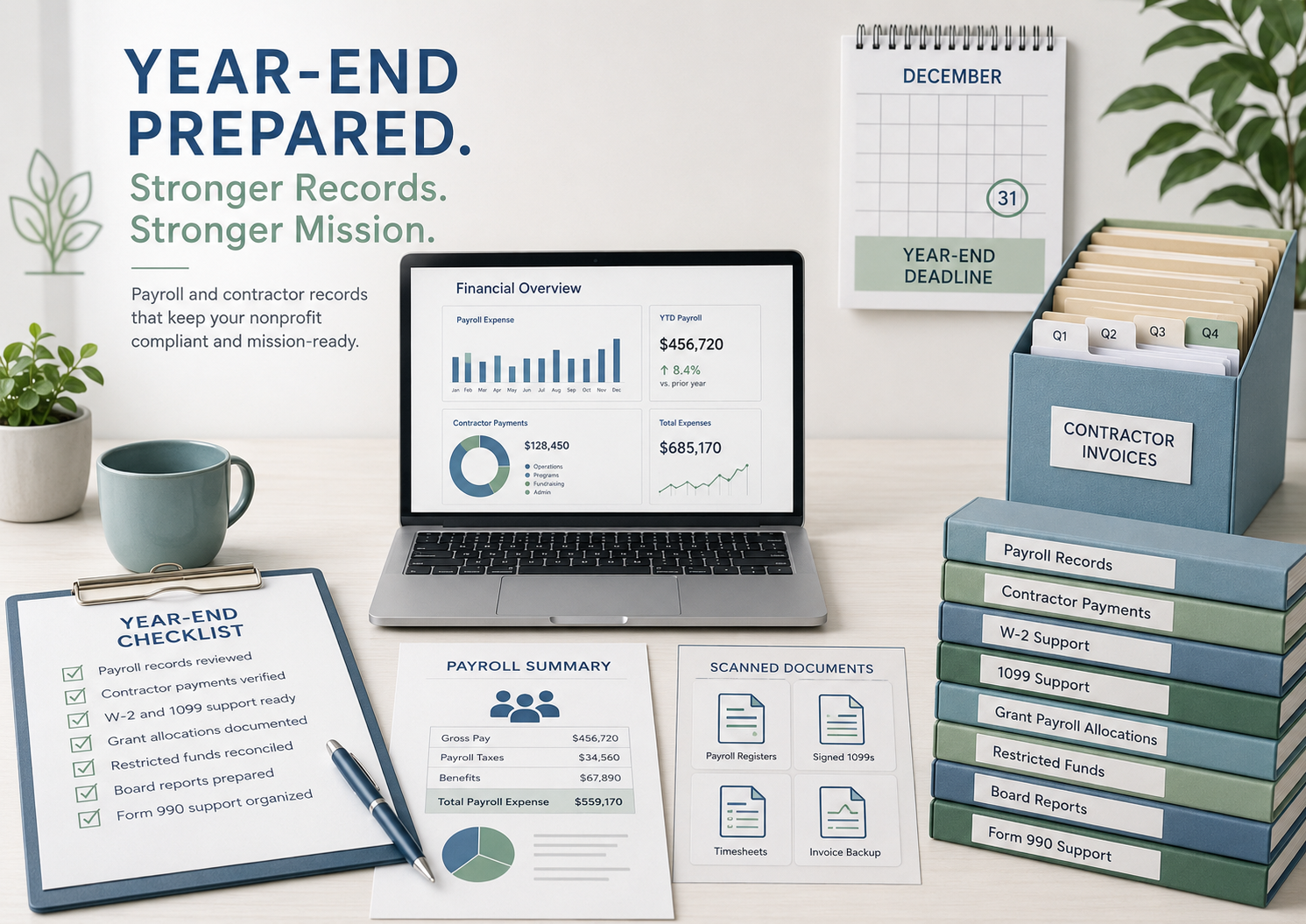
Year-End Payroll and Contractor Checklist for Nonprofits
Use this checklist before year-end to reduce January stress and catch common problems early.
- Review employee information. Confirm employee names, addresses, Social Security numbers, and withholding forms.
- Review payroll reports. Compare year-to-date payroll reports to QuickBooks payroll expense and liability accounts.
- Check payroll tax filings. Confirm payroll tax returns and deposit records are saved.
- Review payroll mapping. Make sure wages, employer taxes, benefits, and reimbursements are posted to the correct accounts.
- Review grant payroll allocations. Confirm wages charged to grants or restricted funds are supported.
- Collect Forms W-9. Gather missing W-9s from contractors before year-end.
- Review contractor payment totals. Run a vendor payment report and identify potential 1099 vendors.
- Review payment methods. Separate payments made by check, ACH, cash, credit card, and third-party platforms because reporting treatment may differ.
- Review contractor invoices. Make sure invoices or service agreements support the payments.
- Review reimbursements. Confirm receipts, business purpose, approval, and coding.
- Review board-approved compensation. Save board minutes or approval records where applicable.
- Flag unclear items early. Do not wait until January to resolve missing vendor names, tax IDs, or classification questions.
If this checklist reveals gaps in your books, you may want to use our free nonprofit bookkeeping checklist to review other year-end areas before filing support begins.
Common Red Flags to Fix Before Year-End
Payroll and contractor problems often show up in the bookkeeping before anyone notices them. Watch for these red flags:
- Contractors were paid but no Form W-9 is on file.
- Vendor names in QuickBooks are incomplete or inconsistent.
- Payments are coded to “miscellaneous” or “contract labor” without enough detail.
- Payroll reports do not match QuickBooks wage and tax accounts.
- Payroll liabilities have old balances no one can explain.
- Employee reimbursements were recorded as contractor payments.
- Grant payroll costs are not supported by time records or allocation schedules.
- Contractor costs are not assigned to the correct program, grant, or fund.
- Board reports do not show payroll and contractor costs clearly.
- Form 990 support requires major cleanup because payroll and vendor records are disorganized.
These issues are easier to fix before year-end than during filing season. A proactive review can help the organization avoid rushed corrections and incomplete support.
How Payroll and Contractor Records Support Form 990
Form 990 support may require more than total income and expenses. Depending on the organization’s facts and the form required, compensation, officer information, contractor activity, program expenses, management expenses, fundraising expenses, and governance records may be relevant.
Clean payroll and contractor records can help support:
- Employee compensation and payroll tax expense
- Officer, director, trustee, and key employee information
- Program service expenses
- Management and general expenses
- Fundraising expenses
- Independent contractor payment summaries
- Grant-related payroll or contractor costs
- Restricted fund activity
- Board-approved compensation decisions
Because nonprofit filing requirements vary based on the organization’s facts, payroll and contractor records should be reviewed in the context of the organization’s annual filing support, board reporting, and grant reporting needs.
When to Get Professional Help
Some nonprofits can review payroll and contractor records internally. But professional support may be helpful when the organization has messy QuickBooks records, grant-funded payroll, missing W-9s, unclear contractor payments, old payroll liabilities, or upcoming filing deadlines.
Consider getting help if:
- Your payroll reports do not match QuickBooks.
- You are unsure which vendors may need 1099 support.
- Contractor records are missing Forms W-9 or invoices.
- Payroll costs are not tracked by program, grant, or fund.
- Grant payroll allocations are unclear.
- Board reports do not separate payroll and contractor costs clearly.
- Form 990 preparation has required cleanup in prior years.
- Your nonprofit recently changed treasurers, bookkeepers, payroll providers, or executive directors.
Professional bookkeeping support can help your nonprofit organize payroll reports, contractor payment summaries, QuickBooks records, grant allocations, restricted fund activity, board reports, and annual filing support.
For service details, visit our nonprofit bookkeeping services page. If your records are already messy or a deadline is approaching, you can request nonprofit bookkeeping support.
Board report note: Board financial reports prepared as part of bookkeeping support are generally for internal management and board use unless a different engagement is specifically agreed to in writing. Small Business Accounting Inc. does not claim to provide CPA audit, review, or compilation services.
FAQ: Nonprofit Payroll and Contractor Records
1. What payroll records should a nonprofit review before year-end?
Review employee information, Forms W-4, year-to-date wage reports, payroll tax filings, payroll deposit confirmations, benefit records, reimbursements, payroll liabilities, and payroll expenses posted to QuickBooks Online.
2. What contractor records should a nonprofit collect for 1099 support?
Gather Forms W-9, contractor legal names, taxpayer identification numbers, mailing addresses, invoices, payment totals, contracts, and notes about payment methods. This helps identify which payments may need 1099 review.
3. Should nonprofits collect Form W-9 before paying contractors?
Yes, collecting Form W-9 before payment is a practical best practice. It is much easier to gather accurate vendor information while the relationship is active than after year-end.
4. Do payroll and contractor records affect Form 990?
They can. Payroll and contractor records may support compensation reporting, program expenses, management and general expenses, fundraising expenses, grant activity, restricted fund tracking, and board review.
5. Can nonprofit payroll and contractor record cleanup be handled remotely?
Yes. Many nonprofit bookkeeping cleanup projects can be handled remotely using QuickBooks Online, payroll reports, contractor records, Forms W-9, bank statements, board reports, and secure document sharing.
Simple Compliance Note
This article provides general educational information and is not legal advice. Payroll, worker classification, Form W-2, Form 1099, Form 990, employment tax, state reporting, grant reporting, and contractor rules can vary based on the organization’s facts, tax year, state, payment type, worker relationship, and filing requirements. Always confirm current IRS and state requirements before filing or making compliance decisions.
Need help getting your nonprofit books organized?
Small Business Accounting Inc. helps nonprofits with bookkeeping cleanup, QuickBooks Online organization, board financial reports, grant tracking, restricted fund bookkeeping, and Form 990 support. Remote support is available nationwide. Hawaii and Oahu clients may request local appointment availability when appropriate.
Learn more about nonprofit bookkeeping support:
https://smallbusinessaccountingfirm.com/nonprofit-bookkeeping/
Ready to request help?
https://smallbusinessaccountingfirm.com/contact/
Want to start with a checklist?
https://smallbusinessaccountingfirm.com/nonprofit-bookkeeping-checklist-pdf/