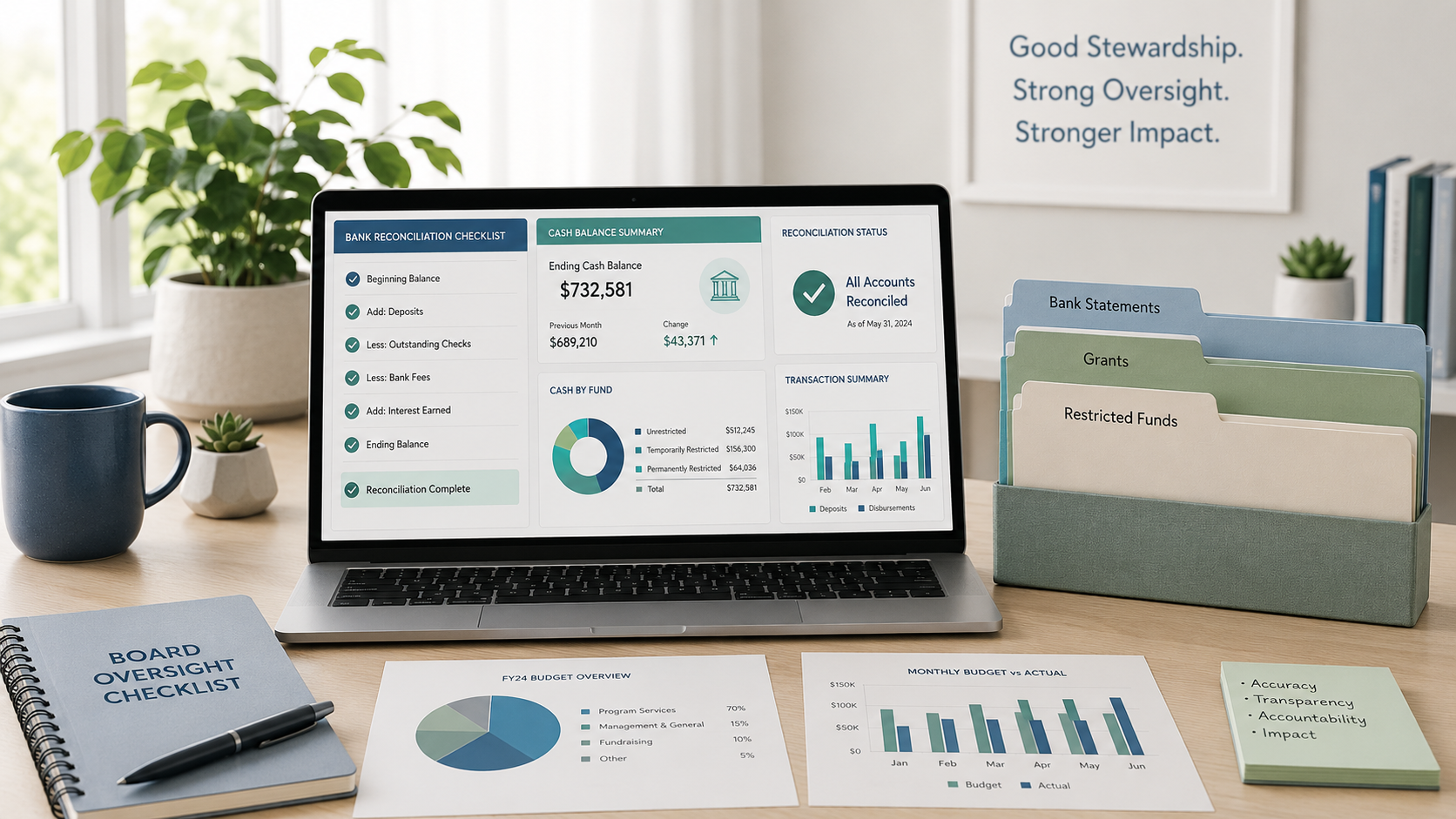
Nonprofit Bank Reconciliations: Why They Matter for Board Oversight
Bank reconciliations may not sound exciting, but they are one of the most important parts of nonprofit bookkeeping.
For a nonprofit board, reconciled books help answer a very basic question: can we trust the financial reports we are reviewing?
If bank accounts are not reconciled, the board may be looking at cash balances, income reports, grant reports, and budget updates that are incomplete or inaccurate. Missing deposits, duplicate expenses, uncleared checks, bank feed errors, and old transactions can all create confusion.
For small nonprofits, churches, foundations, scholarship funds, and grant-funded organizations, bank reconciliation is not just a back-office task. It supports board oversight, cash management, restricted fund tracking, grant reporting, and year-end readiness.
If your nonprofit is reviewing its records before filing or board reporting, you can download the free nonprofit bookkeeping checklist to help identify what needs to be organized.
What Is a Bank Reconciliation?
A bank reconciliation compares the transactions in your bookkeeping system to the transactions on your bank statement.
The goal is to confirm that the accounting records match the actual bank activity. This usually includes reviewing deposits, checks, debit card charges, ACH payments, transfers, bank fees, interest, and other account activity.
For nonprofits using QuickBooks Online or another accounting system, reconciliation helps confirm that the books are not missing transactions, duplicating transactions, or carrying old items that no longer make sense.
A completed bank reconciliation gives leadership more confidence that the reported cash balance is reliable. It does not guarantee every accounting category is perfect, but it is a major step toward cleaner books and better board reporting.
Why Bank Reconciliations Matter for Nonprofit Board Oversight
Board members are responsible for oversight. They do not need to manage every transaction, but they should have confidence that the reports they receive are based on complete and reviewed records.
Monthly bank reconciliations help the board:
- Confirm reported cash balances are reliable
- Identify missing income or duplicate expenses
- Review unusual withdrawals or transfers
- Monitor restricted funds and grant-related cash activity
- Support more accurate budget-to-actual reports
- Reduce year-end bookkeeping cleanup
- Improve readiness for Form 990 support, when applicable
When bank accounts are not reconciled, the board may not realize that reports are only preliminary. That can lead to decisions based on numbers that later change.
Small Business Accounting Inc. provides nonprofit bookkeeping support for organizations that need bank reconciliation cleanup, QuickBooks organization, board financial reports, grant tracking, restricted fund bookkeeping, and Form 990 support.
What Can Go Wrong When Accounts Are Not Reconciled?
Unreconciled bank accounts create uncertainty. Even if the reports look professional, the numbers may not be dependable.
Common issues include:
- Deposits recorded twice
- Missing donor deposits or grant payments
- Expenses entered but never cleared the bank
- Bank feed transactions added incorrectly
- Transfers recorded as income or expenses
- Old checks still showing as outstanding
- Credit card payments duplicated as expenses
- Bank fees, interest, or merchant fees missing from the books
- Restricted fund activity mixed into general operating activity
These issues may seem small individually, but they can distort board reports, grant reports, and year-end financial information.
What Should a Nonprofit Reconcile?
Most nonprofits should reconcile more than one account. Any financial account used by the organization should be reviewed regularly.
Common accounts to reconcile include:
- Operating checking accounts
- Savings accounts
- Money market or reserve accounts
- Credit card accounts
- Online giving processor deposits
- Merchant processing accounts
- PayPal, Stripe, Square, or similar accounts, if used
- Loan or line of credit accounts
- Investment or brokerage accounts, when applicable
If donations, grants, or program fees flow through a third-party processor before reaching the bank, those records may also need to be reviewed. Otherwise, the nonprofit may only record the net deposit and miss processing fees, donor details, or restricted fund information.
Monthly Nonprofit Bank Reconciliation Checklist
A monthly reconciliation process does not need to be complicated, but it should be consistent. The following checklist can help nonprofit treasurers, executive directors, finance committees, and bookkeepers understand the basic workflow.
1. Gather Monthly Statements
Start by collecting the bank and credit card statements for the month being reconciled.
Make sure you have:
- Bank statement PDF or official statement
- Credit card statement, if applicable
- Online giving reports
- Merchant processor reports
- Deposit detail reports
- Payroll reports, when payroll clears through the account
Using complete statements helps avoid guessing based only on bank feed activity.
2. Match Deposits to Income Records
Each deposit should be reviewed and matched to the correct income source.
For nonprofits, deposits may include:
- Donations
- Grant payments
- Program fees
- Membership dues
- Fundraising event income
- Reimbursements
- Interest income
Be careful with deposits that include multiple types of income. For example, one bank deposit may include general donations, restricted donations, and event income. Those may need to be separated in the bookkeeping records.
3. Match Payments and Withdrawals
Review all payments, withdrawals, checks, debit card transactions, ACH payments, and transfers.
Look for:
- Missing expenses
- Duplicate entries
- Payments recorded to the wrong vendor
- Expenses coded to the wrong category
- Transfers accidentally recorded as expenses
- Unclear withdrawals that need documentation
This step helps improve both the cash balance and the accuracy of the statement of activities.
4. Review Outstanding Checks and Deposits
Outstanding items are transactions recorded in the books but not yet cleared by the bank.
Some outstanding items are normal. For example, a check written near month-end may clear the next month. But old outstanding items should be reviewed carefully.
Watch for:
- Checks outstanding for several months
- Old deposits that never cleared
- Duplicate checks
- Voided payments still appearing in reports
- Prior-year items that were never resolved
Old outstanding items can make the books look like they have more or less cash than the organization actually has.
5. Confirm Transfers Are Recorded Correctly
Transfers between bank accounts should not usually be recorded as income or expenses. They are movements of cash between accounts.
For example, if a nonprofit transfers money from savings to checking, the organization did not earn new income. It simply moved funds from one account to another.
This is a common cleanup issue, especially when bank feeds are used without careful review.
6. Review Restricted Fund and Grant Activity
Bank reconciliation should connect with restricted fund and grant tracking. If grant funds were received or restricted funds were spent, the bookkeeping should show that clearly.
Each month, review whether:
- Grant payments were recorded to the correct grant
- Restricted donations were separated from unrestricted donations
- Grant expenses were matched to the correct purpose
- Restricted fund balances still make sense
- Board reports show restricted cash clearly
For nonprofits with grants or donor restrictions, nonprofit QuickBooks cleanup and reporting support can help improve both reconciliation and restricted fund reporting.
7. Save the Reconciliation Report
After the reconciliation is complete, save the reconciliation report or documentation. This creates a record that the account was reviewed for that month.
Good documentation may include:
- Bank statement
- Reconciliation report
- Notes about unusual items
- Support for adjustments
- List of follow-up questions
Consistent documentation helps with board review, bookkeeping cleanup, and year-end preparation.
For a broader review process, you can use our free nonprofit bookkeeping checklist to help identify other records that should be reviewed before filing or board reporting.
How Reconciliations Improve Board Financial Reports
Board financial reports are much more useful when they are based on reconciled accounts.
A reconciled bookkeeping system can support:
- More accurate cash balance summaries
- Cleaner statement of financial position
- More reliable statement of activities
- Better budget-to-actual reports
- Clearer grant tracking reports
- More useful restricted fund summaries
- Cleaner year-end records for tax support
Board financial reports are generally for internal management and board use unless otherwise agreed. They are not the same as CPA audit, review, or compilation reports.
The board should also know whether the reports are final or preliminary. If bank reconciliations are not complete, the report packet should say so clearly.
Red Flags Your Nonprofit Reconciliations Need Cleanup
Your nonprofit may need reconciliation cleanup if any of these issues sound familiar:
- Bank accounts have not been reconciled monthly
- QuickBooks cash balances do not match bank statements
- There are old outstanding checks or deposits
- Transfers are showing as income or expenses
- Donation deposits do not match donor records
- Grant payments are not separated from general income
- Credit card payments are duplicated as expenses
- Bank feed transactions are sitting uncategorized
- Board reports change after the meeting because cleanup was still in progress
- Form 990 preparation is delayed because cash and income records are unclear
These issues are common, especially for growing nonprofits or organizations that have changed treasurers, bookkeepers, or accounting systems. The important thing is to clean them up before leadership relies on the numbers.
How Bank Reconciliations Support Form 990 Readiness
Bank reconciliations help support year-end reporting and Form 990 preparation when an annual filing is required.
The IRS explains that exempt organization filing requirements can vary depending on the organization’s facts, return type, tax year, gross receipts, assets, and exempt status. The IRS also notes that organizations that do not file required annual returns or notices for three consecutive years can automatically lose tax-exempt status, and late filing may result in penalties in some cases.
You can review IRS information about annual filing and forms, annual exempt organization return penalties, and automatic revocation of exemption.
This article is for general educational purposes and is not legal advice. Nonprofits should confirm their specific filing requirements, deadlines, return type, and extension options with current IRS guidance and qualified professional support when needed.
Clean bank reconciliations can make Form 990 and board reporting support more efficient because the income, expenses, cash balances, and restricted fund activity are easier to review.
When to Get Professional Help
Some nonprofits can reconcile accounts internally when the books are current and activity is simple. But outside help may be useful when accounts are behind, there are multiple bank accounts, grants are involved, or QuickBooks records are messy.
Consider professional help if:
- Bank reconciliations are several months behind
- QuickBooks does not match the bank statements
- There are old uncleared transactions
- Restricted funds or grants are not clearly tracked
- Board reports are unreliable or difficult to explain
- Donation records do not match deposits
- There has been turnover in the treasurer, bookkeeper, or administrator role
- The organization is preparing for Form 990 and the books are not clean
If your nonprofit books are already behind or your board needs cleaner reports, you can get help with your nonprofit books from Small Business Accounting Inc.
FAQ: Nonprofit Bank Reconciliations
1. What is a nonprofit bank reconciliation?
A nonprofit bank reconciliation compares the organization’s bookkeeping records to the bank statement to confirm that deposits, payments, transfers, fees, and ending balances are recorded correctly.
2. How often should a nonprofit reconcile bank accounts?
Most nonprofits should reconcile bank and credit card accounts monthly. Monthly reconciliation helps catch errors early and supports more reliable board reporting.
3. Why do bank reconciliations matter for board oversight?
Bank reconciliations help the board know whether cash balances and financial reports are reliable. Without reconciled accounts, the board may be reviewing incomplete or inaccurate reports.
4. Can QuickBooks help with nonprofit bank reconciliations?
Yes. QuickBooks can help reconcile bank and credit card accounts, but transactions still need to be reviewed carefully. Bank feeds alone do not replace reconciliation and bookkeeping review.
5. What happens if nonprofit bank accounts are not reconciled?
Unreconciled accounts can lead to incorrect cash balances, duplicate income or expenses, missing transactions, unclear grant balances, unreliable board reports, and more difficult year-end filing preparation.
Need Help Getting Your Nonprofit Books Organized?
Small Business Accounting Inc. helps nonprofits with bookkeeping cleanup, QuickBooks Online organization, board financial reports, grant tracking, restricted fund bookkeeping, and Form 990 support.
Remote support is available nationwide. Hawaii and Oahu clients may request local appointment availability when appropriate.
Learn more about nonprofit bookkeeping support: https://smallbusinessaccountingfirm.com/nonprofit-bookkeeping/
Ready to request help? https://smallbusinessaccountingfirm.com/contact/
Want to start with a checklist? https://smallbusinessaccountingfirm.com/nonprofit-bookkeeping-checklist-pdf/