Monthly Nonprofit Bookkeeping: Why Waiting Until Year-End Creates Problems
Many nonprofits wait until year-end to deal with bookkeeping because the organization is busy serving its mission. Donations are coming in, programs are running, grants need attention, volunteers need coordination, and the board may only ask for reports a few times a year.
But waiting until year-end can create bigger problems than many nonprofit leaders expect. Bank accounts may not be reconciled. Grant expenses may not be tracked clearly. Restricted funds may be mixed with unrestricted funds. Board reports may not match QuickBooks Online. And when Form 990 preparation begins, the organization may discover that the books are not ready.
Monthly nonprofit bookkeeping helps prevent those problems by keeping the records organized throughout the year. It gives the board, executive director, treasurer, and finance committee better information before small issues become expensive cleanup projects.
If you want a practical starting point, you can download the free nonprofit bookkeeping checklist to review whether your books are ready for board reporting and annual filing support.
Why Monthly Bookkeeping Matters for Nonprofits
Nonprofit bookkeeping is not just data entry. It supports accountability, board oversight, donor confidence, grant reporting, and annual tax filing support. When the books are updated only once or twice a year, leadership may be making decisions based on outdated or incomplete information.
Monthly bookkeeping helps your organization answer important questions such as:
- How much cash is truly available for general operations?
- Are restricted funds separated from unrestricted funds?
- Are grant expenses being tracked correctly?
- Are bank and credit card accounts reconciled?
- Do board reports tie to QuickBooks Online?
- Are donations, grants, program revenue, and fundraising income coded correctly?
- Will the books support Form 990, 990-EZ, or 990-N preparation?
The longer these questions go unanswered, the harder they become to fix. Monthly bookkeeping gives the organization a rhythm for reviewing the numbers before they turn into year-end surprises.
What Goes Wrong When Nonprofits Wait Until Year-End?
Year-end bookkeeping may seem efficient, but it often creates more work. By the time the organization reviews the books, memories have faded, staff may have changed, grant reports may already be due, and transactions may be harder to explain.
1. Bank Reconciliations Fall Behind
Bank reconciliation is one of the most important parts of bookkeeping. If accounts are not reconciled monthly, QuickBooks may include duplicate transactions, missing deposits, deleted entries, old checks, or expenses posted to the wrong period.
For nonprofits, unreconciled accounts affect more than the bank balance. They can make board reports unreliable, create grant reporting issues, and delay annual filing support.
2. Grant Tracking Becomes Harder
Grant-funded nonprofits often need to track income, allowable expenses, grant periods, budgets, and remaining balances. If this is not maintained monthly, the organization may have to rebuild reports from bank statements, invoices, payroll records, and spreadsheets.
That creates stress for the executive director, treasurer, program staff, and anyone responsible for submitting reports to funders.
3. Restricted Funds Get Blurry
A nonprofit may have cash in the bank, but that does not mean all cash is available for general operations. Some funds may be restricted by donors, grants, scholarship rules, capital campaigns, or board designations.
When restricted funds are not tracked throughout the year, the board may not know how much money is actually available to spend freely.
4. Board Reports Become Less Useful
Board members need timely financial reports to make informed decisions. If reports are only prepared at year-end, the board may miss opportunities to adjust spending, address cash flow concerns, review grant activity, or correct coding issues.
Monthly reports do not need to be overly complicated. They just need to be accurate, understandable, and tied to the accounting records.
5. Form 990 Preparation Becomes More Stressful
Many tax-exempt organizations have an annual IRS filing requirement unless an exception applies. Depending on the organization’s gross receipts, total assets, and facts, the organization may need Form 990-N, Form 990-EZ, Form 990, or another return.
When bookkeeping is incomplete, annual filing support becomes harder. The organization may need to confirm gross receipts, year-end assets, revenue categories, functional expenses, grant activity, restricted funds, and board information while also trying to clean up the books.
What Should Monthly Nonprofit Bookkeeping Include?
A good monthly bookkeeping process should be practical and repeatable. The goal is not to create paperwork for the sake of paperwork. The goal is to help leadership understand the organization’s financial position and stay ready for board, grant, and annual filing needs.
Monthly nonprofit bookkeeping may include:
- Recording and categorizing income and expenses
- Reconciling bank and credit card accounts
- Reviewing uncategorized transactions
- Separating donations, grants, program revenue, fundraising income, and other receipts
- Tracking restricted and unrestricted funds
- Tracking grant income and grant expenses
- Reviewing payroll, contractor payments, and reimbursements
- Preparing profit and loss reports
- Preparing balance sheet reports
- Reviewing budget versus actual activity
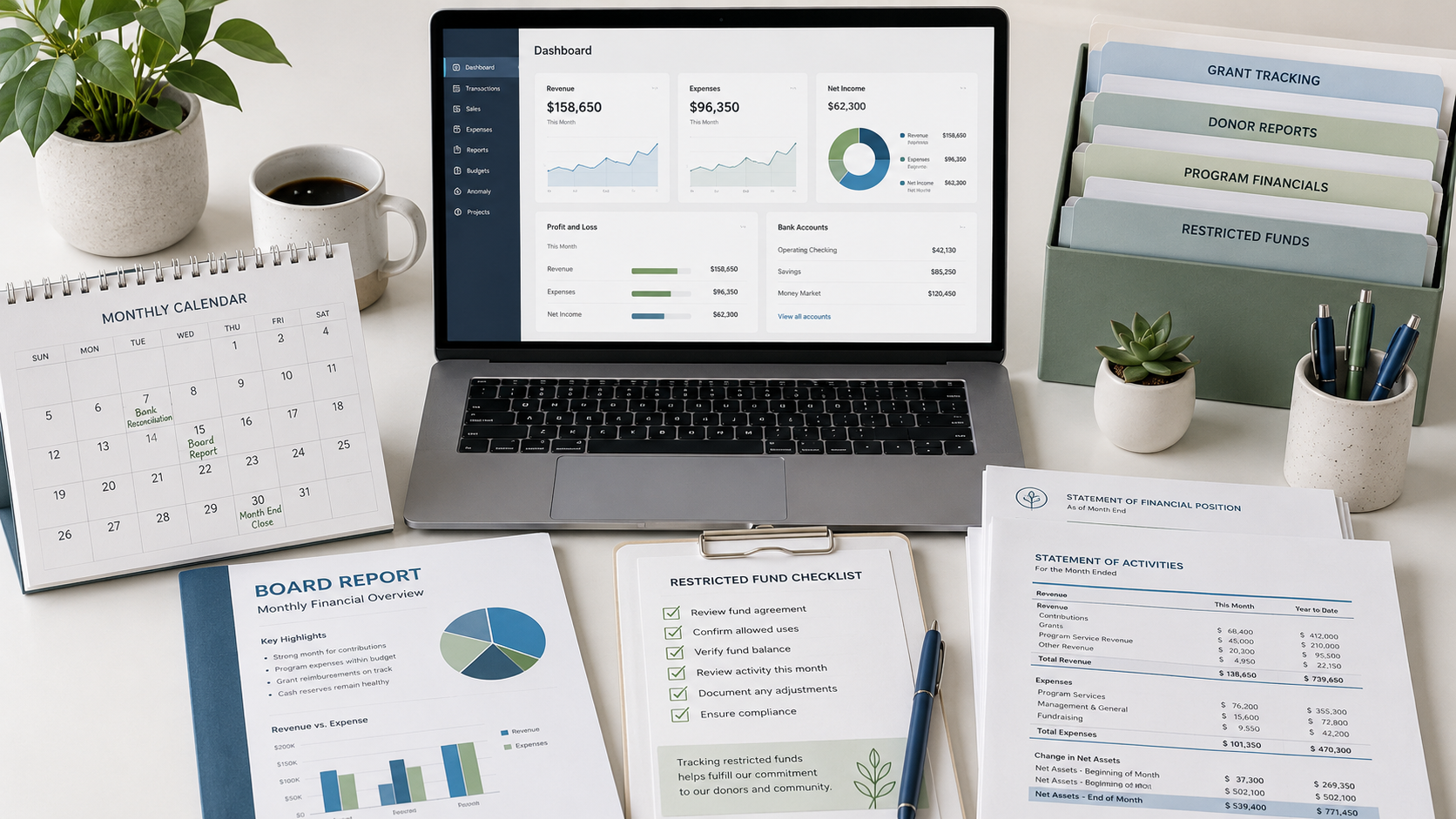
- Preparing board financial reports for internal management use
- Flagging unusual items or missing documents
Helpful next step: If your nonprofit is not sure what should be reviewed each month, get the free Form 990 bookkeeping checklist. It can help your board, treasurer, or executive director identify common bookkeeping gaps before year-end.
A Practical Monthly Bookkeeping Checklist
Here is a simple monthly process your nonprofit can use as a starting point. The exact checklist may need to be adjusted based on your organization’s size, programs, funding sources, and reporting needs.
- Collect monthly bank and credit card statements. Make sure all accounts used by the nonprofit are included.
- Update QuickBooks Online. Import or enter transactions and confirm that bank feeds are working properly.
- Categorize income correctly. Separate donations, grants, membership dues, program revenue, fundraising income, interest, and other income.
- Categorize expenses consistently. Review program, management, fundraising, payroll, contractor, occupancy, supplies, insurance, and professional service expenses.
- Track grants and restricted funds. Make sure grant expenses and restricted fund activity are coded to the correct project, program, fund, class, or supporting schedule.
- Reconcile every bank and credit card account. Confirm QuickBooks agrees with the monthly statements.
- Review old or unusual balances. Look for uncategorized transactions, suspense accounts, negative balances, old receivables, old payables, and unclear liabilities.
- Prepare monthly reports. At a minimum, review a profit and loss statement, balance sheet, and budget versus actual report.
- Prepare board-level summaries when needed. Add notes explaining major changes, unusual items, restricted balances, or grant deadlines.
- Save support documents. Keep invoices, receipts, grant agreements, donor letters, payroll records, reimbursement forms, and board approvals organized.
- Review open questions. Send follow-up questions while the information is still fresh.
This monthly process helps reduce year-end cleanup and gives leadership better information throughout the year.
Red Flags That Year-End Bookkeeping Is Creating Problems
If your nonprofit is waiting until year-end to update the books, watch for these warning signs:
- Bank accounts have not been reconciled for several months.
- QuickBooks shows large amounts in uncategorized income or expenses.
- Grant reports are prepared manually from bank statements.
- Restricted and unrestricted funds are not clearly separated.
- Board reports are delayed, incomplete, or difficult to explain.
- Financial reports do not match the bank statements.
- The treasurer or executive director is unsure what the numbers mean.
- Old balance sheet items have not been reviewed.
- Form 990 preparation requires major cleanup before the filing can move forward.
- Leadership only discovers cash flow problems after the year ends.
These red flags usually mean the organization needs a more consistent monthly process, not just a one-time cleanup.
How Monthly Bookkeeping Supports the Board
Board members have a responsibility to understand the organization’s financial position, but they do not need to see every transaction. What they need is a clear reporting package that helps them ask better questions.
A monthly or periodic board financial report may include:
- Profit and loss statement
- Balance sheet
- Budget versus actual report
- Restricted fund summary
- Grant activity summary
- Cash balance and available cash summary
- Notes about major changes, unusual activity, or missing documents
These reports help the board understand whether the nonprofit is financially stable, whether funds are being used properly, and whether the organization is prepared for upcoming deadlines.
Board report note: Board financial reports prepared as part of bookkeeping support are generally for internal management and board use unless a different engagement is specifically agreed to in writing. Small Business Accounting Inc. does not claim to provide CPA audit, review, or compilation services.
If your organization needs a clearer reporting process, Small Business Accounting Inc. provides Form 990 and board reporting support for nonprofits nationwide.
When to Get Professional Help
Some nonprofits can handle monthly bookkeeping internally, especially when activity is simple. But professional support may be helpful when the organization has grants, restricted funds, multiple programs, payroll, messy QuickBooks records, or board reporting needs.
Consider getting help if:
- Your QuickBooks Online file has not been reconciled regularly.
- Your board reports are delayed or confusing.
- Your nonprofit receives grants with reporting requirements.
- Restricted funds are not separated from unrestricted funds.
- Form 990 preparation has required major cleanup in prior years.
- You recently changed treasurers, bookkeepers, or executive directors.
- Your organization is growing and needs a stronger monthly process.
- You want more reliable reports before year-end.
Professional monthly bookkeeping can help your nonprofit move from reactive cleanup to proactive financial organization. Instead of waiting until year-end, your organization can review the books throughout the year and address issues while they are still manageable.
For service details, visit our nonprofit bookkeeping services page. If your books are already messy or you need help quickly, you can also request nonprofit bookkeeping support.
FAQ: Monthly Nonprofit Bookkeeping
1. How often should a nonprofit update its bookkeeping?
Many nonprofits benefit from monthly bookkeeping because it keeps bank reconciliations, board reports, grant tracking, restricted funds, and annual filing support more organized. Very small organizations may have fewer transactions, but they should still review records regularly.
2. Why is monthly bookkeeping better than year-end cleanup?
Monthly bookkeeping helps catch issues while the information is still fresh. Year-end cleanup can be harder because documents may be missing, transactions may be harder to explain, and reports may be needed quickly for board review or filing support.
3. What reports should a nonprofit review monthly?
Common reports include a profit and loss statement, balance sheet, budget versus actual report, bank reconciliation status, restricted fund summary, and grant activity report. The right report package depends on the organization’s funding sources and board needs.
4. Does monthly bookkeeping help with Form 990?
Yes. Monthly bookkeeping can help organize gross receipts, year-end assets, income categories, expense categories, grant activity, restricted funds, and other support that may be needed for annual filing preparation.
5. Can monthly nonprofit bookkeeping be handled remotely?
Yes. Many nonprofit bookkeeping projects can be handled remotely through QuickBooks Online, secure document sharing, bank statements, prior reports, and organized follow-up questions.
Simple Compliance Note
This article provides general educational information and is not legal advice. Nonprofit bookkeeping, Form 990 requirements, state filing obligations, tax-exempt status issues, grant reporting, donor restrictions, and deadlines can vary depending on the organization’s facts, tax year, exemption type, funding sources, and activities. Always confirm current IRS and state requirements before filing or making compliance decisions.
Need help getting your nonprofit books organized?
Small Business Accounting Inc. helps nonprofits with bookkeeping cleanup, QuickBooks Online organization, board financial reports, grant tracking, restricted fund bookkeeping, and Form 990 support. Remote support is available nationwide. Hawaii and Oahu clients may request local appointment availability when appropriate.
Learn more about nonprofit bookkeeping support:
https://smallbusinessaccountingfirm.com/nonprofit-bookkeeping/
Ready to request help?
https://smallbusinessaccountingfirm.com/contact/
Want to start with a checklist?
https://smallbusinessaccountingfirm.com/nonprofit-bookkeeping-checklist-pdf/